Peace for the World World ! Your War Our Lives

The Dalai Lama
A Brief Colonial History Of Ceylon(SriLanka)
Sri Lanka: One Island Two Nations
A Brief Colonial History Of Ceylon(SriLanka)
Sri Lanka: One Island Two Nations
(Full Story)
Back to 500BC.

Thursday, April 7, 2016
Will Sri Lanka Wake Up To The Realities of The ‘Panama Papers’ Exposure?

By LUKMAN HAREES-
Featured image courtesy AFP/GETTY – Rodrigo Arangua
 On April 3, 2016, Suddeutsche Zeitung, Germany’s largest daily newspaper leaked 11.5 million files from the database of Mossack Fonseca,
a law firm headquartered in Panama City, Panama. The firm is one of the
world’s top creators of shell companies, corporate structures that can
be used to hide ownership of assets. The files exposed financial
dealings of some of the world’s richest and most powerful individuals.
The documents included financial records, legal documents such as
passports, and correspondences dating back over 40 years ,which reveal
offshore accounts of current and former world leaders as well as
individuals with close ties to political figures and business moguls
around the globe. The files also revealed that it is not only
politicians who are found to be tied to the alleged laundering of funds
but many celebrities, professional sporting stars and even sporting
bodies too. Now that the door is open, new revelations are bound to come
forward to expose the depth of the Panamanian corruption scandal. The
release of the Panama Papers is thought to be merely ‘Chapter One’ of a
much more serious and larger case.
On April 3, 2016, Suddeutsche Zeitung, Germany’s largest daily newspaper leaked 11.5 million files from the database of Mossack Fonseca,
a law firm headquartered in Panama City, Panama. The firm is one of the
world’s top creators of shell companies, corporate structures that can
be used to hide ownership of assets. The files exposed financial
dealings of some of the world’s richest and most powerful individuals.
The documents included financial records, legal documents such as
passports, and correspondences dating back over 40 years ,which reveal
offshore accounts of current and former world leaders as well as
individuals with close ties to political figures and business moguls
around the globe. The files also revealed that it is not only
politicians who are found to be tied to the alleged laundering of funds
but many celebrities, professional sporting stars and even sporting
bodies too. Now that the door is open, new revelations are bound to come
forward to expose the depth of the Panamanian corruption scandal. The
release of the Panama Papers is thought to be merely ‘Chapter One’ of a
much more serious and larger case.
Analysts comment that these findings show how deeply ingrained harmful
practices and criminality are in the offshore world and that the release
of the leaked documents should prompt governments to seek “concrete
sanctions” against jurisdictions and institutions that peddle offshore
secrecy. The documents reveal that Mossack Fonseca, far from being an
aberration, was an integral part of the operations of leading global
banks. As the International Consortium of Investigative Journalists (ICIJ) puts
it, “The documents make it clear that major banks are big drivers
behind the creation of hard-to-trace companies in the British Virgin
Islands, Panama and other offshore havens. The files list nearly 15,600
paper companies that banks set up for clients who want to keep their
finances under wraps, including thousands created by international
giants UBS and HSBC. This leak is thus proof that despite explicit
banking laws against tax evasion, criminal uses and money laundering,
the global offshore shell game business remains open for the wealthy and
well connected to exploit.”
This state of affairs bears much direct relevance to Sri Lanka as well, as the map, published by the Irish Times, titled as ‘secret companies around the world’ indicates that there were 3 Sri Lankan companies too which were listed in the report with 3 clients and 22 shareholders.
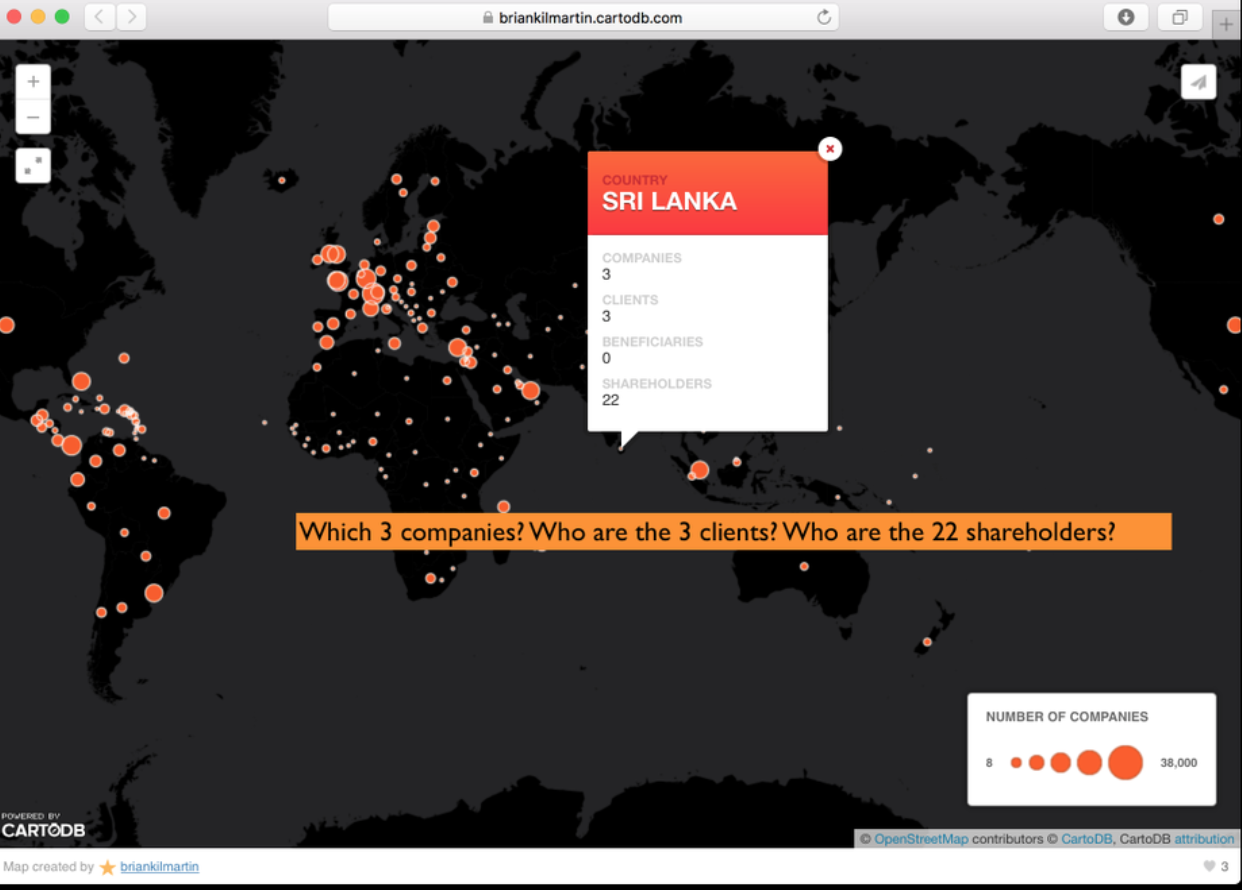
Therefore, there is direct interest for Sri Lanka to investigate further
regarding this exposure about Sri Lankan companies and entities being
named in this controversy. The Government should however not just limit
their interest to a full detailed exposure of those companies and
personalities involved, but also ascertain the extent of the tentacles
of corruption and money laundering followed by politicos and businesses
in stashing their ‘ill-gotten’ wealth abroad. One of the largest
protests in Iceland’s history demanding Prime Minister Sigmundur
Gunnlaugsson to step down after the leaked files revealed he and his
wife were hiding investments worth millions of dollars behind a
secretive offshore company, has much resonance to all of us following
political developments in Sri Lanka.
Mangala Samaraweera went on record some time back saying that Sri Lanka
had already secured support from four countries to track an estimated USD 18 billion in assets stolen
by former president Mahinda Rajapaksa and his family. The US and India
had previously announced they were helping Sri Lanka’s new government
track down stolen wealth stashed abroad, allegedly hoarded in tax
havens.
Yet the start of the Maithripala-Ranil era too smacked of corruption. One prime example was the Central Banks Governor’s alleged
shady deal, which dented this Government’s credibility to a great
degree. It is therefore vital that the new government too, reads their
mandate correctly, as it was the result of the winds of political change
which swept through Sri Lanka in 2015. People demanded a clear plan of
action to bring in good governance, transparency and accountability; not
just small doses of them. Of course,
investigative and law enforcement arms such as the Financial Crimes Investigative Division (FCID) and the Commission to Investigate Allegations of Bribery or Corruption (CIABOC)
were set up and/or strengthened. It has been a routine daily news
bulletin item in the post-January 2015 period, with many parties
submitting petitions to the Commission and the Police subsequently
arresting and releasing various culprits. These staged dramas, now
almost a source of public entertainment rather than showing any
significant results, have made the public question whether the ‘Yahapalanaya’
promise to have zero tolerance’ to corruption is merely an eye wash or a
serious commitment to clean the stables and ensure a clean political
culture.
Of course, there are noticeable improvements in accountability and
transparency and press freedom, arming people with knowledge about how
political leadership is managing public finances. However, people are
quite rightly demanding concrete steps to achieve the ideal of zero
tolerance to corruption; not just ‘flash in the pan’ marginal
improvements to attract public attention or gain short term cheap
political mileage by hunting down political opponents. The public also
needs to know about the progress of the government’s drive to track down
the nation’s wealth allegedly stashed abroad, which was a major
campaigning point during election time.
Sri Lanka was ranked 83rd out of 175 countries, according to the 2015 Corruption Perceptions Index reported
by Transparency International. Sri Lanka’s corruption Rank averaged
81.79 from 2002 until 2015, reaching an all-time high of 97 in 2009 and a
record low of 52 in 2002. Sri Lanka clearly need to aim for a
consistent plan of action to achieve a higher rating on the
Anti-Corruption Index of Transparency International (TI).
Black money is basically income from which tax has been evaded and tax
havens are territories which provide a safe and easy environment for
such money to come in. Such territories are “safe” because neither do
they ask the depositors where the money is coming from nor do they
share such account information of depositors easily with other
countries. It is a known fact that the flow of black money out of a
country into tax havens of dubious nature, such as Mossack Fonseca in
Panama (reportedly only the third largest in the world and certainly not
the only one) can easily destabilise the financial market of a country.
It is developing countries like Sri Lanka that are impacted more due to
such capital outflows, hence the need to take immediate and stringent
measures to put these practises to an end. It has been estimated that
every year, developing countries lose about $160 billion to such tax
havens. Adopting urgent measures to curb such an outflow of black money
is therefore the need of the hour for Sri Lanka at this crucial point of
time, when there is a new government which has much more
credibility than the previous one. There is clamour from the public and
aspirations are at an all-time high to ensure a clean political culture
for Sri Lanka. Besides, it is also important to reform the vital
institutions of the judiciary and the law enforcement authorities,
particularly the Police, to crack down on corruption and nepotism to
regain public credibility . Perhaps, this is an opportune time to
reflect on this national priority when constitutional reforms are also
on the cards.
Will the Panama papers therefore propel Sri Lanka to go beyond mere
verbosity and put their house in order – to take concrete action to
bring culprits who have siphoned out public funds abroad to their
advantage, to close the legal /financial loopholes and to hold public
representatives to account by ensuring accountability and transparency
on their part? Only time will tell.
However, in the best interests of future generations, Sri Lankans must insist that their government ‘walk the talk’.
