Peace for the World World ! Your War Our Lives

The Dalai Lama
A Brief Colonial History Of Ceylon(SriLanka)
Sri Lanka: One Island Two Nations
A Brief Colonial History Of Ceylon(SriLanka)
Sri Lanka: One Island Two Nations
(Full Story)
Back to 500BC.

Sunday, May 8, 2016
Antecedents Of July 1983 & The Foundations Of Impunity: The PSO

By Rajan Hoole –May 7, 2016

Dr. Rajan Hoole
When we talked about the Police of 1958 and earlier, we are not saying
that it was at any point an ideal police force. Far from it – there were
a number of instances of police brutality towards the lower orders of
society, of which Vittachi gives one example. A classic example now
fading from living memory is the attack on the strikers of 5th June
1947, on the eve of independence.
The primary issue was the Left protest against the Soulbury Constitution
for Independent Ceylon, for its failure to guarantee workers’ rights.
Associated with it was the interdiction of T.B. Illangaratne, president,
and 19 others of the Government Clerical Services Union for having held
a meeting on Galle Face Green, in contravention of Public Service
Regulations. 50,000 public servants prepared for trade union action.
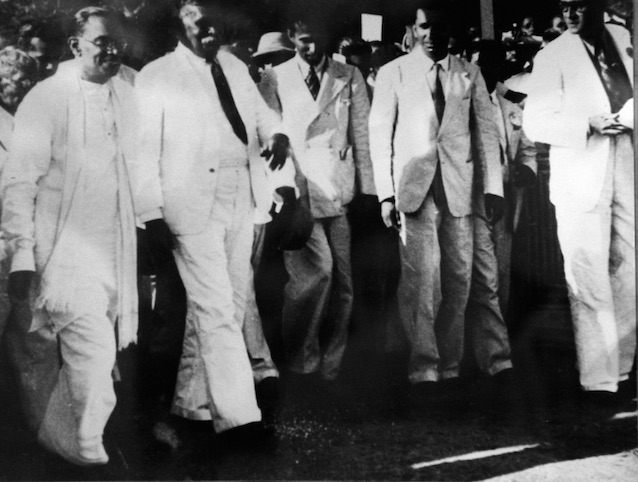 At this point there was a development of considerable historical interest. The
State Council headed by D.S. Senanayake, the prime minister-in-making,
hurriedly passed the Public Security Ordinance, taking barely 90 minutes
over it. We shall encounter the PSO again in the run up to the violence
of July 1983. Perhaps the rulers in 1947 also thought it useful to have
such an act on the statute book before independence, since, one is not
surprised by such laws under colonial rule, while it would be awkward to
present such legislation after independence. Interestingly, however,
the most oppressive piece of legislation ever passed in Parliament – the
one to make Tamil plantation workers non-citizens – could not have been
passed under colonial rule!
