Peace for the World World ! Your War Our Lives

The Dalai Lama
A Brief Colonial History Of Ceylon(SriLanka)
Sri Lanka: One Island Two Nations
A Brief Colonial History Of Ceylon(SriLanka)
Sri Lanka: One Island Two Nations
(Full Story)
Back to 500BC.

Saturday, May 7, 2016
Bragging of free press, Israel jails 19 journalists
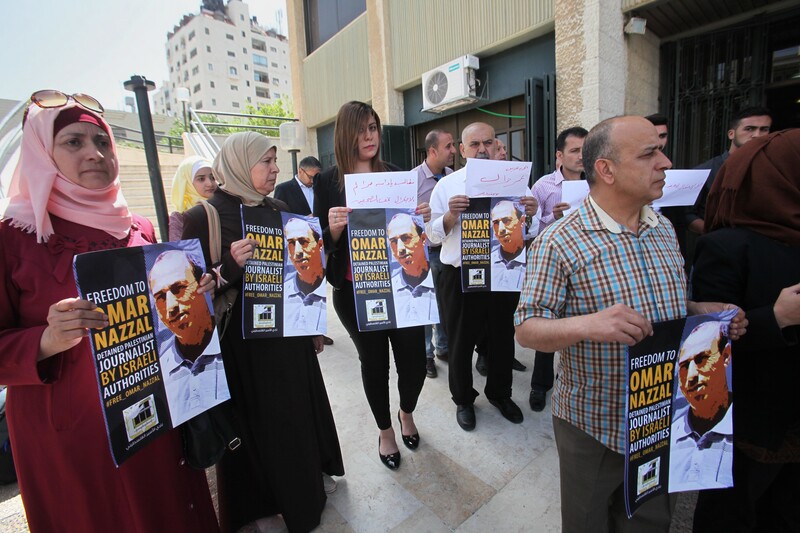
Palestinian
journalists hold a rally demanding that Israel release their jailed
colleague Omar Nazzal, in the occupied West Bank city of Nablus, on 30
April.
6 May 2016
When Israeli police
briefly detained William Booth, The Washington Post’s bureau chief in Jerusalem in February, the incident sparked considerable media attention.
Photographs of Booth and his colleague Sufian Taha being removed from
the Damascus Gate, an entry to the Old City, were widely circulated.
The incident was, however, quickly dismissed as isolated and

Prime Minister Benjamin Netanyahu, visiting Germany at the time, claimed that Israel does not arrest journalists and that the media in Israel is “lively and free.”
Netanyahu was lying: Israel frequently arrests and imprisons Palestinian journalists.
Nineteen Palestinian journalists are currently in Israeli detention, according to data issued by the Palestinian Prisoners Club.
The latest such detainee is 24-year-old photographer and reporter Hasan Safadi.
He was arrested on 30 April at the Allenby crossing, on his way back
from a visit to Jordan. Israel controls that crossing, which connects Jordan to the occupied West Bank.
Safadi is a media officer with Addameer, a group campaigning for Palestinian prisoners.
He has also contributed to numerous publications, including Assafir, a newspaper published in Lebanon.
“After arresting him at the border, they also raided our home and
confiscated several books and any papers that had Hasan’s name,” Ghazal
Safadi, Hasan’s sister, told The Electronic Intifada. As she spoke,
Israeli border police and special units were searching the family’s home
in the Beit Hanina neighborhood of East Jerusalem.
“Hasan was arrested for doing his job, for writing, for documenting Israel’s violations.”
Hasan Safadi is scheduled to appear in court this Sunday.
Wave of attacks
Ghazal believes that her brother’s arrest is part of an escalating wave
of attacks not just against journalists, but against all Palestinians
trying to expose Israel’s oppression of the Palestinians.
Another Jerusalem-based reporter arrested last month was 25-year-old Samah Dweik.
A reporter for both the newspaper Al-Quds and the online Quds News Network, Dweik was arrested at her home in Ras al-Amoud, also in East Jerusalem, on 10 April.
“The army and police raided our home at approximately 9:30 am and turned
it upside down while searching for documents belonging to Samah,” Israa
Dweik, Samah’s sister, told The Electronic Intifada.
“They confiscated my laptop, as well as Samah’s and my mother’s mobile
phone,” Israa added. “They took many books and have not returned
anything yet.”
Samah Dweik was recently transferred to Hasharon prison, an Israeli jail where Palestinian women political prisoners are traditionally held, and faces charges of incitement.
Dweik was one of the few journalists closely following the case of Palestinian schoolgirl Marah Bakir, imprisoned for allegedly stabbing an Israeli soldier.
Israa Dweik feels it is ironic that – after Samah had spent so much time
with Marah’s family and writing about Marah’s plight – Samah and Marah
are now in the same prison.
Concealing occupation
“For Israel, covering the human suffering in Jerusalem and the
aggression that Palestinians face on a daily basis is considered
incitement,” Israa added. “They want Palestinians to remain silent and
they want to conceal the true face of the occupation by arresting and
persecuting people like my sister.”
Samah Dweik had been especially busy since an uprising against Israel
began in October last year. She has covered in detail the effects of
Israel’s crackdown on the Palestinian community in Jerusalem.
Among the topics she has written about were the arrest of Palestinian minors, home demolitions, the placing of Palestinians under house arrests and incursions by Israeli settlers into al-Aqsa mosque.
“Writing about Jerusalem and covering what happens in all of its
neighborhoods was Samah’s primary mission,” said Israa. “She is looking
to improve as a journalist and develop her experience and make a name
for herself. But Jerusalem will always be her main focal point.”
To try to excuse its persecution of Palestinian journalists, Israel has
often pressed charges of incitement. The charge has become so common
that it appears Israel regards all Palestinian journalists who simply do
their jobs as guilty of incitement – a vague and amorphous concept.
Sometimes, though, Israel does not even bother pressing charges. Some journalists are subject to administrative detention, imprisonment without charge or trial.
The TV journalist Muhammad al-Qiq is among those who have been held under administrative detention.
He helped draw attention both to Israel’s use of this practice –
condemned by human rights groups – and to its persecution of journalists
by undertaking a hunger strike.
After al-Qiq refused food for 94 days, Israel agreed to end his detention in February.
Another Palestinian journalist held under administrative detention is 54-year-old Omar Nazzal.
Nazzal, a member of the general secretariat of the Palestinian
Journalists’ Syndicate and the director of a private media firm, was
arrested in March.
While traveling to attend a conference by the European Federation of Journalists in Bosnia, he was arrested at the Allenby crossing. He has since been placed under administrative detention.
Nazzal is a father of three daughters, the youngest of whom is 15. He
was previously arrested during the first intifada for his activism with
the Popular Front for the Liberation of Palestine and had faced a travel ban for more than two years.
“The arrest of Omar demonstrates Israel’s plan to silence Palestinian
voices and to intimidate the entire Palestinian society,” Marilyn
Rabadi, Nazzal’s wife, told The Electronic Intifada. “Israel constantly
brags about its so-called free press, and unfortunately it seems many in
the West subscribe to this myth. But reality couldn’t be more
different.”
Rabadi is aware that her husband’s case has received more attention than
that of many other detained Palestinian journalists. Yet she argues
that the coverage of Nazzal’s case is still far less than he would
receive if he was from the West.
“We are tired of just hearing condemnations that lead to no actual
pressure on Israel to release journalists,” she said. “Palestinian
journalists are arrested, beaten and harassed. Unless practical and
genuine pressure is employed – not just rhetoric – these attacks against
journalists will continue.”
Rabadi believes that it’s not just the so-called international community
that is to blame for the impunity with which Israel carries out its
attacks against Palestinian journalists.
“We obviously appreciate the support we got from the Palestinian
Journalists’ Syndicate but the Palestinian Authority has done nothing,”
she said. “They [the PA] claim to have some sort of sovereignty in the
West Bank, but Israel can easily arrest people in the heart of Ramallah
or at the crossing and all you could hear from the PA is soft, almost
shy, condemnation.”
On 3 May, World Press Freedom Day, Nazzal issued a letter from jail, reiterating his commitment to defending the right to expression in Palestine.
“I was arrested for expressing my opinions, for practicing my job as a
journalist, and for defending human rights, and particularly the rights
of journalists,” Nazzal wrote. “My arrest is a clear attack not just
against the freedom of the press, but also against union organizing and
the freedom to work in general. It is an attack against the entire
Palestinian Journalists’ Syndicate.”
“And on behalf of all imprisoned journalists, I pledge to you that we
will not put down our pens,” Nazzal added. “Our voices will remain loud
and the lenses of our cameras will always be prepared to document the
crimes of the Israeli occupation in order to reveal them to the world.”
Budour Youssef Hassan is a Palestinian writer and law graduate based in occupied Jerusalem. Blog:budourhassan.wordpress.com.
