Peace for the World World ! Your War Our Lives

The Dalai Lama
A Brief Colonial History Of Ceylon(SriLanka)
Sri Lanka: One Island Two Nations
A Brief Colonial History Of Ceylon(SriLanka)
Sri Lanka: One Island Two Nations
(Full Story)
Back to 500BC.

Saturday, May 14, 2016
By ignoring corruption's colonial roots, Cameron's summit was destined to fail
Nigeria may be corrupt, but denying the historical role Britain and others played in this rendered the event useless, argues Ventures Africa
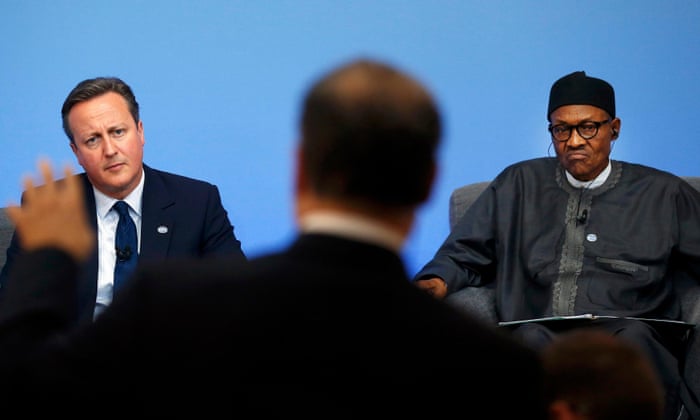
David Cameron and President Muhammadu Buhari at the anti-corruption summit in London. Photograph: Reuters
 Ahead of his anti-corruption summit to tackle what must be the world’s oldest skill, the art of looting, David Cameron was overheard telling the Queen that Nigeria and Afghanistan are the “two most corrupt countries in the world.”
But wasn’t the art of looting perfected and then institutionalised by
the colonial enterprises of the erstwhile British Empire? It’s hard not
to think of this history when you see the footage of old and greying
white men and their queen as they discuss two countries that were once
“possessions”.
It’s also hard not to think about how this history continues to play an
important role in the perpetuation of the corruption about which the
prime minister seems so concerned.
When asked about Cameron’s remarks, Nigeria’s president Muhammadu Buharioffered a terse response.
“I am not going to demand any apology from anybody. What I am demanding
is the return of the [stolen] assets.” Buhari himself has numerous
times publicly and unapologetically denounced his own countrymen for being fabulously corrupt.
So is it really a gaffe that Cameron has said what our own leaders have
already openly told the world? Really, outrage about the British elite
having a hearty laugh over the moral backwardness of their former
colonies misses the point.
The real issue is this: by failing to address the colonial roots of
corruption, any attempt to tackle the problem proposed by the summit was
always going to fall short.
Much of Nigeria’s “fantastic corruption” is tied to its oil industry,
through which multiple western governments have subverted the rule of
law and the will of the people. From bribing local rulers when oil was
first discovered, to bribing military dictators during the 70s, 80s and 90s, to accepting murky funds stashed in British banks, the UK has actively incubated and encouraged a monster.
To be sure, none of this should obscure the fact that today Nigeria has
a corrosive corruption problem that has been exceedingly detrimental to
its hardworking (and mostly honest) general population. However it
should help to contextualise the British prime minister’s offensive
remarks.
As expected, there have been varying reactions to Cameron’s statement,
many angry, but just as many supportive of what they view as Cameron
calling it like it is. “The prime minister’s remarks were outspoken and
unguarded but they were not untrue,” said BBC correspondent James Landale.
The basis for this assumption is the 2015 corruption perception index prepared by Transparency International, which ranked Nigeria as the 136th “least transparent country” in the world.
But one could argue that this popular index is only a measure of
perception, and therefore mainly reflects international business
opinion. The Tax Justice Network’s financial secrecy index provides
an alternative set of metrics for the “global measure of probity” and
here the tables turn. This index ranks the UK as the 15th worst
jurisdiction for secrecy, guilty of allowing illicit cross-border
financial flows.
It is not far fetched to argue that these “networks of secrecy” in the
UK and other European countries have helped to perpetuate fraud, money
laundering, bribery, political impunity, and even devastating violence
in affected countries, many of them in Africa.
That Nigeria’s politics suffers from corruption is not up for debate. At
the same time, “fantastic” corruption in a globalised world is reliant
on enablers, often the finely suited businessmen and politicians from
developed nations who value rule of law at home but think nothing of
subverting law and order in emerging markets.
At the close of his anti-corruption summit, Cameron and the attending heads of state announced plans for an anti-corruption coordination body based
in London. While this is an interesting first step, it has also been
stated that this body will have no legal powers and will serve only to
advise governments and law enforcement agencies tracking stolen assets.
There was also mention of a global forum for asset recovery which will
bring world leaders together in 2017 to discuss returning stolen assets
to countries like Nigeria, Ukraine, Sri Lanka and Tunisia.
But without western leaders – who are supposedly evangelists for
transparency – seriously considering their historical role in generating
and maintaining systems that encourage the looting, none of this will
have an impact.
We look forward to the day when the leaders of emerging markets
countries will summon the heads of western nations to their capitals to
atone for their roles in perpetuating corruption. We’re not holding our
breath.
A version of this article first appeared on Ventures Africa
