Peace for the World World ! Your War Our Lives

The Dalai Lama
A Brief Colonial History Of Ceylon(SriLanka)
Sri Lanka: One Island Two Nations
A Brief Colonial History Of Ceylon(SriLanka)
Sri Lanka: One Island Two Nations
(Full Story)
Back to 500BC.

Saturday, May 7, 2016
IMF threatens to pull out of Greek rescue
Christine Lagarde issues warning in letter leaked three days before eurozone finance ministers discuss help for Athens
Greek
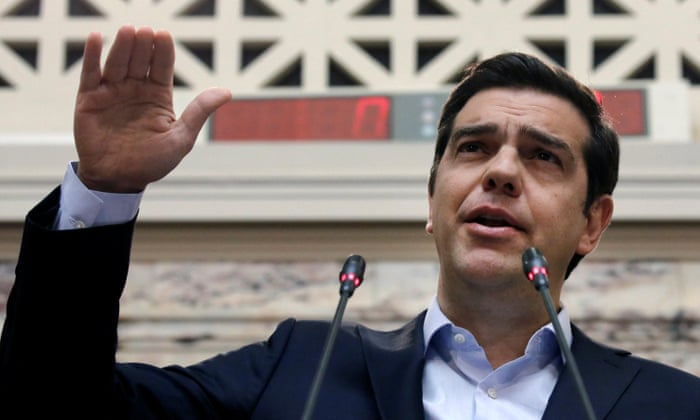
prime minister Aleixis Tsipras addresses Syriza parliamentarians in
Athens on Friday. Photograph: Alkis Konstantinidis/Reuters

Friday 6 May 2016
Hopes of an end to the impasse between Greece and its creditors have appeared to evaporate after asurprise intervention from the International Monetary Fund.
In a letter - leaked three days before eurozone finance ministers are
scheduled to discuss how best to put the crisis-plagued country back on
its feet – IMF chiefChristine Lagarde issued her most explicit warning yet: either foreign lenders
agree to restructure Greece’s runaway debt or the Washington-based organisation will pull out of rescue plans altogether.
“For us to support Greece with a new IMF arrangement, it is essential
that the financing and debt relief from Greece’s European partners are
based on fiscal targets that are realistic because they are supported by
credible measures to reachthem,” she wrote, lamenting the lack of
structural reforms underlying Athens’ abortive adjustment programme so
far.
Six years have elapsed since Greece, revealing a deficit that was four
times higher than previously thought, received its first loans from a
bailout programme that has since exceeded more than €240bn (£190bn) in
emergency funding. Since a third €86bn bailout last summer, talks have
been largely deadlocked.
Laying bare the differences of view prevailing among those consigned to
keep the insolvent nation afloat, Lagarde said it was imperative that a
lower primary surplus goal was achieved.
“We do not believe it will be possible to reach a 3.5% of GDP primary
surplus [in 2018] by relying on hiking already high taxes levied on a
narrow base, cutting excessively discretionary spending and counting on
one-off measures as has been proposed in recent weeks.”
The IMF managing director’s intervention came after the surprise
decision of the leftist-led government in Athens to put unpopular
pension and tax changes to a vote on Sunday.
The prospect of such controversial measures being passed so urgently
unleashed a wave of civil unrest with a 48-hour general strike by
private and public sector unions bringing Greece to a standstill.
Unionists said the measures were a “barbaric” eradication of hard-won rights and would be “the last nail in the coffin” for workers whose salaries have already been savaged by relentless rounds of gruelling austerity.
Unionists said the measures were a “barbaric” eradication of hard-won rights and would be “the last nail in the coffin” for workers whose salaries have already been savaged by relentless rounds of gruelling austerity.
“They are the worst so far,” said Odysseus Trivalas, president of the
public sector union ADEDY. “At some point, Greeks won’t be able to take
anymore and there will be a social explosion.”
Rallies are planned to protest against measures that include instituting
a national pension of €384 a month, raising social security
contributions and increasing income tax for high earners. The overhaul
of the pension system is among the most contentious reforms to date.
In a repeat of the drama that dominated the eurozone last year, Athens
faces the spectre of default if its fails to honour maturing European
Central Bank bonds and IMF loans in July.
Long overdue rescue loans worth €5bn are at stake. Receipt of the funds
depends on completion of a first progress report, or evaluation, of the
economy that has been drawn out for the past nine months and has stalled
over lender disagreement. With discord over Athens’ ability to achieve
fiscal targets, creditors recently upped the ante, demanding an
additional contingency package of €3.6bn, the equivalent of 2% of GDP.
“While creditors fight this out, the political and social situation in
Athens will deteriorate,” said Mujtaba Rahman, head of European analysis
at risk consultancy Eurasia Group. “Time is running out for creditors
to come to an agreement.”
The Greek prime minister, Alexis Tsipras, unexpectedly called Sunday’s
vote before the conclusion of the negotiations in order to placate
creditors and increase his bargaining power at Monday’s meeting of
eurozone finance ministers.
In a first, the ministers are to discuss Greece’s debt load – which at more than 180% of GDP by far the highest in Europe –
in addition to fiscal adjustment measures that could amount to 5% of
GDP if contingency reforms are taken. The extra policies, as yet
unspecified, will only be enacted if targets are not reached but, with
its narrow three-seat majority, the Greek government has argued they
will never get through parliament.
“Tsipras is looking to demonstrate to Greek voters that he and his
government have done their part, and that the ball, namely that of debt
relief, now lies squarely with the Europeans,” said Rahman.
“The subliminal message to creditors [in Sunday’s ballot] is therefore
this: if you insist on contingency measures, you will end up with the
collapse of my government and early elections.”
Along with Britain’s 23 June referendum on EU membership, that could end up being a “big headache” for Europe, he added.
