Peace for the World World ! Your War Our Lives

The Dalai Lama
A Brief Colonial History Of Ceylon(SriLanka)
Sri Lanka: One Island Two Nations
A Brief Colonial History Of Ceylon(SriLanka)
Sri Lanka: One Island Two Nations
(Full Story)
Back to 500BC.

Friday, May 13, 2016
THE MILD-MANNERED MAN WHO COULD SOLVE SRI LANKA’S ETHNIC STRIFE

 12/05/2016
Committee after blue-ribbon committee has recommended that the majority
Sinhalese, primarily Buddhists who immigrated from India centuries ago,
relinquish some political power to the minority Tamils and Muslims,
allowing them a measure of local self-governance.
And yet one president after another has failed to do so.
Now a president elected by an unlikely coalition of moderates from the
country’s two main majority-Sinhalese parties, along with the Tamil and
Muslim minorities, is trying yet again at what is widely considered the
most opportune moment in Sri Lanka’s history.
President Maithripala Sirisena of Sri Lanka in his office in Colombo, the capital. He has pledged to persuade his Sinhalese people to support a new Constitution that devolves the powers of the central government that they dominate. Credit Sergey Ponomarev for The New York Times
President Maithripala Sirisena of Sri Lanka in his office in Colombo, the capital. He has pledged to persuade his Sinhalese people to support a new Constitution that devolves the powers of the central government that they dominate. Credit Sergey Ponomarev for The New York Times
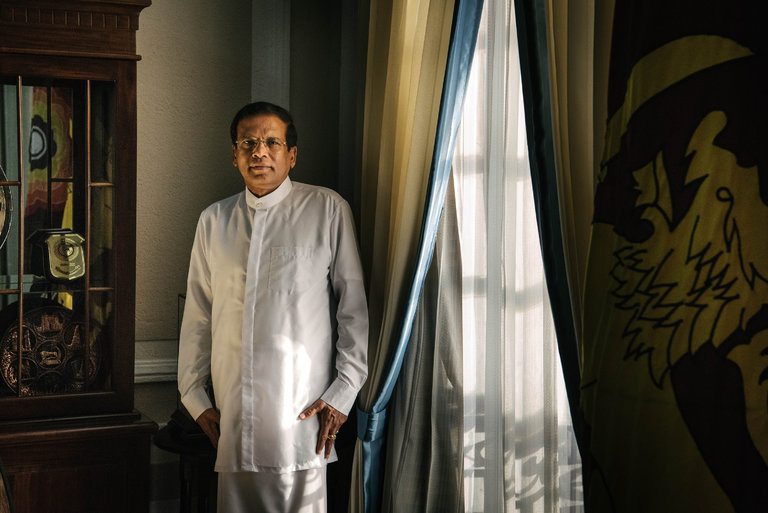
President Maithripala Sirisena of Sri Lanka in his office in Colombo, the capital. He has pledged to persuade his Sinhalese people to support a new Constitution that devolves the powers of the central government that they dominate. Credit Sergey Ponomarev for The New York Times
Long plagued by ethnic strife, Sri Lanka became embroiled in a civil war
with the Tamils that lasted 26 years. The government finally crushed
the secessionist group leading the fight in a brutal battle in 2009, in
which tens of thousands were killed, most of them civilians. That
government, accused of human rights abuses then and in the ensuing
years, was toppled by the coalition that brought Maithripala Sirisena to power in January 2015.
Chosen by the coalition because he was so agreeable and self-effacing as
to have offended practically nobody, Mr. Sirisena has pledged to
persuade his Sinhalese people to support a new Constitution that
devolves the powers of the central government that they dominate. A
referendum is expected later this year.
But questions abound about whether this 64-year-old son of a paddy
farmer, who spent his political life shunning the limelight despite
holding top ministerial posts, could be the one finally to lead this
country into an era of peace.
“We will devolve power to the people as a whole,” Mr. Sirisena said in
an interview last week. “Nobody is trying to take something away from
the Sinhalese to give it to the Tamils. What we are trying to do is to
give something more to everyone.”
“The ruling coalition has proven unable to generate internal consensus on key issues of public policy,”
Verité Research, a Colombo think tank, said in a report last week, warning that the “moderate consensus remains deeply vulnerable.”
Mr. Sirisena, in the interview in his seaside office, where he keeps the
air-conditioner off in the stifling summer heat, insisted he would not
only get a Constitution adopted but also lead his country through the
process of truth and reconciliation that his government committed to undertake in a United Nations resolution last year.
The United Nations estimates that as many as 40,000 people were killed
in the last phase of the civil war in 2009. Families have reported more
than 5,000 people missing, making Sri Lanka the country with the
second-highest number of disappearances in the world, the world body
said.
“I know it is a difficult task, and I decided to accept the challenge
anyway,” Mr. Sirisena said, leaning back in a white upholstered chair,
himself dressed, as always, in white, from his cotton lungi skirt to his
white tunic top.
Fast Facts
- Sri Lanka has a population of about 20.4 million.
- About 74.9% of the population is ethnic Sinhalese, 15.3% is Tamil and 9.3% is Muslim.
- A 26-year civil war ended in 2009.
- A Tamil group, Liberation Tigers of Tamil Eelam, fought the civil war to try to form a separate homeland.
- The United Nations estimates as many as 40,000 people were killed in the final months of the war.
- Sources: Sri Lanka Department of Census and Statistics and report of the Secretary General’s Panel of Experts on Accountability in Sri Lanka 2011
“And when you take up the challenge, you mustn’t face it crying, you
must smile through it,” he said, his normally serious demeanor lifted
into a grin.
But Mr. Sirisena, speaking quietly and slowly, gesturing for emphasis, urged patience.
“I am not a man who rushes into things,” he said. “That is my policy.”
Mr. Sirisena came to power in a revolution at the polls early last year, when a coalition with him at the helm defeated the previous president, Mahinda Rajapaksa.
Revered by some for ending the country’s civil war, Mr. Rajapaksa was
reviled by others because of allegations of corruption and human rights
abuses.
When coalition members were deciding whom to put forward as their
candidate against Mr. Rajapaksa, they chose Mr. Sirisena “because of the
very simplicity of the man,” Mangala Samaraweera, Sri Lanka’s foreign
minister, said in an interview.
There were “more efficient, more iconic persons who may have been also
able to do that job, but none of them would have been able to win the
trust and confidence of so many different layers of Sri Lanka’s
constituencies, the Tamils, the Muslims,” said Mr. Samaraweera, who
joined Parliament in 1989, the same year as Mr. Sirisena. “I really
personally believe Sirisena never ever had any ambitions” for the top
job.
Mr. Sirisena, who was health minister under Mr. Rajapaksa before
defecting to join the coalition against him, had also been his party’s
general secretary for 13 years. He began his political life as a
communist, and still reveres Karl Marx, with a picture of him
prominently displayed in his home.
M. A. Sumanthiran, a leading constitutional lawyer and member of
Parliament from the Tamil National Alliance, said that when he was asked
to support Mr. Sirisena’s candidacy, he knew him only as “a man of few
words who smiles and shies away.”
But as a member of a committee appointed to advise Parliament on a new
Constitution, Mr. Sumanthiran said, he was impressed at how Mr. Sirisena
finessed a divisive question of ethnicity in the preamble to the new
Constitution.
Convinced that a new Constitution must begin its life with unanimous
support in Parliament, Mr. Sirisena persuaded all sides to drop the
preamble and instead support a simple resolution for a Constitution to
be drafted. That garnered unanimous support.
“These are little steps compared to what we expect him to do,” Mr.
Sumanthiran said, but “it’s giving us confidence in his methods.”
Mr. Sirisena, in the interview, said lobbying fellow legislators was his
forte, and laughed as he described his efforts in humorous detail. In
April last year, he got two-thirds of the 225-member Parliament to
support a constitutional amendment reducing presidential powers, as he
had pledged to do if elected.
“I went to the Parliament dining hall, sat with them and asked them to
take away my powers. I put my arm around their shoulders, held them by
their arms and rubbed their bellies to convince them to take away my
powers,” he said, speaking softly, his shoulders rising and falling in
jerks as he chuckled to himself.
Mr. Sirisena steered clear of committing to a timeline, saying, “I don’t
think the drafting of a country’s constitution should be rushed. If we
rush the process, the extremists could exploit that situation.”
But moving slowly has risks, too.
To maintain support within their ethnic communities, the moderates
needed to demonstrate progress, said Verité, the think tank, but the
results they must show are divergent.
“The change in government has renewed Tamil expectations that their
immediate grievances as well as historical grievances — particularly
over power sharing — will be meaningfully addressed,” Verité said in its
report.
But Verité said proposals for greater power sharing and accountability
for rights abuses and war crimes are likely to be strongly resisted
because the government had “made no concerted effort” to shift Sinhala
opinion “in favor of a more equitable power-sharing arrangement.”
Making it harder, Mr. Rajapaksa retains sway over a big portion of Mr.
Sirisena’s political party, and at every opportunity loudly denounces
him as selling out his own people.
That appears to have persuaded the government to back away from a
resolution it co-sponsored at the United Nations in September to involve
foreign judges in a special court to investigate and prosecute human
rights abuses.
“The president is reflecting a kind of general view amongst the public
about not having foreign judges,” said Mr. Samaraweera, the foreign
minister.
The Tamil population, skeptical of a process led by the central
government, had insisted on the involvement of foreign judges, and this
apparent backtracking has worried some.
“Sirisena’s attitude is to try to be deft instead of bold,” said
Paikiasothy Saravanamuttu, executive director of the Center for Policy
Alternatives, a Colombo research and advocacy group. “We’re waiting for
him to play the fullest possible role.”
Mr. Samaraweera said government leaders plan a major effort to build
support in the coming months. The first step would be to raise awareness
among the Sinhalese about what really happened in the civil war,
something they have been largely shielded from.
“The Sinhalese, once they know the truth, are a pretty compassionate
bunch of people,” he said, predicting they will come to support the
process.
Mr. Sirisena said he, too, remained convinced that his Sinhalese majority would support a new Constitution.
“For the Sinhalese people to live happily in this country,” he said,
repeating a line he has used often in speeches, “the minority
communities also must be happy.”
