Peace for the World World ! Your War Our Lives

The Dalai Lama
A Brief Colonial History Of Ceylon(SriLanka)
Sri Lanka: One Island Two Nations
A Brief Colonial History Of Ceylon(SriLanka)
Sri Lanka: One Island Two Nations
(Full Story)
Back to 500BC.

Saturday, June 11, 2016

 Jun 4th 2016
IN JULY 2012 a man calling himself Sam Bacile posted a short video on
YouTube. It showed the Prophet Muhammad bedding various women, taking
part in gory battles and declaring: “Every non-Muslim is an infidel.
Their lands, their women, their children are our spoils.”
The film was, as Salman Rushdie, a British author, later put it, “crap”.
“The Innocence of Muslims” could have remained forever obscure, had
someone not dubbed it into Arabic and reposted it in September that
year. An Egyptian chat-show host denounced it and before long, this
short, crap film was sparking riots across the Muslim world—and beyond. A
group linked to al-Qaeda murdered America’s ambassador in Libya.
Protests erupted in Afghanistan, Australia, Britain, France and India.
Pakistan’s railways minister offered a $100,000 bounty to whoever killed
the film-maker—and was not sacked. By the end of the month at least 50
people had died.
Barack Obama and Hillary Clinton condemned both the video and the
reaction to it. General Martin Dempsey, then chairman of America’s joint
chiefs of staff, contacted Terry Jones, a pastor in Florida who had
previously burned a Koran in public, and asked him not to promote the
video.
“Consider for a moment: the most senior officer of the mightiest armed
forces the world has ever seen feels it necessary to contact some
backwoods Florida pastor to beg him not to promote a 13-minute D-movie
YouTube upload. Such are the power asymmetries in this connected world,”
writes Timothy Garton Ash in “Free Speech”, a fine new book on the
subject. The story of “The Innocence of Muslims” illustrates several
points about how freedom of speech has evolved in recent years.
First, social media make it easy for anyone to publish anything to a
potentially global audience. This is a huge boost for freedom of speech,
and has led to a vast increase in the volume of material published. But
when words and pictures move so rapidly across borders, conflict often
results. Different nations have different notions of what may and may
not be said. If the pseudonymous Mr Bacile had made his video in the
early 1990s, Muslims far away would probably never have heard of it, and
no one would have died.
Second, technology firms are having to grapple with horribly complex
decisions about censorship. The big global ones such as Facebook and
Twitter aspire to be politically neutral, but do not permit “hate
speech” or obscenity on their platforms. In America the White House
asked Google, which owns YouTube, to “review” whether “The Innocence of
Muslims” violated YouTube’s guidelines against hate speech. The company
decided that it did not, since it attacked a religion (ie, a set of
ideas) rather than the people who held those beliefs. The White House
did not force Google to censor the video; indeed, thanks to America’s
constitutional guarantee of free speech, it had no legal power to do so.
In other countries, however, governments have far more power to silence
speech. At least 21 asked Google to block or consider blocking the
video. In countries where YouTube has a legal presence and a local
version, such as India, Malaysia and Saudi Arabia, it complied. In
countries where it did not have a legal presence, it refused. Some
governments, such as Pakistan’s and Bangladesh’s, responded by blocking
YouTube completely.
Shut up or I’ll kill you
The third recent change is that, whereas the threats to free speech used
to come almost entirely from governments, now non-state actors are
nearly as intimidating. In the Mexican state of Veracruz, for example,
at least 17 journalists have disappeared or been murdered since 2010,
presumably by drug-traffickers. The gangs’ reach is long: one journalist
fled to Mexico City, where he was tracked down and butchered. And their
methods are brutal: in February the body of a reporter was found dumped
by the roadside, handcuffed, half-naked and with a plastic bag over her
head.
Globally, the willingness of some Muslims to murder people they think
have insulted the Prophet has chilled discussion of one of the world’s
great religions—even in places where Muslims are a minority, such as
Europe. Radical Islamists are attempting to enforce a global speech
code, in which frank discussion of their beliefs is punishable by death.
This began in 1989 with a threat from a state: Ayatollah Khomeini, Iran’s leader, issued a fatwa condemning
Mr Rushdie to death for a novel that he thought insulted Islam. He
invited devout Muslims everywhere to carry out the sentence. It was
almost certainly one of them who murdered Mr Rushdie’s Japanese
translator in 1991, though the killer was never caught.
Since then, the notion that individual Muslims have a duty to defend
their faith by assassinating its critics has spread. Most Muslims are
peaceful, but it takes only a few to enforce what Mr Garton Ash calls
“the assassin’s veto”. The Islamist who murdered Theo Van Gogh, a Dutch
filmmaker, for making a film about the abuse of Muslim women, said he
could not live “in any country where free speech is allowed”. In 2015
two gunmen stormed the offices of Charlie Hebdo,
a French paper which had published cartoons of Muhammad, killing 12
people. Many speakers and writers across the world are terrified of
offending Islamists. A satirical musical called “The Book of Mormon” is
an international hit; no theatre would dare stage a similar treatment of
the Koran.
Islamist intimidation is the most extreme example of a broader, and
worrying, trend. From the mosques of Cairo to the classrooms at Yale,
all sorts of people and groups are claiming a right not to be offended.
This is quite different from believing that people should, in general,
be polite. A right not to be offended implies a power to police other
people’s speech. “Taking offence has never been easier, or indeed more
popular,” observes Flemming Rose, a former editor at Jyllands-Posten, a Danish paper. He should know. After his paper published cartoons of Muhammad in 2005, at least 200 people died.
The zealots who hack atheists to death in Bangladesh (see article) are far more frightening than the American students who shout down speakers with whom they disagree (see article).
But they are on the same spectrum: both use a subjective definition of
“offensive” to suppress debate. They may do this by disrupting speeches
they object to; Mr Garton Ash calls this “the heckler’s veto”. Or they
may enlist the power of the state to silence speakers who offend them.
Politicians have gleefully jumped on the bandwagon, and are increasingly
using laws against “hate speech” to punish dissidents.
This article will argue that free speech is in retreat. Granted,
technology has given millions a megaphone, and speaking out is easier
than it was during the cold war, when most people lived under
authoritarian states. But in the past few years restrictions on what
people can say or write have grown more onerous.
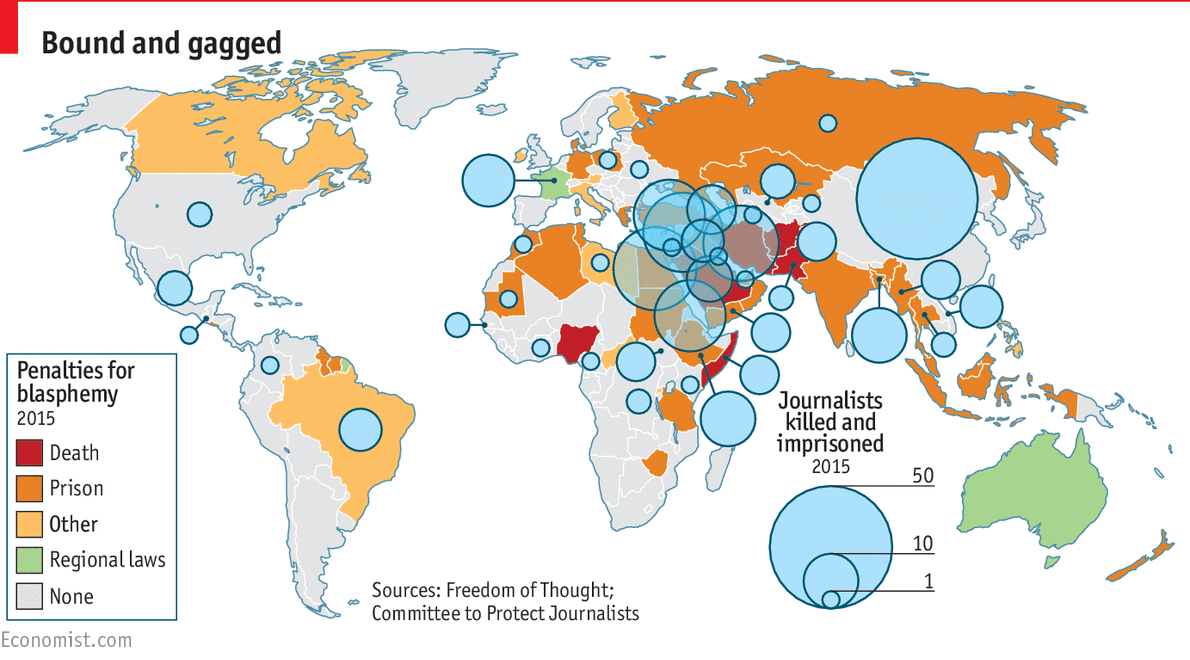
Freedom House, an American think-tank, compiles an annual index of
freedom of expression. This “declined to its lowest point in 12 years in
2015, as political, criminal and terrorist forces sought to co-opt or
silence the media in their broader struggle for power”. The share of the
world’s populace living in countries with a free press fell from 38% in
2005 to 31% in 2015; the share who had to make do with only “partly
free” media rose from 28% to 36%. Other watchdogs are similarly glum.
Reporters Without Borders’ global index of press freedom has declined by
14% since 2013.
Uncle Xi is watching you
Among big countries, China scores worst. Speech there has hardly ever
been free. Under Mao Zedong, the slightest whisper of dissent was
savagely punished. After he died in 1976, people were gradually allowed
more freedom to criticise the government, so long as they did not
challenge the party’s monopoly on power. Digital technology accelerated
this process. By the time Xi Jinping came to power in 2012, hundreds of
millions of Chinese were happily sharing their views on social media.
Mr Xi found this unnerving, so he cracked down. China’s thousands of
censors have ramped up efforts to block subversive online messages.
Hundreds of lawyers and activists have been harassed or jailed. Liberal
debate on university campuses has been suppressed (students and teachers
are being urged to pay more attention to Marxism-Leninism). According
to the Committee to Protect Journalists, a watchdog in New York, at
least 49 journalists were in prison in China in December 2015. In April
that year Gao Yu, an elderly reporter, was given a stiff sentence for
“leaking state secrets”—namely, a party document warning against
“Western” ideas such as media freedom.
Many Chinese stay one step ahead of the censors, using software to jump
over the Great Firewall of China and reach foreign websites.
Nonetheless, Mr Xi’s crackdown will surely weaken his country. If
information does not flow freely, it is hard to innovate or make sound
decisions. In recent months, as the stockmarket has wobbled, the party
has pressed economists to put on a happy face. Analysts who predict
turmoil are warned to shut up or recant. How policymakers are to
understand the economy when no one is allowed to discuss it honestly is
anyone’s guess.
In China the state is the source of nearly all censorship. Private
organisations play a role, but largely at the party’s behest or to avoid
upsetting it. Baidu, the Chinese answer to Google, blocks potentially
subversive search results. Google refuses to do so, and is therefore
unable to operate in China. Wikipedia, YouTube, Facebook and Twitter are
also blocked.
In the Muslim world, by contrast, speech is under attack from state and
non-state actors in roughly equal measure. The assassin’s veto is
exercised keenly in such places as Bangladesh, Iraq, Nigeria, Somalia
and Syria. In several Arab countries, after a brief flowering of free
debate during the Arab spring, regimes even more repressive than the old
ones have taken charge.
Consider Egypt, the Arab world’s most populous country. In 2011 mass
protests led to the overthrow of Hosni Mubarak, a dictator. For a while,
Egyptians were free to say what they wanted. But a Muslim Brotherhood
government elected in 2012 curbed secular speech, and the coup that
toppled it in 2013 made matters worse, says Muhammad Abdel-Salam of the
Association for Freedom of Thought and Expression, an Egyptian pressure
group.
Media outlets supportive of the Muslim Brotherhood, which Abdel-Fattah
al-Sisi, Egypt’s present ruler, has branded a terrorist organisation,
have been closed down. A new law makes it illegal for journalists to
publish “untrue news or data” (ie, anything that contradicts the
official line). “Don’t listen to anyone but me,” warned Mr Sisi in
February. “I am dead serious.”
Foreign reporters have been branded as spies and run out of the country.
Local reporters have it much worse. Mahmoud Abou Zeid, a photographer,
was arrested while snapping the authorities gunning down Islamist
protesters in 2013. He has been in jail ever since, accused of “damaging
national unity”. He has been beaten, tortured and denied medical care.
On May 7th an Egyptian court recommended the death penalty for three
journalists it accuses of spying. They deny the charges; one says he is
being punished for publishing an embarrassing leaked document. The
regime is incompetent as well as oppressive: in May an internal memo on
how to squash the press was accidentally sent to the press.
Claiming to act as Egypt’s father, Mr Sisi is anxious that his children
not be exposed to adult material. Saucy writers are jailed. Rights
groups say that the number of prosecutions involving “contempt of
religion” and “debauchery” (often used to prosecute homosexuals) are at
all-time highs.
The authorities mine Facebook and Twitter for information on future
protests, which are illegal, and for evidence against dissidents. Amr
Nohan, a student, was sentenced to three years in prison for posting a
photo of Mr Sisi with Mickey Mouse ears. Others are locked up for
running websites without a licence. Asked why someone would need one, an
assistant minister said: “You cannot drive without a licence. You
cannot administer a website without a licence. It’s the same.”
All over the world, the spread of organised violence has prompted
governments to curb speech they think may foster terrorism. Even in
liberal democracies they are starting to punish not only those who
deliberately incite violence, but also speakers who are merely
intemperate or shocking.
In February, for example, two puppeteers were arrested in Madrid. Their
show, “The Witch and Don Cristóbal”, was provocative: a nun was stabbed
by a crucifix; a judge was hanged with a noose. What upset the police,
however, was a scene where a puppet policeman accused a witch of
supporting terrorism and shoved a sign reading “Up Alk-ETA” (a reference
to al-Qaeda and ETA, a Basque separatist group) into her hands. The
puppeteers are now awaiting trial and face up to three years in prison
for “glorifying terrorism”. They are said to be surprised.
In much of Europe anti-terror laws are being used more zealously than
before. This is partly because governments are more scared of terrorism,
but also because they have started to police social media, where words
that might reveal extremist sympathies are easily searchable. ETA laid
down its arms in 2011; yet the number of Spaniards accused of glorifying
terrorism has risen fivefold since then.
France criminalised “the defence of terrorism” in 2014 and has enforced
the law more aggressively since the attacks on Paris last year. In the
days after the Charlie Hebdo massacre,
prosecutors opened 69 cases for “defence of terrorism”. One man was
sentenced to a year in prison for shouting in the street: “I’m proud to
be Muslim. I don’t like Charlie. They were right to do it.”
Many countries have introduced or revived laws against “hate speech”
that are often broad and vague. In France Brigitte Bardot, an actress,
has been convicted five times of incitement to racial hatred because, as
an animal lover, she complains about halal slaughter
methods. In India section 153A of the criminal code, which was
introduced under British rule, punishes with up to three years in jail
those who promote disharmony “on grounds of religion, race, place of
birth, residence, language, caste or community or any other ground whatsoever”.
Such laws are handy tools for those in power to harass their enemies.
And far from promoting harmony between different groups, they encourage
them to file charges against each other. This is especially dangerous
when cynical politicians get involved. Those who rely on votes from a
certain group often find it useful to demand the punishment of someone
who has allegedly insulted its members, especially just before an
election. For example, when an Indian intellectual called Ashis Nandy
made a subtle point about lower castes and corruption at a literary
festival in 2013, local politicians professed outrage and he was charged
under India’s “Prevention of Atrocities Act”.
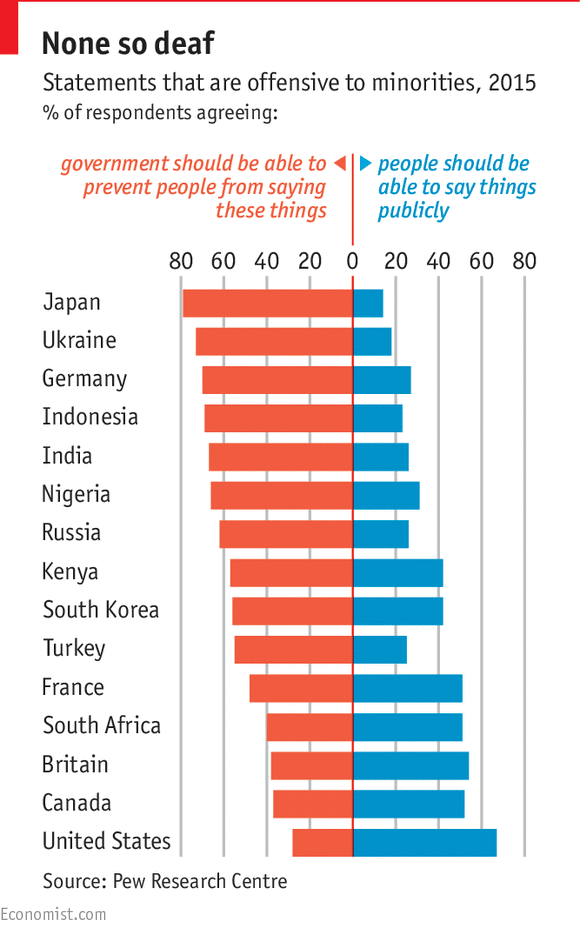
Many countries still have laws against blasphemy, including 14 in
Europe. Rita Maestre, a left-wing Spanish politician, was convicted in
March of insulting religious feelings during a protest in a Catholic
chapel, during which women bared their chests, kissed one another and
allegedly shouted “Get your rosaries out of my ovaries!” She was fined
€4,320 ($4,812).
Islamic governments such as those of Pakistan and Saudi Arabia, which
punish blasphemy against Islam ferociously, are keen for a ban on
insulting religion to be written into international law. They argue that
this is a natural extension of the Western concept of “hate speech”.
Some Western authorities agree: Danish police in February filed
preliminary charges against a man for burning a Koran, thus, in effect,
reviving a law against blasphemy that had not been used to convict
anyone since 1946.
Europe is full of archaic laws that criminalise certain kinds of
political speech. It is a crime to insult the “honour” of the state in
nine EU countries; to insult state symbols such as flags in 16; and to
say offensive things about government bodies in 13. Libel can be
criminal in 23 EU states. Bulgaria, France, Germany, Italy, the
Netherlands and Portugal all punish it more harshly when it is directed
at public officials. Some of these laws are seldom invoked, and France
got rid of its law against insulting the head of state in 2013, five
years after a protester was arrested for waving a banner that said “Piss
off, you jerk” to President Nicolas Sarkozy. (The banner was merely
quoting Mr Sarkozy, who had said the same thing to a different
protester.)
In Germany, however, Jan Böhmermann, a comedian, is awaiting charges for
insulting a foreign head of state, after he recited a scurrilous poem
about Recep Tayyip Erdogan, the president of Turkey, and some frisky
livestock. Angela Merkel, Germany’s chancellor, is now considering
repealing the law. Poland and Portugal, among others, have similar laws
against insulting foreign heads of state. Icelanders can in theory get
six years in prison for it.
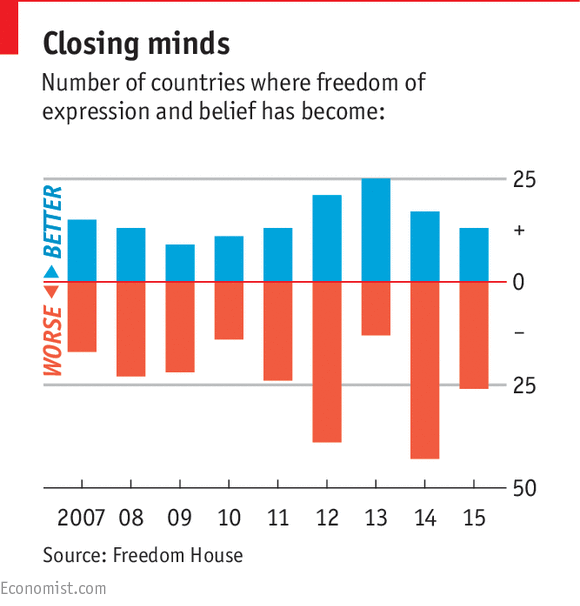
“These are the kinds of provisions we are constantly fighting in
countries where freedom of expression is not as open,” says Scott
Griffen of the International Press Institute. Autocratic regimes are
quick to borrow excuses from the West for cracking down on free speech.
China and Russia accuse dissidents of “promoting terrorism”,
“endangering national security” or “inciting ethnic hatred”. This can
mean simply expressing sympathy for Tibetans on social media—for which
Pu Zhiqiang, a Chinese lawyer, was locked up for 19 months. Rwanda’s
government, borrowing from European laws against Holocaust denial,
brands its opponents as apologists for the 1994 genocide and silences
them. Europeans may laugh at Thailand’s lèse-majesté laws—a Thai was
recently prosecuted for being sarcastic about the king’s dog. But when
13 European democracies also have laws against insulting the head of
state, it is hard to avoid charges of hypocrisy.
A determined regime can usually think of ways to muzzle a voice that
annoys it. Khadija Ismayilova, a journalist in Azerbaijan who revealed
scandalous details about the ruling family’s wealth, received photos in
the post in 2012 showing her having sex with her boyfriend. A secret
camera had been installed in her flat. A letter threatened to post the
video online if she did not stop investigating corruption. She refused,
and it was posted on a website purporting to belong to an opposition
party. When this did not silence Ms Ismayilova, she was charged with tax
evasion and driving a colleague to attempt suicide. No evidence
supported these charges, but she was sentenced to seven years in jail.
However, after an appeal to international law and a campaign to persuade
donors, such as America, to take notice, Ms Ismayilova was released on
May 25th. Even oppressive governments can sometimes be shamed into
behaving better.
