Peace for the World World ! Your War Our Lives

The Dalai Lama
A Brief Colonial History Of Ceylon(SriLanka)
Sri Lanka: One Island Two Nations
A Brief Colonial History Of Ceylon(SriLanka)
Sri Lanka: One Island Two Nations
(Full Story)
Back to 500BC.

Saturday, July 16, 2016
City of fear
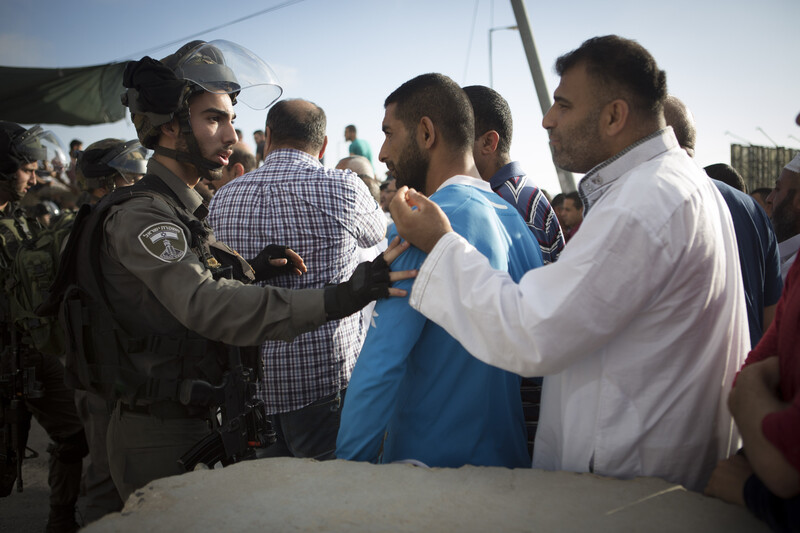
Israeli
border police push Palestinian men as they try to cross through the
Qalandiya checkpoint, between the cities of Jerusalem and Ramallah in
the occupied West Bank, on 11 July. ActiveStills
A few days ago, I was driving through Qalandiya checkpoint for the first time since I came back to Jerusalem.
My dad, sitting next to me, had to yell “stop here!” at me as I was queuing behind a car at the checkpoint.
“You’re too close,” he said, “stop and wait for them to call you, otherwise they’ll shoot you and not even care.”
When I left here to begin my life as a university student four years
ago, and despite my sense of general optimism, I never really believed
that I would come back to a better and more hopeful Jerusalem.
 Over
the four years, I would come back during the summer and end up leaving
again with a strong belief that things would only be worse the next time
I’d be home.
Over
the four years, I would come back during the summer and end up leaving
again with a strong belief that things would only be worse the next time
I’d be home.
Here I am now, four summers later, having earned my degree, and I
believe Jerusalem is worse than it has ever been for its non-Jewish
inhabitants, the Palestinians.
Despite this depressing assessment, I have been looking forward to come
back to Jerusalem as it is not only the city that I grew up in, but it
is the place where I want to embark on the journey of being a young
adult.
Fear everywhere
Two years ago, I wrote about the pervasive fear we Jerusalemites feel in our own city.
Today, sadly, this fear is even more intense and tangible. It is not just fanatics or nationalist mobs that
worry me, it is every armed Israeli – citizen, police and military –
who could end my or anyone else’s life in a second for no reason and
without anyone batting an eye.
Since last summer, the ugliness of life in Jerusalem has come to show.
This is in a city where Israel’s slow, steady but systematic discrimination is forcing Palestinian children out of schools and Palestinian families out of their homes.
In April, Maram Salih Hassan Abu Ismail, a 23-year-old mother of two small children, reportedly five months pregnant,
and her 16-year-old brother Ibrahim Salih Hassan Taha, were gunned down
by Israeli personnel at the same Qalandiya checkpoint, in the occupied
West Bank, north of Jerusalem.
Israel claimed the pair were killed during an attempted knife attack on soldiers, but eyewitnesses described an execution of two people who didn’t understand commands being shouted at them in Hebrew and presented no threat to anyone.
The private firm contracted by the Israelis to man the checkpoint carried out an “internal investigation” andabsolved itself of any wrongdoing.
The siblings were among more than 220 Palestinians, as well as more than
30 Israelis and two Americans, who have died since a new phase of
violence began last October.
And according to
Israel’s B’Tselem human rights group, Maram and Ismail were among
dozens of Palestinians killed when they posed no threat in slayings
“tantamount to executions.”
Driving while Palestinian
On the day I drove through Qalandiya, I recall my dad reminding me
repeatedly how I should be extra careful how I am perceived by Israelis
while on the road as anything they deem suspicious could have fatal
consequences.
It has become standard in recent months for Israelis to judge any
driving irregularities or accidents to be deliberate vehicular attacks,
prompting Israelis to attack the driver and ask questions later.
Last month, an Israeli driver plowed his car into a Tel Aviv restaurant, killing two people, before a mob pulled him from the car and beat him believing him to be a Palestinian attacker.
But the man had suffered a heart attack. He died, though it was unclear whether it was due to the beating or the heart attack.
Sometimes just driving around puts your life at risk. On Wednesday, three young men in al-Ram came under a hail of bullets from
Israeli forces raiding the village north of Jerusalem. One, Anwar
al-Salaymeh, 22, was killed. Another was critically injured and the
third detained.
An Israeli spokesperson told the Ma’an News Agency that the soldiers
“saw a speeding vehicle heading towards them” and opened fire.
An autopsy was ordered for al-Salaymeh, after it was discovered that he was shot in the back three times, challenging the Israeli narrative.
And during Ramadan, 15-year-old Mahmoud Badran was killed when
Israeli soldiers fired on the car he and friends were riding in on
their way home from a late-night pool party. In that case, Israel
admitted the car was “mistakenly hit.”
Merely walking around in Jerusalem’s Old City for the first time this summer was an uneasy experience.
Anything deemed provocative by the pervasive Israeli police could have
costly consequences. It is an environment of fear designed to make us
Jerusalemites feel uncomfortable and unwelcome in our own city.
First resort
The killing of Fadi Alloun last
October, and other instances of Israeli police shooting Palestinians as
mobs cheered them on, are memories we cannot shake and reminders of the
precarious nature of our continued existence in this place.
Newly revealed documents show that Israeli police have been authorized to use lethal force as a first resort against any Palestinian seen to throw stones or firecrackers.
For years, Israel claimed that lethal force was only a last resort –
even though in practice Israeli forces killed frequently, without
provocation and with total impunity.
But you would never see similar measures taken against Jewish stone
throwers or attackers who harass Palestinians regularly across the West
Bank. Instead, the attackers habitually enjoy army protection.
Every few days I wake up to news of
Palestinians being shot for acting “suspiciously” or allegedly
possessing a knife. In all these cases, Israel is judge, jury and,
often, executioner, with no credible justice system in place to independently investigate such claims or killings.
I still remember a few years back when a man in front of me at Qalandiya
checkpoint was kicked by soldiers, humiliated and reduced to tears as
he was denied passage through the checkpoint.
He had been carrying a bag full of cooking equipment and chefs knives
and he had multiple papers showing he was part of a culinary school in
Jerusalem.
Today, a person in a similar situation would have been killed and no one
would question it as the mere possession of a knife has become enough
of an excuse legitimizing the summary execution of Palestinians.
Still standing
An internal police report exposed by the Tel Aviv newspaper Haaretz this
week, revealed, to no surprise of any Jerusalemite, that Israeli Border
Police in Jerusalem “deliberately provoke Palestinians” in order to get
a violent response.
One such manufactured provocation in Issawiyeh, in January, led to a confrontation in which Israeli forces shot 12-year-old Ahmad Abu Hummus in the head, causing severe brain damage.
Social media is never lacking in daily videos documenting the regular
harassment, searches and humiliation of Palestinian youths in Jerusalem
that lead to similar violence.
It is weird living in Jerusalem right now, especially knowing that this
situation only strengthens my determination to stay here, live here and
fight for this city.
I know too that if I wanted to write about all the forms of abuse
against Palestinians in Jerusalem, I would be writing endlessly for
days.
It is a situation where the power and might of the whole Israeli state
is determined to alienate Palestinian Jerusalemites. However, this
cruelty and injustice only breeds further resistance and defiance.
They may deem our lives worthless, our dignity of no value, our
existence an inconvenience, but I believe Jerusalem continues to stand
tall and defy the oppression no matter how dark the times have become.
