Peace for the World World ! Your War Our Lives

The Dalai Lama
A Brief Colonial History Of Ceylon(SriLanka)
Sri Lanka: One Island Two Nations
A Brief Colonial History Of Ceylon(SriLanka)
Sri Lanka: One Island Two Nations
(Full Story)
Back to 500BC.

Monday, August 1, 2016
Brecht within a Tamil Chalk Circle
 2016-07-30

2016-07-30
My first introduction to Bertolt Brecht was through the Sinhala
adaptation of his play “Caucasian Chalk Circle” by renowned, respected
and award winning Sinhala playwright and producer, late Henry Jayasena.
That was way back in 1970. I was once again invited to sit in the
audience to watch the same play when “Janakaraliya” a very versatile,
multi-ethnic, multi-cultural young group of performing artistes led by
reputed, award winning creative artiste Parakrama Niriella, reproduced
“Caucasian Chalk Circle” in Sinhala. That was late December, in 2013
before they left for the international drama festival in Kerala. This
novel Sinhala version by Janakaraliya was based on Jayasena’s
translation of the “Caucasian Chalk Circle”, but given a bit more
political flavour.
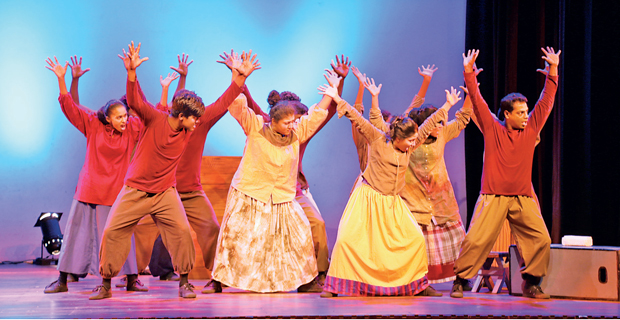
On 22 July, the Janakaraliya mobile theatre ensemble performed its new
version of the “Caucasian Chalk Circle” at the Veerasingham Hall, Jaffna
to an exclusively Tamil audience. This time it was a Tamil adaptation
of Brecht’s play titled “Venkatti Vattam” co-directed by Niriella and K.
Rathidaran.
This was the first Sri Lankan Tamil adaptation of Brecht’s “Caucasian
Chalk Circle”. It was performed for the second time at the Visual and
Performing Arts University in Colombo, on 25 July evening. It was a
mixed audience. It was very much wonderfully youthful. It was also
attended by the Colombo Tamil middle class. After two hours and 25
minutes of pin-drop silence in the audience, there broke out a loud and
rhythmic clapping with the lights coming on.
Then came cheerful whistling and applause. Louder with every member of
the caste coming on stage to greet the audience. It was an aura of
delight and pleasure all around and I have not seen such exuberance in a
theatre audience for many decades.
What prompted such spontaneous applause, is what I am trying to understand here, in my own way.
The tree productions, spanning a period of 46 years certainly have their contextual differences in understanding an “armed conflict”, a war.
The tree productions, spanning a period of 46 years certainly have their contextual differences in understanding an “armed conflict”, a war.
In 1967 when Henry Jayasena set his hands on Brecht’s “Caucasian Chalk
Circle”, none in then “Ceylon” had any idea of what an armed conflict is
and how life in such armed conflict would be. None had experienced
“anarchy” where the State goes under new authority that cannot command
total power over every part of the land. Where the rulers, legitimate or
not, cannot enforce law and order.
Ceylon was merely getting dragged with day to day issues; cost of living
and unemployment, the biggest issues. Politically, the only conflict
was in how the Tamil people could be allowed to share power as equal
citizens and that was not what the majority of the people were grieving
about.
This left Brecht’s Caucasian Chalk Circle as pure fiction, Jayasena could retell on stage as an entertaining folklore. The language thus used was very soft and literary, very musical and nuanced to keep the audience “entertained”. The audience was not taken through travails of a society that demanded justice outside a corrupt and thieving Governor in “Grusinia” appointed by the Persians.
This left Brecht’s Caucasian Chalk Circle as pure fiction, Jayasena could retell on stage as an entertaining folklore. The language thus used was very soft and literary, very musical and nuanced to keep the audience “entertained”. The audience was not taken through travails of a society that demanded justice outside a corrupt and thieving Governor in “Grusinia” appointed by the Persians.
That wasn’t Jayasena’s dramatic intention. His whole adaptation of
Caucasian Chalk Circle, as with his own interpretation of the Sinhala
folk story “Kuveni” in 1963 that brought her to a modern Court of
Justice, revolved around the issue of social justice to the child
(Prince Michael) and the “rightful” mother (Grusha). The disputed
ownership of the child in a “chalk circle” and the maverick Azdak as a
“people’s judge” was what Jayasena loved most to be dramatisedon stage.
It wasn’t therefore what Bertolt Brecht had written as Caucasian Chalk
Circle. It did not carry that human tragedy under a usurping ruler
against whom the people revolted.
After over 400 stage performances of the original Sinhala adaptation,
when Niriella re-produced Jayasena’s Chalk Circle, Niriella had lived
through the ‘71 and 1988 – 90 JVP insurgencies and the brutal ethnic war
that drastically changed Sinhala perceptions on human rights,
democracy, civil liberties and in turn brutalised human decency and
social life.
He was thus prompted to stitch those experiences into Jayasena’s script
of Chalk Circle, he wasn’t going to change. Therefore, Niriella’s
version of the Sinhala Chalk Circle had its war effects, the heavily
brutalised life in anarchy, mostly brought out with stage effects and in
few changes to dialogue. On stage it was more heavy and robust than
Jayasena’s. It was also loud and harsh in language with music that added
weight to what unfolded on stage.
Yet, it wasn’t near enough to Brecht’s version of the Caucasian Chalk
Circle. Obviously, Niriella like those sensitive minds in Sinhala South,
was only a serious observer of what unfolded as war and the brutalising
of society as seen from the South of the barricade and not one who
actually lived through pain of war. Therein lies the difference in this
Tamil version that comes after the savage conclusion of the war on the
banks of Mullivaikkal in 2009 May after over 26 years of armed conflict.
This Tamil translation of Brecht’s Caucasian Chalk Circle is by Jaffna
based veteran Tamil dramatist M. Shanmugalingam. I came to know
Shanmugalingam more popularly known as “Kuzhanthai” through translation
of three of his plays into English by poet Sopa Pathmanathan.
Dramatist Shanmugalingam, I found had the knack to read through ordinary
life in conflict, as captured in his play, “Enthayum Thayum” written
after the Vadamaraachchi attack and its displacements. In fact, Jaffna
lived through armed conflict for more than 26 years with the first
political murder of its Mayor Duraiyappa in July 1975. For
Shanmugalingam therefore, reading the original version of Brecht’s
Caucasian Chalk Circle would have been as agonising and revealing as
reading the events of the last few years of the Vanni war. He thus stood
more sensitive than any Sinhala playwright to handle the translation of
Brecht’s Chalk Circle and he proves it in every line that comes on
stage.
With my very little understanding of spoken Tamil, what stood out strong
for me was the political reading that the Tamil production brings out
on stage. Unlike the two Sinhala stage versions, this Tamil version is
“conflict” driven. It gives the audience the bitterness of human tragedy
in a conflict.
The displacement of human life and the utter desperate haste to find refuge and safety. Scarcity of human decency, in terms of economic life, rule of law and failing morals.
The displacement of human life and the utter desperate haste to find refuge and safety. Scarcity of human decency, in terms of economic life, rule of law and failing morals.
The uncertainty in life the absence of authority in society allows to
rule the day. And then human bondage that struggles to find respect with
people, who dream of a peaceful future.
All of it in this Tamil version, was what any Sri Lankan Tamil could
feel and be emotionally moved, having lived through a bloody and brutal
war.
With Shanmugalingam’s very honest translation of Brecht’s Chalk Circle,
this production co-directed by Niriella and Rathidaran, has thus done
more justice to Brecht than what the two previous Sinhala productions
could do.
The added strength of this production was the hard and powerful
portrayal of characters like Azdak, Grusha, Simon Chachava and the lead
singer to whom everyone else on and off stage add their worth.
All that said and done, what I missed in this Tamil production too is the political link that Bertolt Brecht makes with clear rationality between “ownership” and “right to ownership”. The link he forges on “right” to ownership and actual “possession”.
All that said and done, what I missed in this Tamil production too is the political link that Bertolt Brecht makes with clear rationality between “ownership” and “right to ownership”. The link he forges on “right” to ownership and actual “possession”.
This issue is raised by Brecht in introducing the play on stage and in
concluding the play on stage. Yet in all three productions, two earlier
Sinhala and this Tamil production, what comes out is the right to
possession as articulated through the child and not through land. In
fact, my reading of Brecht’s Chalk Circle tells me, his Chalk Circle and
the child within it is so formulated to establish the fact that land
belongs to the ancestral people, who cared for the land, the issue he
presents to begin his play.
I would thus conclude this short essay by quoting direct from the old English translation of Bertolt Brecht’s script (1944) that argues the case for rightful possession of land.
I would thus conclude this short essay by quoting direct from the old English translation of Bertolt Brecht’s script (1944) that argues the case for rightful possession of land.
This dialogue in Scene I, is set in a war torn Caucasian village.
Members of two “Kolkhoz”, collective farms from two valleys keep arguing
about who should own the land and what should be farmed there.
An “Expert” from the State reconstruction commission from the “capital” moderates the discussion, using his authority as an official from the ruling regime.
An “Expert” from the State reconstruction commission from the “capital” moderates the discussion, using his authority as an official from the ruling regime.
The old peasant seated on the right – “It is not perfect. It’s barely
middling. The new pasture is no good, whatever the young folks may say. I
say we can’t live there. It doesn’t even smell like morning, in the
morning.”
The Expert – “Let them laugh. They know what you mean. Comrades, why
does a man love his home country? Because the bread tastes better, the
sky is higher, the air is spicier, voices ring out more clearly, the
ground is softer to walk on. Am I right?”
The old peasant seated on the right – “The valley has always belonged to us”.
It’s on that same logic that Azdak decides possession of Prince Michael.
He had belonged to Grusha right through the hardest period of life and
Grusha is who cared for him with affection.
This connection, this political argument still goes missing even in
“Venkatti Vattam” If my little Tamil allowed me enough understanding of
the play that the Janakaraliya team, Niriella, Shanmugalingam and
Rathidaran teams up to bring on stage. A play even non-Tamils should sit
through watching.
Easily, an evening of rich entertainment.
Easily, an evening of rich entertainment.
