Peace for the World World ! Your War Our Lives

The Dalai Lama
A Brief Colonial History Of Ceylon(SriLanka)
Sri Lanka: One Island Two Nations
A Brief Colonial History Of Ceylon(SriLanka)
Sri Lanka: One Island Two Nations
(Full Story)
Back to 500BC.

Tuesday, August 23, 2016
'I am sorry': Islamist apologises for destroying Timbuktu mausoleums
Ahmad al-Mahdi faces up to 11 years in jail after becoming first international criminal court defendant to enter a guilty plea
Ruth Maclean West Africa correspondent-Monday 22 August 2016
 The first defendant to plead guilty at the international criminal court has apologised to Mali and to mankind for destroying religious monuments in the ancient city of Timbuktu.
The first defendant to plead guilty at the international criminal court has apologised to Mali and to mankind for destroying religious monuments in the ancient city of Timbuktu.
Ahmad al-Mahdi admitted directing the destruction of nine mausoleums and
a mosque door in 2012, when Timbuktu was controlled by rebels and
members of al-Qaida in the Islamic Maghreb.
At the opening of his trial for war crimes in The Hague, he expressed
his “deep regret” to the people of Timbuktu, to whom the monuments had
been of great religious and cultural importance.
“I seek their forgiveness and I ask them to look at me as a son who has
lost his way,” he said. “Those who forgive me will be rewarded by the
almighty. I would like to make them a solemn promise that this was the
first and the last wrongful act I will ever commit.”
Wearing a grey suit, blue shirt and tie and glasses, his long curly hair
slicked back, Mahdi said he drew on Islamic teachings to enter his
guilty plea. “We need to speak justice even to ourselves. We have to be
truthful, even if it burns our own hands,” he said.
“All the charges brought against me are accurate and correct. I am
really sorry, and I regret all the damage that my actions have caused.”
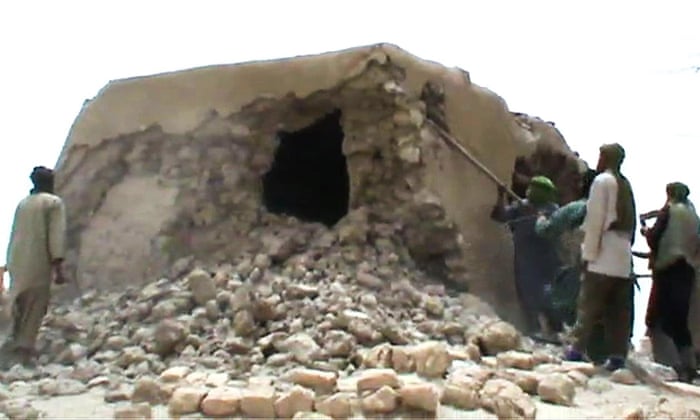
A
screengrab of video footage showing militants destroying one of the
mausoleums in Timbuktu in 2012. Photograph: AFP/Getty Images
Timbuktu, which was once a city of great learning on par with Florence
during the Italian renaissance, was overrun in 2012 by rebels backed by
al-Qaida and carrying Libyan weapons. They imposed sharia law, banned
music and whipped people who did not adhere to their code.
Mahdi was recruited to head the notorious vice squad, which destroyed
structures that looked like simple mud huts but were tombs that were the
“embodiment of Malian history captured in tangible form from an era
long gone,” said Fatou Bensouda, thecourt’s chief prosecutor.
Mahdi, 40, a former civil servant from the Timbuktu area, directed the
destruction of shrines to some of the 333 saints that the city is known
for. In some cases he wielded the pickaxe himself.
“He was fully aware of the importance of the mausoleums, and he showed
determination and focus in his supervision of operations,” Bensouda
said.
Videos shown in court revealed men pushing, kicking and hacking at the
mud and stone walls of the tombs, reducing them to piles of rubble. One
of the piles was topped by a twisted wooden bedstead that had been
inside the tomb.
Another of the monuments Mahdi admitted to destroying was a mosque door
that had not been opened for hundreds of years and which people believed
would stay closed until the end of the world.
His Kalashnikov slung over his shoulder, wearing a white turban and
robe, Mahdi and his fellow extremists ripped down the wooden door,
revealing the bricks behind.
“We’re in charge of fighting superstitions, and that’s why we have
decided to pull down this door,” Mahdi said in a 2012 video that was
shown to the court. “We must eliminate from the landscape everything
that doesn’t belong,” he said in another.
Advertisement
Despite repeatedly justifying his actions on video, Mahdi told the court
that he had been acting under the “evil wave” of the extremists of
al-Qaida and Ansar Dine. “I hope the years I will spend in prison will
enable me to purge the evil spirits that overtook me,” he said.
Mahdi said he would accept the will of the court “with pain and with a
broken heart”, but said he was “pinning my hope on the fact that the
punishment meted out to me will be sufficient for the people of Timbuktu
and Mali to offer forgiveness, for mankind to offer forgiveness.”
Mahdi is the first person to be tried by the ICC for destroying cultural
heritage, something its chief prosecutor said was increasingly under
threat from extremist groups, including Isis.
“Our cultural heritage is not a luxury good – we must protect it from
desecration and ravages,” Bensouda told the court. “This must be stopped
in its tracks. History will not be generous to our failure to care.”
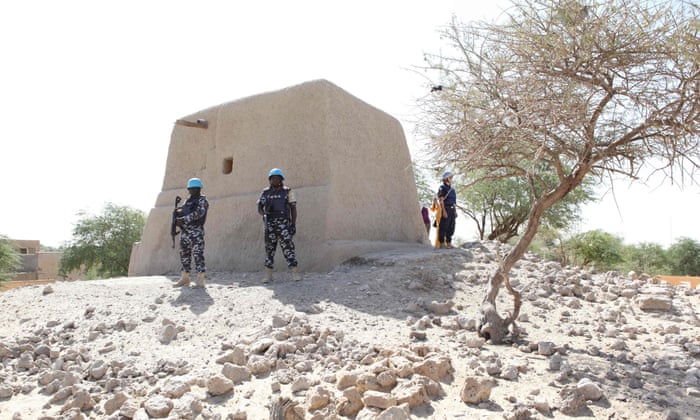
UN peacekeepers guard the mausoleum of Alpha Moya in Timbuktu. Photograph: Sebastien Rieussec/AFP/Getty Images
UN peacekeepers guard the mausoleum of Alpha Moya in Timbuktu. Photograph: Sebastien Rieussec/AFP/Getty Images
Some experts believe the trial could set a precedent for other countries
to prosecute crimes of the destruction of cultural heritage in Syria
and Iraq, where the ICC does not have jurisdiction.
The maximum sentence for such a crime is 30 years in jail, but Mahdi has
struck an agreement with the prosecutor’s office for a sentence of nine
to 11 years.
In court, Mahdi did not renounce his formerly held belief, based on
Islamic teachings, that tombs should not be higher than one inch above
ground.
“As soon as you have the opportunity, you will do the same thing again,” one of the lawyers for the prosecution challenged him.
“I acted because I believed one is not allowed to build upon tombs,”
Mahdi replied, adding: “But from a legal and political viewpoint, one
should not cause damage that is more severe than the usefulness of the
action.”
The ICC has come in for criticism for pursuing a “trial of stones and
earth”, when there has been no trial for the many people who have
suffered in Mali.
“While this case breaks new ground for the ICC, we must not lose sight
of the need to ensure accountability for other crimes under
international law, including murder, rape and torture of civilians that
have been committed in Mali since 2012,” said Erica Bussey, of Amnesty
International.
However, Bensouda said the trial would support reconciliation in the
“ancient and vibrant city” and serve as a deterrent. “It brings truth
and catharsis. It is crucial for Timbuktu’s victims,” she said.
