Peace for the World World ! Your War Our Lives

The Dalai Lama
A Brief Colonial History Of Ceylon(SriLanka)
Sri Lanka: One Island Two Nations
A Brief Colonial History Of Ceylon(SriLanka)
Sri Lanka: One Island Two Nations
(Full Story)
Back to 500BC.

Wednesday, August 24, 2016
Mixed feelings one year on

Featured image courtesy Thuppahi
 RAISA WICKREMATUNGE on 08/22/2016
One year ago, on August 18, a new Parliament was elected on an ambitious
premise of good governance. The public voted for change, and for an
ambitious overhaul of the status quo.
A year later, the public has mixed feelings about whether this new unity
Government has succeeded. A Twitter poll taken by over 90 people
showed that most felt there was only a slight improvement compared to
previous years.
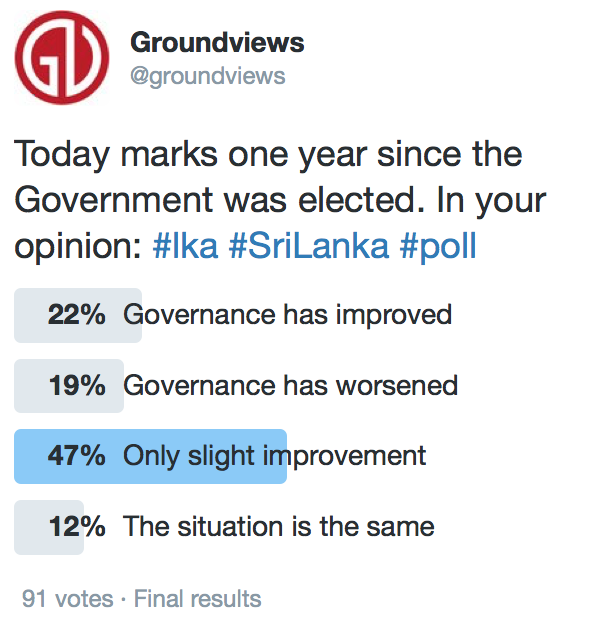
The poll is, of course, by no means indicative of national opinion, but is an interesting insight into what Groundviews’ readership
feels about this Government’s performance. The poll shows that only 22%
saw an improvement, and 19% felt the situation had worsened.
For context, Groundviews also spoke to members of civic society
on their views about the current Government, in the context of their
respective fields of work.
“While there was public expectation there would be a revolution, there
has been more of a reconfiguration [of governance]. The achievements of
this Government have had mixed results. We’ve seen a lot of legislative
activity, but questions and doubts hanging over implementation,” said
barrister and Executive Director of Transparency International, Asoka Obeysekara. “While bridging the gap can’t be done overnight, not enough is being done to change the public mindset.”
“Public consent for legislation is needed as well, so that the public can feel invested in it,” he continued.
However, the signing of the Open Government Partnership in November
showed a willingness to continue commitments similar to the pledges made
during the Presidential election. The passage of the RTI Act too was
positive, but a firm and committed civil society to ensure that the
Government stuck to its promises was crucial at this juncture, he added.
Senior Lecturer at the Department of Philosophy & Psychology, at University of Peradeniya and former Minister of Mass Media and Information, Charitha Herath said
the current Government was better in terms of policy-making (through
the passage of the 19th amendment and the RTI Act) but also concurred
that implementation was weak and not result-oriented. As a result of
this, people’s quality of life and purchasing power was affected. “The
previous government over-reached in terms of their role in the social
space. However this Government overestimates the role of the market, in a
country like Sri Lanka in my view,” Professor Herath said. Certain
essential services such as transportation, education, healthcare,
environment and security should fall more under the purview of the
state. There was a lack of clarity where the market should enhance their
capacities as opposed to the state, and vice versa.
Science writer and development communication consultant Nalaka Gunawardene said
that following the ‘decade of darkness’ of the Rajapakse regime, the
benchmark had been set so low that the current government should not be
measured by the same standards. “We must look at what was pledged and
the practise. Perhaps it’s too soon to judge too harshly, but the first
year sets the tone and should give us a sense of direction. It’s been
very confusing, because this is a many-headed government,” Gunawardena
said. While there were many promising steps made in reconciliation
accountability, economic reforms were being announced but not pursued in
an organised and systematic way. “This is putting political reform at
stake,” he said.
Further, where the government was succeeding, they were not effectively
communicating this to voters. The Government should be in charge of the
narrative and tell its own good stories, rather than being reactive to
the Rajapakse loyalists. “The Government needs to get its act together,
far better than it has in its first year,” Gunawardena added.
Senior journalist and regional gender coordinator for IFJ Dilrukshi Handunnetti said that from a media perspective, Sri Lanka has made some progress, one year later.
“First, and perhaps the most important is the change in the atmosphere.
For years, dissenting journalists had to fear for their safety and some
have paid with their lives. The political culture that can take
significant criticism and does not feel the necessity use the state
machinery to silence journalists is perhaps the biggest achievement
recorded by this government,” Handunnetti said.
Along with this there has also been some systemic change, albeit not
entirely successful, within state run media institutions. Nevertheless,
the space has been created for better journalism within these
institutions, she added.
The introduction of the Right to Information Law was a significant step,
particularly since the previous dispensation was not even inclined to
discuss the positive attributes of such a law.
However, many challenges remain, she added.
“The sense of normalcy journalists experience is incomplete, if it is
not shared by all. There cannot be surveillance of journalists in the
North, a continuing practice – though reduced, according to journalists
there. Also, there can never be a normal media landscape unless impunity
ends. For this, the State must demonstrate sincerity by expediting the
investigations on the murder, assault and abductors of journalists,
charge those responsible and bring closure. So far, investigations have
not been concluded and journalists, much like the war-affected
civilians, await justice and reparation,” Handunnetti said.
The liberalisation of the state media should be completed through the
promised process of converting state-run media houses to public service
media institutions, as in many other countries. Otherwise, these
institutions would remain in government control and could be used as
political tools during election time.
Media reforms, including legal reform, will be incomplete unless
implementing mechanisms are transparent and accountable. The
implementation of RTI will be undoubtedly challenging given Sri Lanka’s
culture of secrecy that dislikes proactive disclosure and conflicting
laws such as the Official Secrets Act. As such, the entire body of
legislation needs amendments for RTI to become a practical reality,
Handunnetti said.
Human rights activist Ruki Fernando said
the appointments to the National Human Rights Commission based on the
19th amendment, as well as that of the constitutional council, were
positive steps as they had asserted their independence and taken
definite policy positions in the field of human rights. “However the
institution as a whole has a long way to go. They are state-centric and
unresponsive, even incompetent. So while the Commissioner is independent
the institution itself has not moved forward so much,” Fernando said.
The passage of the RTI Act was also positive, but there was minimal
progress on transitional justice. The passage of the OMP Act was a
significant milestone, but there were certain questions raised on the
process behind it, leading to a lack of confidence. “The President and
the Prime Minister have not been strong advocates of transitional
justice, particularly among the Sinhalese.” As such, Fernando said the
process was driven by international pressure, indicative of the fact
that only Foreign Minister Mangala Samaraweera was a strong advocate of
the process. “There has not been much outreach done locally.”
Violations too continued to occur. Human rights defender Jeya Kumari had
been summoned yet again for questioning by the TID, while another human
rights activist in the North had recently been threatened by a
provincial UNP politician, not to get involved in issues pertaining to
land. A culture of military surveillance and intimidation still
persists, including the military acquisition of land, with the military
still intruding on civilian activity despite recent assurances from
Minister Samaraweera that the country would be demilitarised by 2017.
“There is a lot of progress that still needs to be made in terms of
human rights,” Fernando said.
For a more detailed look at the shifting perspectives on human rights over a year, a report was just released by INFORM Human Rights Documentation centre.
Freelance consultant Sharanya Sekaram spoke
about youth issues, in the context of being appointed a Youth
Parliamentarian in 2016, from the Minister’s List (i.e. directly
appointed by the Prime Minister.)
“One key difference is that the Youth Ministry is no longer a separate
entity, but falls under the purview of the Economic Development
Ministry, under the Prime Minister. I saw this as positive, as it showed
a direct commitment by the Prime Minister to the critical importance of
engaging the youth,” Sekaram said.
This was a positive difference compared to previous years, she added,
having engaged with former Youth Parliaments in the past. The 2016 Youth
Parliament had also been representative, with quotas for student
prefects, and university students in addition to the Minister’s list.
The Youth Federation Club had ensured representation from the district
to the national level as well.
However, Sekaram said that there were some missteps. As a prerequisite,
members had to attend 3 day programmes which could have been better
planned out and condensed. The members were put into different
committees to debate various issues, with no consideration for past
expertise. In practise, the Youth Parliament also ended up being almost a
replica of the real thing, with Parliamentarians more interested in
grandstanding, as opposed to applying their own belief systems. Most of
the young Parliamentarians had never held jobs, but were attempting to
make a career out of politics.
The result of this was young people who had perhaps worked on the
private staff of Ministries but had otherwise never worked full-time
engaging on issues like education, employment and urban development.
Women were also underrepresented – though less so than in Parliament.
However men still took the primary position, with women mostly not
speaking up on issues.
“I didn’t see an effort to address the root causes of the problems in
Parliament – why some politicians play to the gallery but don’t adhere
to personal belief systems, why the public does not hold
Parliamentarians who do so accountable. While the programme is a
fantastic opportunity to see what young leadership in Sri Lanka looks
like, it could be better structured to address these issues.” Sekaram
said. In this sense, the current government had a lot to do before
ensuring that youth were properly and effectively engaged in
Parliamentary process, going by the youth Parliament model.
From an economic perspective, Sri Lanka is yet to see a comprehensive
development strategy from the Government, one year on, Chief economist
from the Ceylon Chamber of Commerce,Anushka Wijesinha said.
“We have a statement by the PM last November, and we hear that a more
fleshed out plan will be revealed by him later this month or next. That
is important to articulate clearly to domestic and foreign stakeholders
alike on what the government’s plans are, and bring in some consistency
and stability,” he added.
There were positives – that Sri Lanka has reset foreign relations with
strategically important countries over the past year. “This is probably
the biggest win, in terms of government performance and its impact on
business. Trade and investment is intrisincally linked to foreign policy
and so good foreign relations helps advance trade and investment
relations too,” Wijesinha said. The IMF package too helped give the
government some breathing space needed for reform.
However, these gains were marred by policy uncertainty, particularly
with regards to tax. Changes in taxes like VAT while announced haven’t
gone through, while there was no roadmap for implementation for capital
gains taxes. Foreign Direct Investment has not increased as expected,
though there is considerable interest, as evidenced from visits from
delegations from Norway, Chile, Mexico and Bahrain to name a few.
“Converting that to results is now key,” Wijesinha said. The economy is
also beginning to move away from the heavy dependency on public to
private investment, which is a positive step, as is a much more open
space for debate and even dissent on economic policy issues. “Whether
[the discussion] is around the CBSL Governor or on tax policies…this is a
very good thing. A contestation of ideas is needed to to come with a
better path for the Sri Lankan economy.” Wijesinha said.
Yet despite the positive steps, many corporate executives were critical
of progress made by the Government, a recent survey conducted by the Economist Intelligence Unit of the Ceylon Chamber of Commerce found.
In fact, 49% of those surveyed gave the government a 2 out of 5 in
terms of how successful their action has been on policy – though 41%
also said they were optimistic the Government would deliver on its
economic promise in around 4 years.
Interfaith issues has recently been in the news, particularly with the recent disruption of a peaceful vigil on equality. With this in mind, Groundviews spoke to visiting Fellow at the Institute of Advanced Islamic studies, Malaysia Amjad Mohamed-Saleem,
who said “We have an opening up of the space for interfaith dialogue.
It is welcoming that the President has appointed a new committee. ”
However, Saleem noted that the re-emergence of groups such as Bodu Bala
Sena and Sinha Le in the public consciousness, as evidenced by the
disruption of the Different Yet Equal vigil, highlighted deep-seated
issues that needed to be addressed. “More work needs to be done at the
grassroots [to address these issues]” Saleem said.
Senior Researcher with the Consultation Task Force on Reconciliation Mechanisms Chulani Kodikara said
that from the perspective of women’s political participation, there has
certainly been an improvement compared to the Rajapakse regime. “Many
of us felt the Rajapakse era was regressive in terms of women’s rights –
for 10 years there was a space emphasising family values over women’s
autonomy.”
In this sense, Kodikara said she thought this government had made
improvements over the past year, but the full extent was yet to be seen,
given ongoing processes of constitutional reform and transitional
justice. She added that at times, the Government showed a propensity to
carry out such reform without adequately listening to society and
women’s rights activists for real needs.
While the Local Government Authority Act of 2011 had given token
attention to women’s participation in government, the new Government’s
commitment to a 25% quota was an improvement. However there were some
weaknesses, Kodikara pointed out. “Although the proposal does increase
the number of seats awarded to women, it doesn’t challenge the
incumbents.” Kodikara said. Rather, the current system empowered the
party to select women candidates. “These women can’t go to the
electorate and seek votes.
This bypasses the electoral system.” While the new system would allow
for more than 2000 women in local government, (compared to around 100
earlier) there was no explanation as to allocation of resources.
A huge challenge was that under the proportional representation system,
women had to compete at the Pradeshiya Sabha level, with men who often
had much more access to resources. Being responsible to represent the
whole Pradeshiya Sabha rather than the smaller wards was also an
additional burden. “So the quota proposed is problematic, and we can’t
be fully happy with it. For other issues, we will have to see until
after the constitutional reform process to see whether they will be
recognised.”
An uphill battle to be fought was the argument of “quality vs quantity.”
“We always argue that these are two different issues – that women
should have the right to be represented, irrespective of what they bring
to the table.” Following on from this there was also a need to build
women’s leadership skills moving forward, Kodikara said.
Dr Sepali Kottegoda, Executive Director of Women and Media Collective said
the new Government’s promise of good governance offered a new platform
and a different political context for women to advocate for gender
equality. “The 25% nomination quota for women is a very positive step,
and something we have been advocating for 20 years,” she said – even if
it was only for nominations. “Sri Lanka doesn’t offer a social,
political and economical environment to get voted in, just because our
social development indicators are better than many in the South Asian
region.” While it was positive that one woman had been appointed to the
National Police Commission, the WMC wanted to see 30% representation of
women in decision making bodies related to governance overall, she
added.
Another positive step was the constitutional reform process, where the
Government had attempted to be inclusive. “Women were given the space to
voice issues, and many seized the opportunity in all districts, whether
the North and East or the South. Citizens were told we can speak on any
issue, even without expertise, which has never been the case before. We
have never been invited to participate in such a process,” Kottegoda
said. The WMC were till looking at how the law could be more gender
responsive, and were looking at making submissions to the Fundamental
Rights and the Law and order Committees.
The question now was to see whether the Government would take up the
submissions made. Over the past year, the number of reported gang rapes,
sexual and physical abuse appeared to have gone down, which either
meant the media was not reporting on such cases, or the number of
incidents had reduced, in relative terms, she added.
However, delays in the legal system with pursuing cases of violence
against women, sex workers, and transgender people continued to persist,
as the Attorney General’s department said they were overburdened.
“People are languishing in jail, others are languishing waiting for
justice. These cases are in limbo. The Attorney General’s department
should find a solution to this,” Kottegoda said.
Reflecting the results of our Twitter poll, it’s clear that civil
society feels that while there are some positives, there is a lot that
needs to be addressed in order for the currently elected Government to
live up to its promise of good governance. These issues, while
multi-faceted and difficult to address, are nevertheless vital to be
tackled in the coming year, and beyond. Not doing so will lead to an
increasingly disillusioned populace, which could unravel the positive
steps that have been made, particularly dangerous as Sri Lanka is only
now taking the first tentative steps towards its own transitional
justice process.
