Peace for the World World ! Your War Our Lives

The Dalai Lama
A Brief Colonial History Of Ceylon(SriLanka)
Sri Lanka: One Island Two Nations
A Brief Colonial History Of Ceylon(SriLanka)
Sri Lanka: One Island Two Nations
(Full Story)
Back to 500BC.

Friday, August 19, 2016
Rights groups appeal sham probe into teen’s slaying
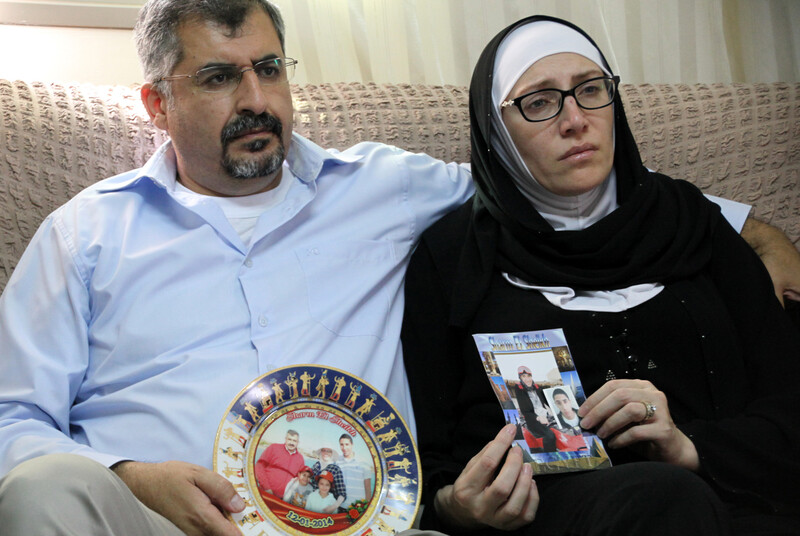
The parents of Mustafa Khatib in their Jerusalem home one day after their son was slain by Israeli forces, 13 October 2015.APA images
Maureen Clare Murphy-18 August 2016
 Palestinian rights groups are appealing an Israeli justice ministry decision to close an investigation into the shooting and killing of Mustafa Khatib, 17, in Jerusalem’s Old City last year.
Israeli media reported at the time of
the 12 October incident that Khatib was shot when he pulled out a knife
and stabbed a paramilitary Border Police combatant who had asked him to
take his hands out of his pockets.
No police were reported injured during the incident.
The Palestinian rights groups, Adalah and Addameer, say that not only
was the justice ministry’s investigation incomplete, “it is not clear
from the investigative materials if the officer involved was, in fact,
even stabbed.”
A number of serious flaws of the probe into the killing “convincingly
suggest” that it “was conducted strictly for the sake of appearances,”
Adalah stated.
Security camera footage shows police shooting Khatib in the back as he runs away from them:
Israeli forces prevented anyone from reaching the scene and no medical assistance was offered to Khatib. Israelheld the youth’s body for three months before transferring his remains to his family for burial.
An autopsy initiated by the Khatib family’s lawyers – the police
objected to an examination of the teen’s body – found that “the shots
that killed Khatib were aimed at his upper body,” as the Tel Aviv
newspaper Haaretzreported.
Extrajudicial executions
The slaying of Khatib came as Israeli politicians called for the execution of suspected Palestinian attackersfollowing a wave of violence that began in late September last year.
Since that time, dozens of Palestinians, many of them children, have been shot dead during attacks and alleged attacks. Video footage of
many of the incidents shows that lethal force was used against
Palestinians when they posed no immediate, life-threatening danger.
In many instances, no Israelis were reported injured during attacks in which the alleged Palestinian assailant was shot dead.
Human rights groups have condemned Israel’s
use of deadly force as a matter of first resort in such incidents,
saying it amounts to an unofficial shoot-to-kill policy encouraged by Israel’s top leadership.
Earlier this year, Patrick Leahy, head of the US Senate Appropriations Subcommittee on Defense, urged the State Department to
investigate alleged extrajudicial executions of Palestinians by Israeli
forces and other “possible gross violations of human rights … that may
have involved recipients, or potential recipients, of US military
assistance.”
“Systemic flaw”
The Israeli justice ministry’s police investigation unit, known as
Mahash, claimed that in the case of Mustafa Khatib, “no factual
foundation was established suggesting a criminal offense on the part of
any of the officers during the incident.”
The rights groups Adalah and Addameer point to a number of failures in
the investigation, saying that it was incomplete, relied exclusively on
materials provided by police and included no eyewitness statements,
indicating “a basic systemic flaw in Mahash’s operations; the police
have a clear conflict of interest and cannot be the body that
investigates its own personnel (officers involved in the incident).”
The Border Police combatants involved were not questioned by
investigators, who were given a report written by police after the event
– though the only report in the file sent to the Khatib family’s
lawyers “did not even concern the incident in which Khatib was killed,” Haaretz reported. “It was about an incident that occurred two days earlier.”
Moreover, Adalah and Addameer state, Khatib’s lawyers were provided no
photographs of the knife which was allegedly used by Khatib against
police, and photographs taken by police at the scene were not requested
by Mahash.
“These circumstances, including the video [of the incident] reveal that
the shooting of the deceased was unjustified – certainly in the manner
it was carried out,” one of the rights groups states in the appeal.
“There exists a suspicion that the shooting was carried out in violation
of police open-fire regulations and therefore constitutes a violation
of the law. This suspicion obligates Mahash to conduct a serious and
independent investigation, and not rely solely upon partial
investigatory materials collected by police in the aftermath of the
incident,” the group adds.
Impunity
The failure to investigate Khatib’s killing is hardly an anomaly.
“In the past 10 months, a number of requests have been submitted to the
justice ministry about examining the rules concerning the shooting of
assailants,” according to Haaretz. “But in all but one incident, the cases have been closed without the unit investigating and questioning the officers.”
The level of impunity afforded to Israel’s Border Police is the same as that enjoyed by its military.
Earlier this year, the Israeli rights group B’Tselem said that it would no longer cooperate with the army’s investigations into human rights violations in the West Bank and Gaza Strip.
“We will no longer aid a system that whitewashes investigations and
serves as a fig leaf for the occupation,” the group’s director, Hagai
El-Ad, stated.
Since late 2000, of the 739 cases raised by B’Tselem in which
Palestinians were killed, injured or subjected to other abuses, only 25
led to charges against soldiers.
