Peace for the World World ! Your War Our Lives

The Dalai Lama
A Brief Colonial History Of Ceylon(SriLanka)
Sri Lanka: One Island Two Nations
A Brief Colonial History Of Ceylon(SriLanka)
Sri Lanka: One Island Two Nations
(Full Story)
Back to 500BC.

Thursday, August 25, 2016
SAMPANTHAN TELLS GOVT TO WALK THE TALK RE PTA AND POLITICAL PRISONERS
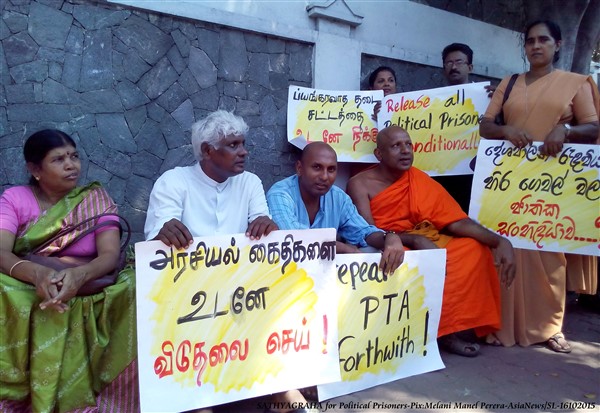
 25/08/2016
“Government has consistently undertaken to repeal the Prevention of
Terrorism Act in view of the several obnoxious provisions contained in
the said Act.
Several Tamil persons are held in custody under the provisions of the
said Prevention of Terrorism Act for various offences arising out of the
armed conflict.
It is seven years since the armed conflict came to an end. Though much
time has lapsed, there is no finality to the issue of these Tamil
prisoners in custody and several persons are in custody for long
periods. These prisoners have been staging various protests and
demonstrations from time to time demanding their release.
Several others who should have faced charges for much graver offences,
have not been brought before the law while very many others have been
released. This has happened recently and also after the insurrections in
1971 and 1988-89. The prisoners in custody genuinely complain that the
treatment meted out to them is discriminatory and unequal. They have
thus been denied equal treatment under the Law.
It is compulsory that the Government states its position on this matter
and takes action to release the said prisoners. Their continuance in
custody causes immense harm and harassment to their families, and
impedes the process of reconciliation. The Government is seen as being
insensitive to the genuine grievances of these prisoners.”
As this House is aware, this is a matter which has been pending for a
long time. This is a matter we have discussed with His Excellency the
President and his views in regard to this matter have always been
positive. We have discussed this matter with the Hon. Prime Minister and
his views in regard to this matter have always been positive. There
seemed to be some difficulty with the Attorney-General’s Department
earlier on. Now, there is a change in the Attorney-General’s Department.
The third person in command who may bring this matter under his control
is the Minister of Justice. We have been talking to him quite
frequently. He has not been negative, but I do not know whether action
taken by him is not positive enough to bring about the desired and a
desirable result to this issue.
What are the obstacles?
We need to know, Sir, what the obstacle is to an acceptable
decision being arrived at in regard to this matter. His Excellency the
President pardoned his assailant and that man has been given his
freedom. That really indicates his thinking.
I want to pose the question as to why others should be treated
differently. It is seven years since the conflict ended. Persons have
been in custody for long periods of time; some for about 10 – 15 years.
There seems to be a justification for their release.
It is accepted widely that the Prevention of Terrorism Act is an obnoxious law and needs to be repealed. I want to, Sir, refer to certain matters which have been decided upon before the UN Human Rights Council in Geneva. Paragraph 12 of the Resolution adopted on the 1st of October, 2015 states, I quote:
“Welcomes the commitment of the Government of Sri Lanka to review the
Public Security Ordinance Act and to review and repeal the Prevention of
Terrorism Act, and to replace it with anti-terrorism legislation in
accordance with contemporary international best practices; ”
So, the Sri Lankan Government has given a commitment to the
UN Human Rights Council that the Prevention of Terrorism Act would be
repealed. Why? Because the law is obnoxious. The law contains provisions
under which there cannot be a fair trial. The rules of natural justice
cannot be ensured under this law. That is why the Sri Lankan Government
has given this commitment to the UN Human Rights Council.
Recently, the UN High Commissioner for Human Rights made a statement in
June, 2016 and what did he have to say? He said, “The fate of remaining
security detainees held under the PTA remains a major concern for the
Tamil Community.”
“In December 2015, the Government released on bail 39 individuals
detained without charge, but around 250 detainees are believed to remain
in detention. The Government has made indictments in 117 of these cases
and in January, created a special High Court Bench to expedite
proceedings. The Government had promised that the Attorney-General’s
Department would make decisions by the end of March, but there have been
no further charges or releases this year. This situation is not only
traumatic for the individuals concerned. Some of whom resorted to hunger
strikes and for their families but a source of growing frustration
among Tamil political parties and the community at large.”
“At the end of his visit in February 2016, the High Commissioner urged
the Government to quickly find a formula to charge or release the
remaining security-related detainees.” You will see, Mr. Deputy Chairman
of Committees, even the Human Rights Council and the High Commissioner
have quite clearly expressed grave concern in regard to the situation of
these detainees and they say that it is a matter of concern not merely
to the detainees or their families but also to the Tamil people and to
the Tamil political parties. The High Commissioner is aware that the
political parties have also taken up this issue not merely with the UN
Human Rights Council and the High Commissioner himself but also in this
august Assembly on several occasions.
PTA: Please walk the talk
There was a Statement made by the Sri Lankan Minister of Foreign
Affairs, the Hon. Mangala Samaraweera also in June, 2016 at the UN Human
Rights Council, where he said, “A Committee is now putting the final
touches to the first draft of the new counter-terrorism legislation that
will replace the much criticized and the much abused Prevention of
Terrorism Act, in keeping with Sri Lanka’s commitments and obligations
to human rights and countering terrorism.” Even the Sri Lankan Minister
of Foreign Affairs described the Prevention of Terrorism Act as the much
criticized and the much abused Act. He has said this in his Statement
before the UN Human Rights Council. How can anyone be held in lawful
custody under such a law? I want to pose that question. It is a law
which you say is obnoxious, it has been criticized by everyone, not
merely by people in this country, by the international community, and it
is a law which has been abused. How can anyone be held legally in
custody under that law? How can anyone be charged under that law? How
can anyone be convicted under that law? It is our submission that all
persons taken into custody under the Prevention of Terrorism Act must be
released because your Government concedes that the law is unjust, is
obnoxious and is not a law that should remain on statute books in this
country. This is a law that must be repealed. So, I think the time has
come for all these people who were taken into custody under this law,
whatever their present status maybe, whether they have been charged,
they have not been charged, and even if they have been convicted, it
would be my very strong submission that all persons taken into custody
under an obnoxious law must be released. Sir, it is sometimes said that
some of these persons have committed grave offences. Most of them have
not been convicted of having committed such grave offences up to now.
But, if the law under which they are being charged, the procedure under
that law in regard to arresting a person, in regard to investigating a
person, in regard to prosecuting a person and in regard to coming to a
finding in respect of such person is deficient, then surely such persons
must be released. Does that law conform to principles of natural
justice? What does it matter, whether the offence is grave or not?
It maybe a grave offence. It may not be such a grave offence. But the
fact of the matter is that the provisions of the law under which that
person is dealt with are unacceptable. And if the law is unacceptable,
it would be my submission Sir, very strongly, that those persons must be
released and that there is a compulsory need to look at this matter
objectively.
Is KP a favourite fo the government?
What is worst, Sir, is different people have been treated
differently. I normally do not refer to persons by name, I do not like
to do so. But the prisoners pose the question, “Why has KP not been
charged?” He was a favourite of the former Government. Is he a favourite
of the present Government? Why is the Government not taking action
against him? He is a person who is believed to be on the wanted list of
the International Police, Interpol. He is a person who has not merely
smuggled arms to this country, he was the chief arms procurer. What has
happened to other persons who had held Ministerial office in the former
Government – the person who held the position of Chief Minister in the
Eastern Province? Have they not committed grave offences? Why do you not
charge them? You pick up some youth or people from weaker sections of
society and you hold them in custody under the Prevention of Terrorism
Act.
I do not think, Sir, this should continue any longer. These prisoners
want to know, “Are the offences that we have committed graver than the
offences committed by the other people?” In 1971 there was an
insurrection. In 1988 and 89 there was an insurrection. A large number
of persons were taken into custody. They were eventually released. They
were sent home. They were pardoned. They took to arms against the State.
They conducted an armed insurrection against the State. But you
pardoned and sent them home. How can you justify keeping these persons
in custody any longer, particularly when you admit that the law under
which you are holding them in custody is not a law which conforms to
principles of natural justice either by domestic norms or by
international norms? Therefore, Sir, I would very strongly urge that
these persons must be released. It is our duty to raise this issue on
the Floor of this House on behalf of these prisoners.
This government has even lagging behind Rajapaksa
The Tamil people as a whole look upon the reluctance of the Government
to act firmly in regard to this matter as a severe impediment to the
process of reconciliation. Even the Mahinda Rajapaksa Government released over 11,000 persons in custody. They
gave them rehabilitation and released them. But this Government in the
course of the past almost 18 months or more than that has not been
acting in this matter as expeditiously as we expected them to.
I wish to also record, Sir, that this afternoon, I and my Colleague,
Hon. Sumanthiran, had a meeting with the Hon. Prime Minister which was
also attended by the Hon. Minister of Justice and the Hon.Deputy
Minister of Justice and we discussed this matter fairly extensively with
the Hon. Prime Minister. Then, there is a meeting to be held by the
Hon.Minister of Justice this Friday with the Attorney-General and other
relevant authorities to examine the question of how this issue can be
addressed without further delay. We would very strongly urge, Sir, in
the context of these persons being charged under a law which you,
yourself concede as being unfit to remain in the statute books of this
country, that all these persons are entitled to be released irrespective
of whether they have not been charged, they have been charged or even
those who have been convicted. It would be my submission, that if you
accept that basically, your law is not a just law that entitles them to
their release.
I thank you, Sir.
I thank you, Sir.
– Adjournment motion presented by Hon. Sampanthan in Parliament with
regard to the Tamil political prisoners on 23rd August . Heading are
from SLB.
