Peace for the World World ! Your War Our Lives

The Dalai Lama
A Brief Colonial History Of Ceylon(SriLanka)
Sri Lanka: One Island Two Nations
A Brief Colonial History Of Ceylon(SriLanka)
Sri Lanka: One Island Two Nations
(Full Story)
Back to 500BC.

Sunday, August 21, 2016
Sitting In The hotseat

By Ranil Senanayake –August 19, 2016

Dr Ranil Senanayake
Sri Lanka’s position paper on Climate Change given at the COP21 in
Paris stated : “We are aware that the optimum operating temperature of
chlorophyll is at 37 deg C. In a warming world where temperatures will
soar well above that, food production will be severely impacted. We
would request the IPCC to address responses to this phenomenon”.
This statement is now being vindicated by the temperature profiles that
we are seeing over the planet. July 2016 was the warmest on record.
Thankfully the bursts of extreme temperature are restricted to short
episodic events, but the trend is that these events will become more
commonplace in both frequency and duration. Heat-waves will become a
disturbing phenomena that leaves little room for adaptation.
Why are heat waves so dangerous? It is because extreme temperatures
experienced in heat waves often exceed the threshold for enzymatic
activity. In humans this phenomenon leads to heat stress results in
death. The same pattern follows for plants and animals. But I a warming
world, long before thermal collapse, we would have succumbed to hunger.
All of agriculture depends on the good growth of plants, all plants rely
on their chlorophyll to grow and produce. Chlorophyll is a molecule
that functions to an optimum at about 37degrees, above that temperature,
its performance falls. In heat waves often exceeding 38 degrees plant
productivity will impact photosynthetic productivity and there will be a
yield drop (fig1).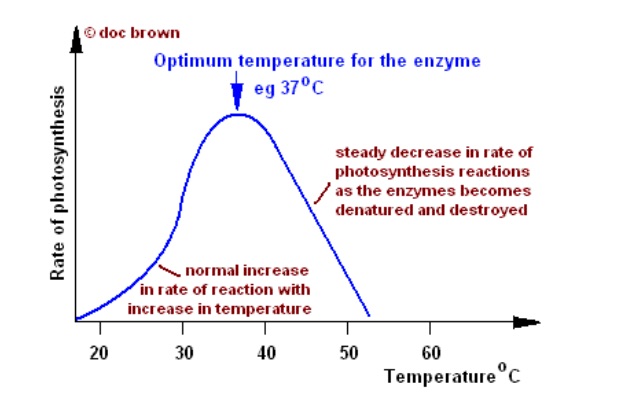
The danger to agricultural production is further exasperated by the
reliance on chemical farming with so-called ‘high yield ‘ crops of the
so called ‘Green Revolution’. These crops have been bred by reducing the
plant’s maintenance biomass (leaves and roots) in exchange for crop
biomass (seeds or fruit). The reduction of the plant’s natural defenses
being made possible by the use of chemical fertilizers and toxins (fig
2). But in a high temperature situation when chlorophyll is functioning
sub-optimally such reductions in leaf volume will bring serious crop
losses.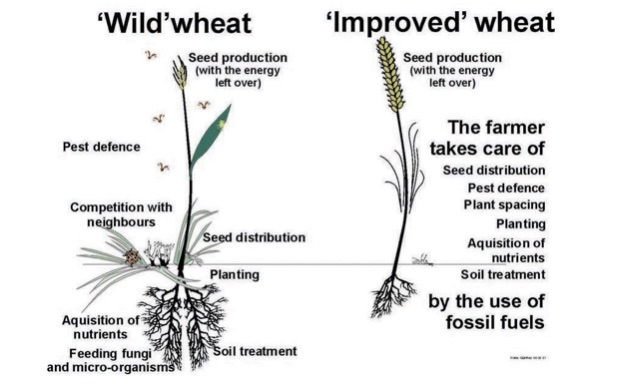
Chemical fertilizers are produced using large amounts of energy, usually
fossil energy. The creation of this fossil energy results in the
discharge of huge volumes of Carbon Dioxide into the atmosphere. This,
in addition to the fossil carbon footprint of agro toxins and fossil
fuel use adds greatly to global warming which in turn creates the
dangerous heat waves around the planet and finally affects the farmer
through increased heat stress on the crop.
