Peace for the World World ! Your War Our Lives

The Dalai Lama
A Brief Colonial History Of Ceylon(SriLanka)
Sri Lanka: One Island Two Nations
A Brief Colonial History Of Ceylon(SriLanka)
Sri Lanka: One Island Two Nations
(Full Story)
Back to 500BC.

Monday, October 10, 2016
Britain to push post-Brexit UK immigration controls back to Irish border
Northern
Ireland secretary James Brokenshire says London and Dublin will share
data to stop migrants using Irish border as backdoor into Britain
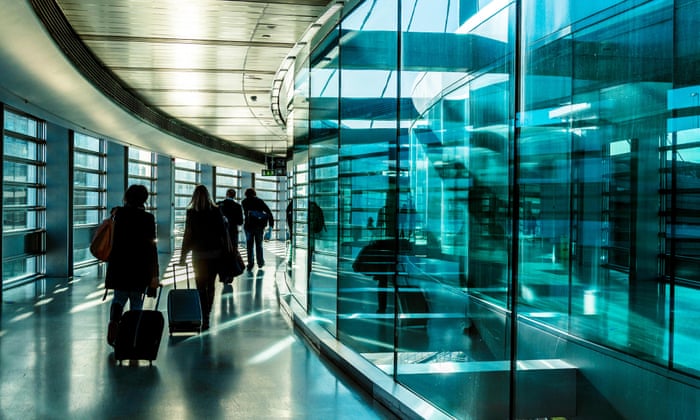
Passengers head for passport control at Dublin airport. Photograph: Richard Wayman/Alamy
James
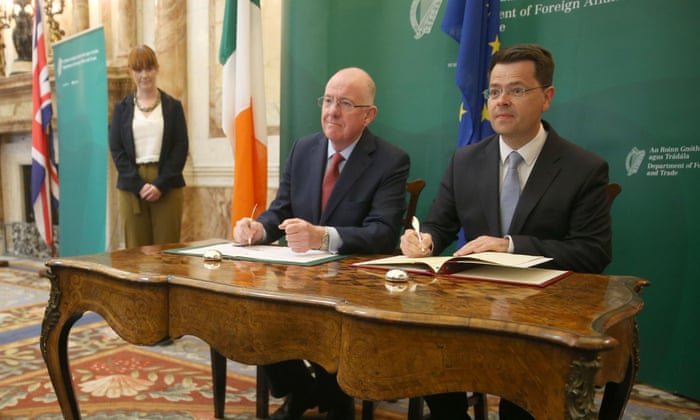
Brokenshire, right, with his Irish counterpart, Charles Flanagan, at
talks in Dublin in September. Photograph: Brian Lawless/PA

Britain is seeking to shift the frontline of immigration controls to
Ireland’s ports and airports to avoid having to introduce a “hard
border” between north and south after the UK leaves the European Union, the Guardian has learned.
The Northern Ireland secretary,
James Brokenshire, has told the Guardian that London and Dublin will
work to strengthen Ireland’s external borders in order to combat illegal
migration into the UK once it leaves the European Union.
In an interview, Brokenshire said there was now a “high level of
collaboration on a joint programme of work” between the two states to
control immigration.
“We have put in place a range of measures to further combat illegal
migration working closely with the Irish government,” Brokenshire said.
“Our focus is to strengthen the external border of the common travel
area [CTA], building on the strong collaboration with our Irish
partners.”
The CTA is a unique arrangement that allows for full freedom of movement
between people from Ireland and Britain on both islands.
After Britain’s vote to leave the EU in June, concern mounted that to
control immigration, measures would have to be imposed on the 300-mile
border between the Irish Republic and Northern Ireland. Any such border
controls would probably be seen as a violation of the Good Friday
agreement and a provocation in a region that has only relatively
recently put violence behind it.
Shifting the onus of immigration control to Irish entry points such as
Dublin airport and Rosslare port would avoid this. However, it would
also make a mockery of claims by the Brexit camp that leaving the EU
would enable Britain to “take back control of its borders”.
Brokenshire said: “We are already working closely with the Irish
government and other members of the common travel area to prevent people
from seeking to evade UK immigration controls from entering via another
part of the CTA. There is a high level of collaboration on a joint
programme of work. This includes investment in border procedures;
increased data sharing to inform immigration and border security
decisions; passenger data systems enabling the collection and processing
of advance passenger information; and harmonised visa processes.”
The measures will be aimed primarily at non-Europeans seeking entry into
the CTA. Politicians on all sides of the divide on the island of
Ireland have expressed concern that Irish border towns such as Dundalk
could become the “new Calais”
if people-traffickers trying to send migrants into the UK target the
Irish Republic as a “jump-off point” into Northern Ireland.
Precedents already exist for this Anglo-Irish collaborative model:
Indian and Chinese visitors are subject to a system whereby they apply
for a single visa, valid for travel in both Ireland and the UK.
The joint Anglo-Irish border procedures will not be able to stem the
arrival of EU nationals, as they will retain the right to free movement
to live and work in the Irish Republic. However, this point is seen as
moot: officials believe few EU citizens will want to come and work
illegally in the UK after Brexit. “The numbers would be very small,”
said one diplomatic source familiar with Brexit discussions.
The Fine Gael-led coalition government in Dublin has confirmed it is in
negotiations with London to better share intelligence to tighten
immigration controls for people from outside Britain and Ireland.
Ireland’s foreign minister, Charles Flanagan, said he welcomed
Brokenshire’s commitment to an invisible north-south border and agreed
on the importance of an intelligence-led approach to curbing illegal
immigration across the Irish border.
Flanagan said: “In terms of the threat of illegal immigration through
the border, the sharing of information is vital, as is the sharing of
systems and the use of digital technology. These are means by which we
can ensure that any adverse impact is minimised. The object of our
engagement is to maintain the common travel area.”
However, he stressed that upgrading immigration controls between the UK
and Ireland would, from Dublin’s perspective, have to be negotiated
alongside the country’s EU partners.
“I caution that this will be a decision not just by the UK or Irish
governments but ultimately also by the 27 EU states. I have been
impressing on my fellow 26 EU foreign ministerial colleagues the
importance of maintaining what is now an invisible border. I have to say
there was among them a deep understanding of theconsequences for the peace process of the reimposition of a heavily fortified border,” he added.
Brokenshire said that Brexit would neither destabilise the power-sharing
institutions set up under the Good Friday agreement nor provide any
propaganda boost for hardline dissident republicans opposed to
devolution in Belfast.
“Political stability and prosperity in Northern Ireland has been hard
fought over many decades, and we will not do anything to undermine it,”
he said. “There is no reason to think that the outcome of the referendum
will do anything to undermine the rock-solid commitment of the UK
government and the people of Northern Ireland to the settlement set out
in the Belfast agreement and its successors.”
The Northern Ireland secretary insisted that he did not even want to see
customs checks on the border when the UK triggers article 50 and
finally leaves the EU.
“The open border for people and businesses has served us well and no one
wants to see a return to the borders of the past. It is a high priority
for the government that we do not see border controls coming into
place. There is a very strong commitment from the Irish government as
well as ourselves to see that that does not happen.”
