Peace for the World World ! Your War Our Lives

The Dalai Lama
A Brief Colonial History Of Ceylon(SriLanka)
Sri Lanka: One Island Two Nations
A Brief Colonial History Of Ceylon(SriLanka)
Sri Lanka: One Island Two Nations
(Full Story)
Back to 500BC.

Monday, October 10, 2016
Judicial upholding of the right not to be violated

 Sunday, October 09, 2016
Last week’s affirming by the Supreme Court of a female school teacher’s
constitutionally protected right to talk to the media in the face of
prolonged sexual harassment and intimidation at a leading educational
establishment in Colombo calls for a multipronged deterrent approach to
an all-pervasive problem in Sri Lanka.
Emphasizing two broad principles of value
It is common knowledge that the complaint upon which the Court acted
this time around is not rare. Indeed, this country ranks disgracefully
high in South Asia when it comes to sexual harassment in the workplace. A
mandatory code within the work place in general and the educational
system in particular needs to be enforced with efficacious and
independent inquiry mechanisms. The legal framework in this regard also
needs to be revised. Clearly, penalising sexual harassment has not been a
deterrent given the reluctance of many to undergo the traumatic ordeal
of the criminal justice system.
Let us see exactly what the Court said. Two broad principles of equal
importance were emphasized, namely the constitutional right to
expression and information and the right to equality together with the
constitutional regime of affirmative protections. Here, Manohari
Pelaketiya, a female school teacher had petitioned the court alleging
that a fellow teacher and the principal of Mahanama College had
attempted to force unwanted sexual favours on her.
Upon refusal, she was subjected to constant harassment including the
deprivation of increments. Unable to bear the strain and with no
immediate relief forthcoming, she had aired her grievances on a
television channel after which she was interdicted for infringing the
Establishments Code which expressly prohibited such public utterances.
Deploring long and oppressive sexual harassment
Defending themselves, the authorities argued that her interview included
allegations that the Ministry of Education had not taken measures to
punish those responsible whereas, shortly before that interview, an
internal inquiry had recommended that the offending school principal be
compulsorily retired and the fellow teacher be interdicted.
It was also forcefully argued that if the Court was to rule in the
petitioner’s favour, this would amount to a precedent that would make it
impossible for government institutions to prevent public officers from
disclosing information on internal disciplinary matters when such
matters are being inquired into. However, the severity of the harassment
to which the petitioner had been subjected to, clearly dominated the
mind of the Court.
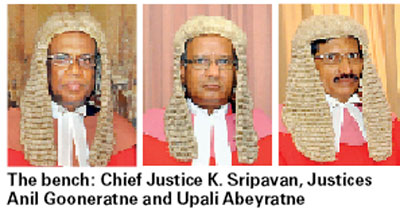
In the words of Justice Anil Gooneratne writing for the Court (with K.
Sripavan CJ and Upali Abeyratne J. agreeing), the petitioner had
‘snapped’ under ‘the stress and strain occasioned by oppressive and
burdensome conduct under colour of executive office,’ carried out for a
long time. Indeed, the Court’s outrage in this regard is quite
remarkable. Thus, it was opined that ‘it is not possible for a female to
resist such abuses unless she is a strong personality who could react
and retort to such abuses and harassment and make the abuser to
shamelessly withdraw, being exposed to the public at large of his
indecency.’
Echoing liberal jurisprudence of the nineties
Consequently, it was held that, even if she acted contrary to the
Establishments Code, that would not deprive her of her constitutional
protection. Quoting precedents of the Indian and US courts, the
petitioner’s freedom of expression was ruled to ‘trump’ the
Establishments Code.

Manohari Pelaketiya
There is firm domestic precedent supporting this view, though not
explicitly quoted as such by the Court. Thus, in a norm-setting decision
during the mid nineties, Justice MDH Fernando declared that the
arbitrary stopping of the Non Formal Educational (NFEP) programme of the
Sri Lanka Broadcasting Corporation (SLBC) that it ‘caused public
unrest’ was unconstitutional. The Court asserted that “…. it is well to
remember that the media asserts, and does not hesitate to exercise, the
right to criticise public institutions and persons holding public
office…such criticism must be deplored when it is without justification,
(but) the right to make and publish legitimate criticism is too deeply
ingrained to be denied.’
The September 2016 decision of the Court thus reflected its sweepingly
liberal jurisprudence in the mid to late nineteen nineties before it
became entangled in the ugly politicization of the Office of the Chief
Justice.
Affirming the right to equality
Of equal importance is the second principle emerging from the Pelaketiya
Case which emphasizes the right to equality of a female school teacher
who became helpless ‘in the hands and control of indecent public
servants within the school premises.’ As Justice Gooneratne observed,
‘sexual harassment or work place stress and strain occasioned by
oppressive and burdensome conduct under colour of executive office,’
amounts to unconstitutional action infringing the right to equality.
Here too, it was held that the right to equality as well as the regime
of affirmative rights in the Constitution cannot be restricted or
limited by the provisions of the Establishments Code
Undoubtedly this is a judicial salutation of the exemplary courage of a
female school teacher in employing the media to stand up to the male
establishment and against conduct that, (in the words of the Court),
‘would be unacceptable to any decent society.’ This stands as a
categorical assertion of the fact that if internal procedures are
futile, then public complaints are justified.
In this instance, the offender was an educational institution. Yet a
warning is implicit therein for other organizations, including those of
the private sector and the non-governmental sector. Taking disciplinary
action against an individual on the basis that ‘internal institutional
grievances’ are ventilated to the media where there is no other option
available, will now be frowned upon. Even though such action may not be
constitutionally challenged given that the constitutional remedy is
limited to executive or administrative action, the unequivocal judicial
stance reflected in the Pelaketiya Case remains of general legal
importance.
Enforcing compliance to a policy of deterrence
In a wider sense, Sri Lanka may do well to look across the Palk Strait
where the celebrated ‘Vishaka’ case (1997) did not merely result in
token legislation but gave rise to country-wide awareness and anger
against sexual harassment in the Indian workplace, forcing policy makers
into reluctant compliance.
If Sri Lankan authorities fail to give serious attention to this issue,
others who have been similarly violated should publicly discuss what
they have faced. This would be a welcome ‘opening of the floodgates’ as
it were.
In sum, the Pelaketiya Case must not be allowed to rest as one lonely
judicial view. Given its singular value, it must attract a critical mass
to propel compliance to reformed policy and legal standards, ensuring
the right of both Sri Lankan men and women not to be violated in the
workplace and to publicly protest thereto if needed. This is crucial.
