Peace for the World World ! Your War Our Lives

The Dalai Lama
A Brief Colonial History Of Ceylon(SriLanka)
Sri Lanka: One Island Two Nations
A Brief Colonial History Of Ceylon(SriLanka)
Sri Lanka: One Island Two Nations
(Full Story)
Back to 500BC.

Saturday, October 29, 2016
Progressive Constitution Needed To Prevent Repeat Of War

Veluppillai Thangavelu
The shooting of the two Jaffna University students is a tragedy just
waiting to happen. During the last few years tension between the armed
forces and the general public was on the rise. Reluctance of the armed
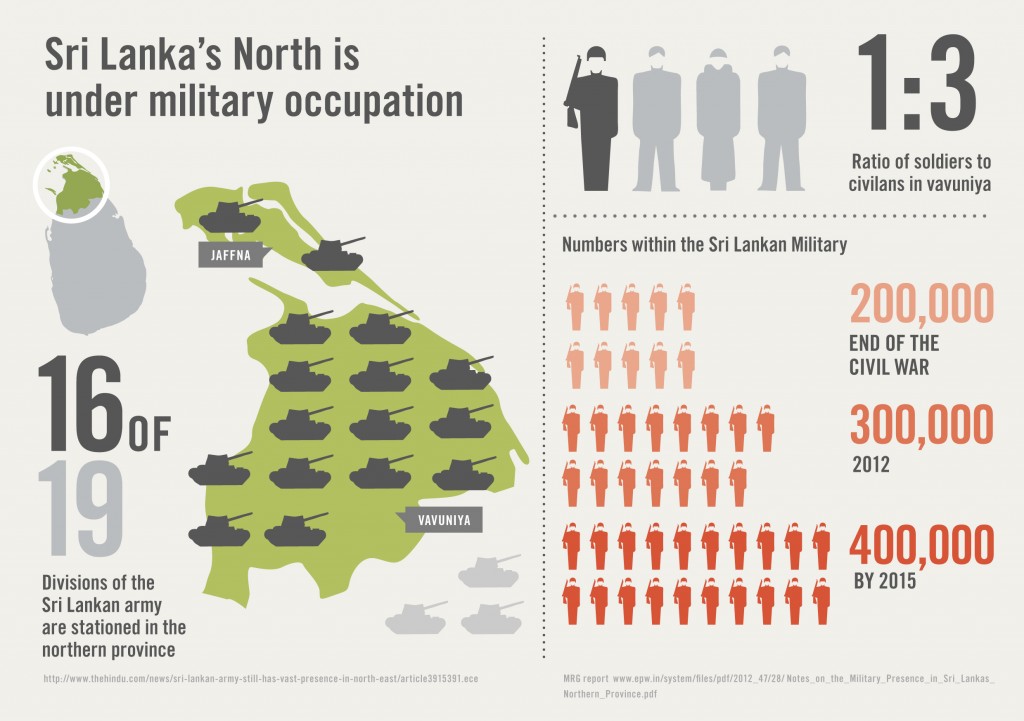
forces to release occupied lands belonging to Tamil people and failure
to dismantle the numerous army camps in built up areas even after the
war ended 7 years ago led to friction and despair.
It is claimed the two students failed to stop at the check point when
ordered to do so. That may or may not be true, but within hours the
Police headquarters described the death of the two students aged 23 and
24 as a fatal motorcycle accident. Police claimed that the two students
had hit a wall and died of serious injuries. This version turned out to
be a total lie by the police after the autopsy revealed that at least
one of them was killed due to a gunshot injury. Under Mahinda
Rajapaksa’s dispensation the police would have been cleared of any wrong
doing. Or even decorated for their bravery like the shooting of five
students at Trincomalee by soldiers on January 2, 2006.
Because of the regime change, President Maithripala Sirisena intervened
directly to stop Police covering up the murder of the two Jaffna
university students. He gave orders to interdict the five Police
officers involved in the shooting. He also gave orders information
department to issue a fresh statement setting the record straight. “Five
Police officers have been arrested and immediately interdicted,” the
information department statement said contradicting Inspector-General
Pujith Jayasundara’s headquarters.
There was no immediate comment from the police chief following the
presidential intervention to ensure justice to victims. Ironically, the
shooting took place a day after Ms. Izsak-Ndiaye, UN
Rapporteur and human rights expert, asked Colombo to demonstrate its
commitment to protect minorities.
Most agree that even if the two students were drunk and they did not
obey police orders to stop as alleged by the Police, the shooting
is totally unwarranted and very high handed. Naturally, the killing of
the students has evoked strong reaction from not only the students, but
also from all sections of the Tamil community. There were peaceful
demonstrations not only in the North even in Colombo. There is even an
ill-advised call for a hartal which will only inconvenience the traders
and the general public.
The situation would have got out of control, if not for the prompt and
decisive intervention by President Sirisena himself by ordering the
interdiction and arrest of all the 5 policemen involved.
Unfortunately, even after the regime change, the Sinhalese dominated armed forces consider the Tamils as second class citizens. We saw this during the clash between the Tamil and Sinhalese students at the Jaffna University last July, 2016. The army sided with the Sinhalese students by providing food and refreshments. A National army of a country are proud to serve the country by defending its borders, democracy and sovereignty. Regrettably, this is not the situation with the armed forces of Sri Lanka. The politicised members of the armed forces do not think they have to serve the country as a whole and not a selective group.
Unfortunately, even after the regime change, the Sinhalese dominated armed forces consider the Tamils as second class citizens. We saw this during the clash between the Tamil and Sinhalese students at the Jaffna University last July, 2016. The army sided with the Sinhalese students by providing food and refreshments. A National army of a country are proud to serve the country by defending its borders, democracy and sovereignty. Regrettably, this is not the situation with the armed forces of Sri Lanka. The politicised members of the armed forces do not think they have to serve the country as a whole and not a selective group.
Human Rights activists and critics of the government have pointed out
that a climate of impunity has prevailed for decades where the armed
forces can kill Tamils and get away with it easily.
The shooting of 5 students on January 2, 2006 sitting in the Trincomalee beach to while away their time was a cold blooded murder. Immediately after the shooting President Rajapaksa promised donor co-chairs that abuse of power by security forces would not be tolerated under any circumstances and that perpetrators of the Trincomalee killings would face justice, irrespective of rank. But he or his government never went after the murderers, namely members of the army intelligence /Naval Special Forces.
The shooting of 5 students on January 2, 2006 sitting in the Trincomalee beach to while away their time was a cold blooded murder. Immediately after the shooting President Rajapaksa promised donor co-chairs that abuse of power by security forces would not be tolerated under any circumstances and that perpetrators of the Trincomalee killings would face justice, irrespective of rank. But he or his government never went after the murderers, namely members of the army intelligence /Naval Special Forces.
