Peace for the World World ! Your War Our Lives

The Dalai Lama
A Brief Colonial History Of Ceylon(SriLanka)
Sri Lanka: One Island Two Nations
A Brief Colonial History Of Ceylon(SriLanka)
Sri Lanka: One Island Two Nations
(Full Story)
Back to 500BC.

Sunday, November 20, 2016
Aleppo’s last hospital destroyed by airstrikes
Russia-led attacks on rebel area in Syria’s second city leave up to 250,000 people without access to surgery or specialist care
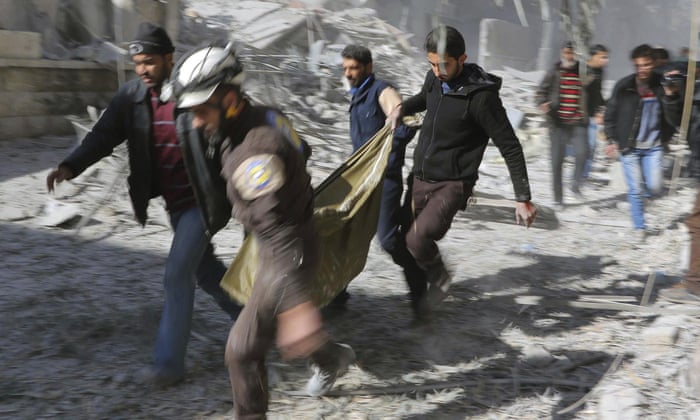
People carry a body through the neighbourhood of Seif al-Dawleh in Aleppo, Syria. Photograph: Uncredited/AP

The last operating hospital in east Aleppo has
been destroyed by airstrikes, leaving up to 250,000 residents without
access to surgery or specialist care and rebel-held districts at the
point of collapse.
Another four hospitals were hit and forced to close on Friday before the
Omar bin Abdul Aziz facility was struck just after 8.30pm, capping the
most deadly day yet for the medical system in Syria’s second city, which
has been systematically targeted by Russian and regime jets over the
past year.
“They have all been repeatedly attacked over the last few days,” said
David Nott, a surgeon with decades of experience working in war zones
and who has been supporting the Aleppo doctors.
“I don’t think in all my years of doing this I’ve seen such dreadful
pictures of injuries, of people lying on the floor in an emergency room,
the dead mixed with the living,” he said. At least two doctors were
among the dead, he added, and he feared hospitals that had kept
operating under attack and with dwindling supplies might now have been
shut down permanently.
“The Aleppo hospitals have been reopened so many times, underground or
in new locations, but between the bombing and the siege I don’t know if
it will be possible to resurrect them this time,” he said.
The destruction comes during a blitz of opposition areas spearheaded by Russiaover
the past three days, which has whittled away what remains of the
opposition-held east in preparation for a ground invasion led by
Iranian-backed militias allied to Syrian forces.
Médecins Sans Frontières said east Aleppo’s hospitals had been hit by
bombs in more than 30 separate attacks since the siege began in July and
that there was no possibility of sending help or more supplies.
Schools, roads and homes have also been bombed repeatedly as the Syrian
leader Bashar al-Assad’s allies attempt to drive opposition communities
out of the city and, by doing so, change the face of the near six-year
war. Doctors and residents inside Aleppo said there were no more than
two weeks’ supplies of food and medicines left inside the city.
In the lead-up to the US election, Russia had pledged to obliterate what
remained of anti-regime forces and the communities that support them,
and as president-elect Donald Trump prepares to take over the White
House, Moscow is acting on its threats.
Condemnation of the latest attacks was swift in part, with medical
organisations and aid agencies that support the city’s healthcare system
labelling them as war crimes. Governments were slower to react, with
Turkey, the opposition’s most important backer, remaining silent as the
attacks intensified. Turkish forces continue to back a rebel push
against the Isis stronghold of al-Bab, 25 miles to the north-east of
Aleppo.
There was no immediate response from Washington, which has supplied
light arms to some opposition groups for the past three years, but has
refused requests to introduce battle-changing weaponry such as
anti-aircraft missiles. Trump has indicated he will withdraw US support
from anti-Assad rebels soon after his inauguration in January.


Britain’s international development secretary, Priti Patel, condemned
the attack. “The bombing of the last functioning hospital in Aleppo is
part of a systematic campaign to remove even the most basic of services
left in the city,” she said.
“This sickening act is part of a humanitarian catastrophe that will
leave hundreds of thousands of innocent civilians already desperate for
food without access to medical care.
“The inhumanity shown by the Russian and Syrian regime has created a
systemic and deliberate humanitarian crisis that cannot be ignored …
Russia has the power to allow the aid so desperately needed into the
city, if it does not the world will hold it to account for the barbarous
result.”
Russia has said its latest campaign is directed at Isis, along with
Jabhat Fatah al-Sham, a prescribed terror organisation with links to
al-Qaida. It said it was focusing its efforts on Homs and Idlib, closer
to the Mediterranean coast.
On Friday, Russia’s ambassador to the UK, Alexander Yakovenko, said
Moscow’s bombing aimed to ensure that Isis members did not enter the
area from Mosul in Iraq, where the organisation is besieged by the Iraqi
military, militias fighting in support of it and Kurds. In response,
the UK’s special representative for Syria, Gareth Bayley, tweeted: “How is that geographically sensible … that’s 400km from border with Iraq?”
Farida, a doctor living in south-eastern Aleppo, said: “It’s unnatural,
we’ve seen so much bombardment but nothing like this ever. It is hell.
We wanted to try to set up a maternity ward somewhere else because ours
was damaged in the bombing of the hospitals but we couldn’t leave the
house. They want life to end in Aleppo.
“They cannot take it from the ground, so they’re trying to take it from
the air. They bombed all the hospitals and schools, so there is no life
and people give up. If it stays like this, people cannot wait it out.
“Medicines, vaccines, will finish. At this rate I cannot see us
continuing for more than two weeks … I cannot predict the scenario, that
is if there is still anyone living in Aleppo by that time.
“Nobody cares about us. We’re just Sunni Arabs living in Aleppo. If we
had one Frenchman in Aleppo the whole world would have risen up. There
is no longer any humanity. The wounded are dying, a patient whose
stomach is open in the operations room has to be abandoned, women are
leaving delivery rooms still bleeding because the hospitals are getting
attacked, babies are dying because oxygen tanks are empty and generators
aren’t working.”
