Peace for the World World ! Your War Our Lives

The Dalai Lama
A Brief Colonial History Of Ceylon(SriLanka)
Sri Lanka: One Island Two Nations
A Brief Colonial History Of Ceylon(SriLanka)
Sri Lanka: One Island Two Nations
(Full Story)
Back to 500BC.

Monday, November 28, 2016
Castro’s legacy: how the revolutionary inspired and appalled the world
A
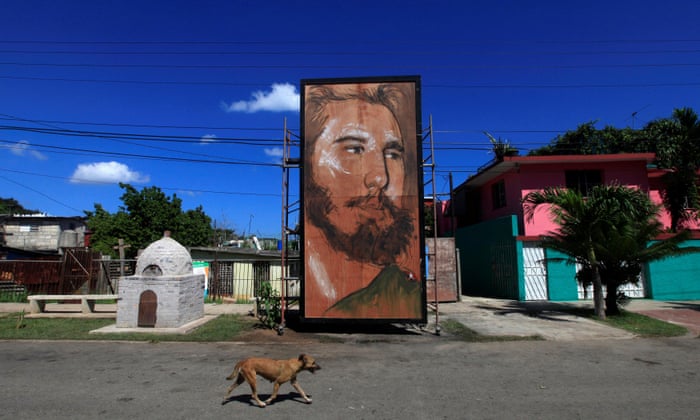
dog walks past a painting depicting Fidel Castro by Cuban artist Kcho
in Havana, Cuba, in August 2016. Photograph: Enrique de la Osa/Reuters
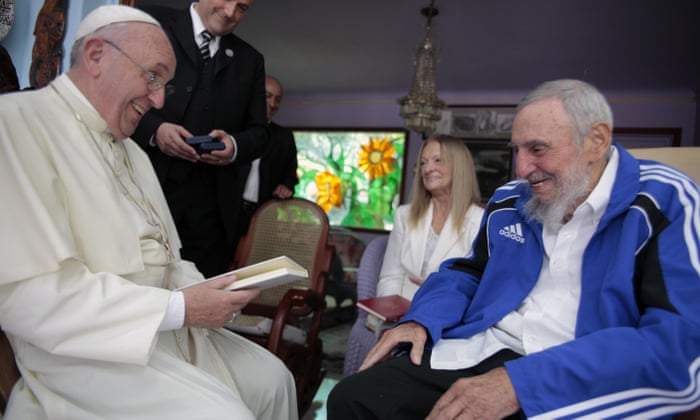
Pope
Francis meets Cuba’s Fidel Castro, as Castro’s wife Dalia Soto del
Valle looks on, in Havana in 2015. Photograph: Alex Castro/AP
Rory Carroll and Jonathan Watts in Havana-Saturday 26 November 2016

No street bears his name and there is not a single statue in his honour but Fidel Castro did not want or need that type of recognition. From tip to tip, he made Cuba his living, breathing creation.
No street bears his name and there is not a single statue in his honour but Fidel Castro did not want or need that type of recognition. From tip to tip, he made Cuba his living, breathing creation.
Children in red neckerchiefs scampering to free schools, families
rationing toilet paper in dilapidated houses, pensioners enjoying free
medical treatment, newspapers filled with monotonous state propaganda:
all in some way bear the stamp of one man.
Historians will debate Castro’s legacy for decades to come but his
revolution’s accomplishments and failures are on open display in
today’s Cuba, which – even with the reforms of recent years – still bears the stamp of half a century of “Fidelismo”.
The “maximum leader” was a workaholic micro-manager who turned the
Caribbean island into an economic, political and social laboratory that
has simultaneously intrigued, appalled and inspired the world.
“When Fidel took power in 1959 few would have predicted that he would be
able to so completely transform Cuban society, upend US priorities in
Latin America and create a following of global proportions,” said Dan
Erikson, an analyst at the Inter-American Dialogue thinktank and author
of The Cuba Wars.
The most apparent downside of his legacy is material scarcity. For
ordinary Cubans things tend to be either in short supply, such as
transport, housing and food, or prohibitively expensive, such as soap,
books and clothes.
These problems have persisted since Fidel handed the presidency to his brother Raúl in 2008.
Despite overtures to the United States and encouragement of micro
businesses since then, the state still controls the lion’s share of the
economy and pays an average monthly wage of less than £15. This has
forced many to hustle extra income however they can, including
prostitution and low-level corruption. The lucky ones earn hard currency
through tourism jobs or receive dollars from relatives in Florida.
Cubans are canny improvisers and can live with dignity on a shoestring,
but they yearn for conditions to ease. “We want to buy good stuff, nice
stuff, like you do in your countries,” said Miguel, 20, gazing wistfully
at Adidas runners on a store on Neptuno street.
Castro blamed the hardship on the US embargo, a longstanding, vindictive
stranglehold which cost the economy billions. However, most analysts
and many Cubans say botched central planning and stifling controls were
even more ruinous. “They pretend to pay us and we pretend to work,” goes
the old joke.
Thanks to universal and free education and healthcare, however, Cuba
boasts first-world levels of literacy and life expectancy. The comandante made sure the state reached the poorest, a commitment denied to many slum-dwellers across Latin America.
Idealism sparkles in places such as Havana’s institute for the blind
where Lisbet, a young doctor, works marathon shifts. “We see every
single one of the patients. It’s our job and how we contribute to the
revolution and humankind.”
Castro continued to hold a place in people’s hearts and minds despite
largely withdrawing from public life in the last decade of his life.
Increasingly infirm, he mostly tended his garden in Zone Zero (the high
security district of Havana), rebutted frequent premature rumours of his death with photographs showing him holding the latest edition of the state-run newspaper Granma, and wrote the occasional column, including grumpy criticism of Cuba’s drift towards market economics and reconciliation with the United States.
But his influence was clearly on the wane. Although he met Pope Francis in 2015,
he spent a lot more time with his plants than with national and global
power brokers. Even before his death, he had become more of a historical
than a political figure.
“Fidel was the dominant figure for decades, but Raúl has been calling
the shots,” observed a European diplomat based in Havana, who predicted
the death would have more symbolic than political significance. “Has his
presence been a block to reforms? Possibly. There could be an impact on
young Cubans, but we won’t see a huge shift of Cuban politics after
Fidel’s death. More significant would be if Raúl dies because he put his
leadership on the line for reform.”
Cuba had already begun the move away from Fidel’s era in a similar
series of gradual steps to that taken in China after the the death of
Mao Zedong or Vietnam after the demise of Ho Chi Minh.
Under the Economic Modernisation Plan of 2010, the state shed 1m jobs,
and opened opportunities for small private business, such as paladares – family-run restaurants – and casas particulares, or home hotels. Farmers have been given more autonomy and price incentives to produce more food. The government haseased overseas travel restrictions, loosened pay ceilings, ended controls on car sales and tied up with overseas partners to build a new free-trade zone at the former submarine base in Mariel.
The biggest changes have been in the diplomatic sphere, where Cuba strengthened ties with the Vatican and signed a historic accord with the United States to ease half a century of cold war tension.
But this is still an island shaped more by Fidel Castro than
any other man. Wander up the marble steps at the centre of Revolution
Square and stand where Castro used to give his marathon orations to an
audience of more than a million and you can still see just how much the
revolution he led reshaped the country. On one side are the giant
profiles – illuminated at night – of his two lieutenants: Che Guevara on
the ministry of the interior and Camilo Cienfuegos across the facade of
the communications ministry.
‘He led a humble life’: Fidel Castro’s biographer on the legacy of a revolutionary
‘He led a humble life’: Fidel Castro’s biographer on the legacy of a revolutionary
In the distance, you can see the tower blocks that were formerly the
headquarters of major US corporations such as ITT and General Electric
but were nationalised under Castro, and hotels such as the Havana Libre,
which were once owned by US mobsters but later turned over to the
state.
Part of Cuba’s charm for tourists – and the curse for many locals – is
that it is all too easy to remember what life here was like in the early
days of the revolution because the city has barely move on in the
subsequent half century. Thanks to the economic embargo imposed by the
United States, Castro’s Cuba became a time capsule. Despite a partial
facelift ahead of Pope Francis’s visit in 2015, many streets are still
lined by crumbling colonial facades and potted by holes that look like
they have been there for decades.
The former mafia hotels have had little more than a lick of paint since
they were frequented by mobsters like Meyer Lansky and Charles “Lucky”
Luciano. And, of course, classic cars from the 1950s – Buicks, Chryslers, Oldsmobiles and Chevrolets – still cruise the Malecón.
Close to Revolution Square is the run-down La Timba neighbourhood, where
a young Fidel Castro cut his teeth as a lawyer defending the local
community of shanty-home dwellers against eviction by developers.
Juvelio Chinea, an elderly resident, said the changes brought by the
revolution in his own life had been modest, but his sons and grandsons
had been able to attend university – the first generations in their
family to be able to do so.
Chinea recalls hearing the comandante’s speeches from inside
his home. The 21-gun salute used to crack the walls and shake the
cutlery. There would be singing and shouting from the crowd, then a hush
as Castro started speaking. “Some speeches were better than others,” he
remembers. “I wish he could have stayed in power longer.”
Not everyone is so sure about that. At the law department in Havana
University, where Castro studied from 1945, there is admiration for the
country’s former leader, but many believe he held back development.
“The best thing Fidel did for Cuba was to give us free healthcare at the
level of a first world nation,” said one student. “The worst thing is
that economic change has been delayed. If Fidel and Raúl had acted
earlier, many of today’s problems would already have been solved.”
The student dreams of starting his own private law firm but that is not
yet possible, he says, “because the government prefers to keep lawyers
and courts under control” so he is thinking of joining his brother, who
moved recently to the United States. Nonetheless, he is proud of his
country’s and his university’s history. “It’s great that this school was
where an icon like Fidel studied.”
That many still feel affection for “El Jefe Máximo” despite his
ruinous economic policies is because he is judged more for his
nationalist triumphs than his communist failures. Castro’s main
inspiration was not Karl Marx, but José Martí, the 19th-century Cuban
independence hero. While the latter fought to eject Spanish colonisers,
Castro ended US neo-imperialist rule by kicking out US corporations and
gangsters. The former banana republic is now proudly sovereign.
Camilo Guevara, the son of Castro’s comrade-in-arms Ernesto “Che” Guevara, said these achievements were secure despite the recent overtures from Washington.
“The revolutionaries changed the status quo and established a base for
this nation that is independent, sovereign, progressive and economically
sustainable. That’s how we got where we are,” he said at the Che
Guevara Institute, which is dedicated to maintaining the ideological
legacy of his father’s generation.
The message is driven home at the Museum of the Revolution, where the
trophies of the early Castro era are prominently displayed outside the
building that was once the presidential palace. Here you find the Granma
yacht, on which Castro and 81 fellow revolutionaries sailed from Mexico
in 1956 to begin the war against the US-backed dictatorship of Fulgencio Batista. Here too is the engine of the US U-2 spy plane that was shot down in 1962 during the Cuban missile crisis.
Inside, the exhibits and photographs ram home how this small island,
under Castro’s leadership, defied the Yankee superpower despite the
threat of nuclear annihilation.
For many elderly Cubans, that was a terrifying, thrilling time to be
alive and they remain grateful to Castro for guiding them through it.
Frank López, a retired teacher, speaks fondly of that early era under
the comandante. “It was frightening. The US jets would fly low
and fast above the city, shattering the windows with their noise. We
were all trained to use rifles and machine guns and would have to do
drills every night. But in the end, nothing happened and we all went
back to school. People should stand up to the US more often.”
But he is not dewy-eyed about Castro. Although he admires the early
healthcare and education reforms, he also recalls the economic hardships
and the intrusive, suspicious state security apparatus. At one point,
he was placed under surveillance for six years because a friend had
plotted against Castro. These days, a bigger problem is making ends meet
in the face of shortages of basic foodstuffs. “We must all do other
work to get by. It’s been like that for more than 20 years,” he says.
“So while we say thank you to the revolution for the education and
healthcare, we also ask how much longer we have to keep saying thank
you.”
While Castro became a figurehead for revolutionary armed struggle
throughout and beyond Latin America, the former guerrilla was far from
universally popular in his home country once he turned his hand to
government. Property appropriations, restrictions on religion and
crackdowns on suspected enemies left many, particularly in the old
middle class, hating him – a sentiment that has spanned the generations.
As a child, Antonio Rodiles said he rebelled after learning his mother’s
property had been confiscated and a cousin executed as a suspected CIA
agent. “They used to tell me ‘Fidel is your daddy’. I replied ‘No, he’s
not’. I hated them for forcing me to do things. As I grew up I realised
this kind of system is not natural,” he recalls. Today, he heads the
opposition group Citizen Demand for Another Cuba and is often arrested
and beaten. “Fidel has left a shadow over Cuba. His legacy is terrible.
He destroyed families, individuals and the structure of society.”
Similarly, Rosa María Payá grew up watching her father fight against and
suffer from a system that tolerated little dissent. Oswaldo Payá was a
leading campaigner for free elections who was imprisoned first for his
religious beliefs and then for his political campaigns. He died in a car
accident in 2014. Rosa María believes he was forced off the road by the government agents who were following him. She
said the Castros have left a legacy of tyranny that is unchanged
despite the cosmetic reforms and diplomatic deals of recent years.
“The Cuban people haven’t had a choice since the 1950s,” she says. “My
father spent three years in a forced labour camp because he was
Catholic. Others were imprisoned with him because they were homosexuals
or dressed the ‘wrong’ way. The reality is that you can’t be alternative
to the line of Fidel and Raúl.”
From the 1960s onwards, the Intelligence Directorate intrusively
monitored opponents, many of whom were beaten by police or spent years
in jail. Despite the release of dozens of political prisoners in the
wake of the 2014 Cuba-US agreement, many activists were detained or harassed ahead of visits by Barack Obama in 2016 and Pope Francis the previous year.
Yet, compared with the past, there is a little more scope for criticism,
a lot more opportunity to travel, and slightly less of a sense of
crisis. Cuba may still be more closely aligned to Venezuela than the
United States, but it is clearly hedging its bets more than it used to
do under Fidel. Today the country is different from the one that
confidently erected a now-fading plaque on Avenida Salvador Allende with
a quotation from Chile’s socialist leader: “To be young and not to be
revolutionary is a contradiction, almost a biological one.”
Instead, on Avenida G, a bohemian hub of cafes and street corners for
Havana’s teens, the talk is not of politics but iPods, fashion, films
and Major League Baseball.
In a valedictory speech at the close of the 2016 Cuban Communist party congress, Castro urged his compatriots to stick to their socialist ideals despite the warming of ties with the US, but he recognised that his generation was passing.
“Soon I’ll be like all the others,” he said of his dead comrades. “The
time will come for all of us, but the ideas of the Cuban communists will
remain as proof on this planet that if they are worked at with fervour
and dignity, they can produce the material and cultural goods that human
beings need, and we need to fight without truce to obtain them.”
Despite the trembling voice and mournful tone, it was a typically
combative call to arms. The last of many. It may have been several years
since Castro’s thunderous, marathon orations, but Cuba will still feel
strangely quiet without him.
