Peace for the World World ! Your War Our Lives

The Dalai Lama
A Brief Colonial History Of Ceylon(SriLanka)
Sri Lanka: One Island Two Nations
A Brief Colonial History Of Ceylon(SriLanka)
Sri Lanka: One Island Two Nations
(Full Story)
Back to 500BC.

Saturday, November 5, 2016
Debating escalation of the war in Syria
4 November 2016
 This is the video of a debate that took place in New York on 1 November titled “Syria and the Left.”
This is the video of a debate that took place in New York on 1 November titled “Syria and the Left.”
Co-hosted by the online publication Muftah and Verso Books, it featured journalist and author Max Blumenthal, anti-war activist Zein El-Amine, The Intercept’s Murtaza Hussain and Syrian activist Loubna Mrie.
The debate was presented as an opportunity for deliberation about what
role a broadly defined left can have with regard to Syria, in an
atmosphere where such discussions have been all too rare.
Mrie charged that many on the left “deny the Syrian voices and deny the
agency of the Syrian people.” She added that she wants people on the
left to “at least start with showing solidarity with the Syrian people
by insisting on the accountability for all war crimes committed by all
sides” and to start by acknowledging “that the party that is doing the
most killing is the Syrian government.”
Blumenthal argued that the urgent question for people in the United
States was whether to allow their government to support further military
escalation in Syria, either by continuing to supply weapons to
combatants or through a major direct intervention under the banner of a
no-fly zone.
“Escalation leads to escalation in Syria and elsewhere,” Blumenthal said.
“We can’t have this debate without acknowledging that Turkey, Saudi
Arabia, Qatar, the United States, have pumped hundreds of millions,
maybe billions of dollars of weapons and arms and helped fuel a human
catastrophe which of course Russia and the Syrian government are heavily
involved and implicated in,” he added.
“The war is the root of all evil,” Blumenthal said. “This war has to end
today and anyone who says that it should continue, that it should be
escalated for an idea that they don’t have to bear the consequences of,
deserves to be challenged.”
Blumenthal described calls for a no-fly zone as a push for an “all-out US military assault across Syria.”
The eastern part of the northern city of Aleppo is “being turned into a
kill box by the Syrian government and Russia,” Blumenthal observed. But
he also argued that its plight is being used to “protect a narrative
that erases West Aleppo” – the government-held part of the city where
United Nations envoy Staffan de Mistura has saidmany civilians have died as a result of indiscriminate rebel attacks that may amount to war crimes.
Blumenthal pointed to the support from the US and its allies of
extremist factions. As an example, he noted that Robert Ford, who was US
ambassador to Syria until 2014, promoted rebel leader Zahran Alloush as
a “moderate.”
Ford is now a fellow at the Middle East Institute, a think tank funded by the arms industry and the state-owned Saudi Aramco oil company.
At the time Ford was writing in 2014, Alloush’s extreme sectarianism was already well exposed.
In November 2015, rebels in Ghouta, a Damascus suburb controlled by Alloush’s Saudi-financed Army of Islam, paraded Alawite prisoners, including women, in cages, to be used as human shields against airstrikes. Alloush was himself killed in an airstrike last December.
“We have to remove our complicity,” Blumenthal argued. “And that means
when think tanks in Washington, especially those that are promoted by
the same country that is helping fuel the violence in Yemen, in Bahrain,
in Syria are promoting people like Alloush, that we call them out, that
we expose them, that we make sure that arms stop flowing to figures
like that.”
This is a point made by the UN Human Rights Council’s independent inquiry on Syria published in August.
The report concludes that “direct external [state] support to
belligerents, as well as support filtered through proxies … has fuelled
further violence and undermined prospects for a peaceful settlement.”
“Such backing ensures the fragmentation and general decentralization of
the conflict, making the potential for a coherent diplomatic resolution
of the crisis less attainable,” the UN inquiry report adds.
No alternative?
Murtaza Hussain asserted he is “not in favor of more US involvement or escalation, which will inevitably result in more deaths.”
But the terms he set out seemed to offer no alternative.
The worst outcome, he argued, would be an end to the war that leaves the government of Bashar al-Assad in control.
“After committing terrible, horrific acts, in full view of the world for
five years, they will continue to rule the country indefinitely as they
did before,” Hussain said. “The country will be given to the son of
Bashar al-Assad in 15 to 20 years. That’s an affront to humanity. It’s
disgusting. There’s absolutely no way we can countenance that.”
Hussain said that the onus is on those opposing further US military
intervention to “proffer another solution where there’s a sense of
justice in Syria.”
Zein El-Amine noted that even Hillary Clinton – who has supported a no-fly zone – has acknowledged that it would “kill a lot of Syrians.”
Top US military brass have said it would take 70,000 personnel to implement. In September, Joseph Dunford, the chairman of the US joint chiefs of staff, told the Senate that a no-fly zone would “require us to go to war against Syria and Russia.”
But El-Amine argued that continued talk about a no-fly zone, even if unlikely given these assessments, was fueling the war.
“[Clinton] knows that’s not going to happen, as much as she’s a war
hawk,” El-Amine said. “But the rhetoric that’s being put out is what’s
causing both parties to increase, to escalate the massacre of the Syrian
people.”
Misinformation
In early 2014, the UN abandoned efforts to count the number of dead in Syria, because of the difficulties of verifying reports amid the chaotic situation.
But there is no doubt that the toll of the war in Syria has been
staggering and horrific, and continues to mount. In addition to
estimates of hundreds of thousands of dead, the UN says that 4.8 million Syrians are refugees outside their country.
Another 6.5 million are internally displaced.
Yet despite the undeniable horror of this war, misinformation continues
to poison the discussion and sow distrust of those advocating various
positions.
An example in this debate came when The Intercept’s Murtaza
Hussain asserted that “a UN Human Rights Council report issued today
found that over 90 percent of the deaths in the conflict are from the
Syrian government.”
Hussain elaborated that “this is a five-year periodic human rights
review of Syria. This review found over the past five years, over
400,000 deaths, over 90 percent were attributed to government sources.”
But the UN had issued no such report. In fact, the UN Human Rights
Council did hold a session in Geneva on 31 October on Syria’s five-year
review, at which certain governments, including the United States and United Kingdom, made statements.
But the final outcome of the review has yet to be published.
Hussain was unhelpful when asked by The Electronic Intifada for details
of the report to which he was referring. “I recommend you contact the UN
directly if you want to see the summary findings. This might be
something an assistant can help you with if you are experiencing
difficulties,” he responded.
He did not reply to further inquiries about whether he had actually seen
such a report. Hussain’s source appears to be this misleading 31
October tweet by BuzzFeed writer Borzou Daragahi:
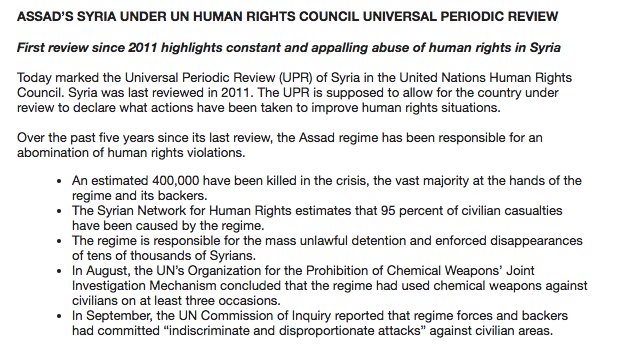

Daragahi claims: “Breaking: UN Human Rights council finds in 1st review
of Syria since 2011 that 400,000 people killed in war, most at hands of
regime.”
This tweet has been retweeted almost 700 times.
Attached to Daragahi’s tweet is a screenshot of an unidentified document
that is not written in the language of a UN report. The UN would, for
example, refer to the “Syrian Arab Republic,” rather than “Assad’s
Syria.” But the screenshot contains the same claims Hussain presented as
UN findings of fact to support his implicit arguments for intervention
at the debate.
In response to an inquiry, Daragahi emailed The Electronic Intifada that
the document attached to his tweet “was a press release put out by UK.”
An Internet search using the title of the document in the tweet did not
turn up any such press release.
Daragahi did not respond to a request to email the press release. He
also did not respond as to whether he stands by the claim in his tweet
about a UN Human Rights Council finding.
Later, however, Daragahi published a tweet “clarifying”
that the UN “hasn’t made finding yet” and claiming that his earlier
tweet was based on a UK Foreign Office document – for which he provided
no link or reference.
Given the high stakes and high tensions around discussion of Syria, such
misinformation serves no one interested in good faith exchanges of
views.
Resisting McCarthyism
The debate in New York was an exception to what Blumenthal called a
“McCarthyite” environment, in which anyone who challenges the calls for
escalation in Syria is smeared, blacklisted or labeled an “Assadist.”
In an essay in Current Affairs this
month, Fredrik deBoer argues that the purpose of the smears is to
silence dissent against a possible major US military intervention.
Indeed, deBoer writes, this is the way McCarthyite innuendo casting
doubt on dissenters’ motives and loyalties has been used during previous
wars, not least in the run-up to the calamitous 2003 invasion of Iraq.
“Assad is a special kind of monster; Syria is a special kind of hell. I
hope the regime of Assad falls. I hope the people of Syria are finally
allowed to emerge from this horrific, bloody, unthinkable civil war,”
deBoer states.
“But hope is not the basis for action. And a century of American foreign
policy, as well as an adult conception of the reality of a broken
world, should tell us to distrust our instincts even when we are most
moved by humanitarian concern.”
