Peace for the World World ! Your War Our Lives

The Dalai Lama
A Brief Colonial History Of Ceylon(SriLanka)
Sri Lanka: One Island Two Nations
A Brief Colonial History Of Ceylon(SriLanka)
Sri Lanka: One Island Two Nations
(Full Story)
Back to 500BC.

Sunday, November 27, 2016

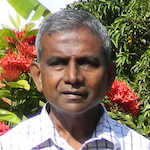
Dr. Rajan Hoole
The Dress Rehearsal In Trincomalee – Part V
To the local Tamils and Muslims everything was stacked against them,
with a number of ministries and state agencies working towards their
discomfiture. Out of several moves, by the State they may protest and
stop some of them. But the ones that succeed would have done a lot of
damage. To those trying to protect the interests of the local community
or seeing the long-term prospects, it was to live at the end of one’s
nerves.
The colonisation scheme for Sinhalese at Periyavilankulam – renamed by
its Sinhalese translation Mahadivulwewa – was started with European
Community funds in the early 80s. Mr. R. Sampanthan, MP for Trincomalee,
immediately took alarm and went up to Minister Gamini Dissanayake, whom
he had known as a junior lawyer, and complained about it. With
characteristic courtesy, in the presence of Sampanthan the Minister made
out a written order cancelling the settlement. Bandaragoda was then GA
Trinco. It was soon learnt that Nanda Abeyawickreme, Secretary Lands,
had sent phone messages to the Trincomalee Kacheri, asking for the
settlement to be speeded up. This was done so that the formal order to
stop would be anticipated by a fait accompli. There was little the
Tamils could do about a government that functioned in this manner. It
again illustrates the role of the GA in Trincomalee.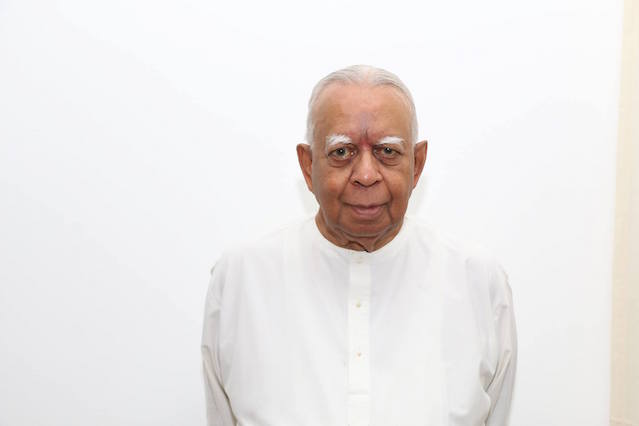
R. Sampan than | Photo via his Facebook
There were a number of government figures scouting around Trincomalee
for places to plant Sinhalese colonies. Among them, was Cyril Mathew,
Minister for Industries and Scientific Affairs. There are ancient
Buddhist ruins in the district of very disparate origins, representing
the country’s variegated past. The ruins of Vilgam Temple had a number
of Tamil inscriptions, and those at Kuchchaveli and Thiriyai were of
Mahayana origin. The ideological position articulated by the State was
that these ruins were proof of the region’s Theravada-Sinhalese Buddhist
past, so putting forward a justification for Sinhalese colonisation. It
was based allegedly on Buddhist piety – the renovation of temples.
Thiriyai was a village north of Trincomalee with a long history, and was
peopled by Tamils. Neelapanikkan Kulam, a tank near the village, was
renovated about the 1940s, and the villagers had since been cultivating
the fields nearby. There is an old Buddhist shrine close to Thiriyai and
another nearby in Mylaweva on the Thiriyai- Gomarankadawela Road, which
has Tamil inscriptions. But the cultivation of the fields referred to,
had not been regularised by the issue of permits. This was really
default on the part of administration, which was deliberate. The farmers
were themselves quite ignorant of such matters.
