
 By James Gallagher-25 November 2016
Peace for the World World ! Your War Our Lives

The Dalai Lama
A Brief Colonial History Of Ceylon(SriLanka)
Sri Lanka: One Island Two Nations
A Brief Colonial History Of Ceylon(SriLanka)
Sri Lanka: One Island Two Nations
(Full Story)
Back to 500BC.
Monday, November 28, 2016
Low social status 'can damage immune system'
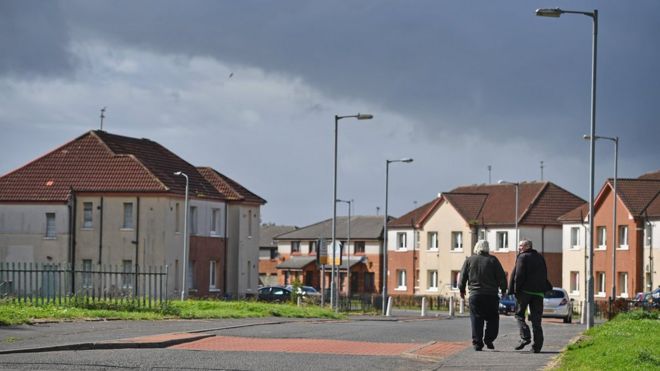 Image copyrightGETTY IMAGESBy James Gallagher-25 November 2016
Simply being at the bottom of the social heap directly alters the body
in ways that can damage health, a study at Duke University in the US
suggests.
Monkey experiments showed low status alters the immune system in a way
that raises the risk of heart disease, diabetes and mental health
problems.
One expert said the findings were "terrifically applicable" to people.
The findings, in Science, had nothing to do with the unhealthy behaviours that are more common in poorer groups.
The gulf in life expectancy between the richest and poorest is huge - in the US it is more than a decade for women and 15 years for men.
Part of the explanation is that people from poorer backgrounds are more
likely to have a worse lifestyle - including smoking, little exercise
and diets containing junk food.
But the latest study goes further to show low status - with all of those
other factors stripped out - still has an impact on the body.
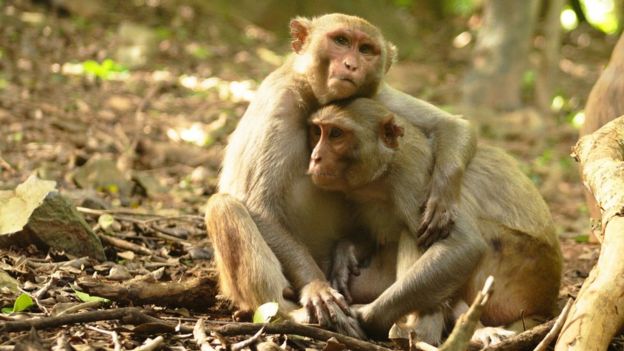
Looking at 45 non-human primates allowed scientists to adjust only
social status to assess its impact - something impossible to do in
people.
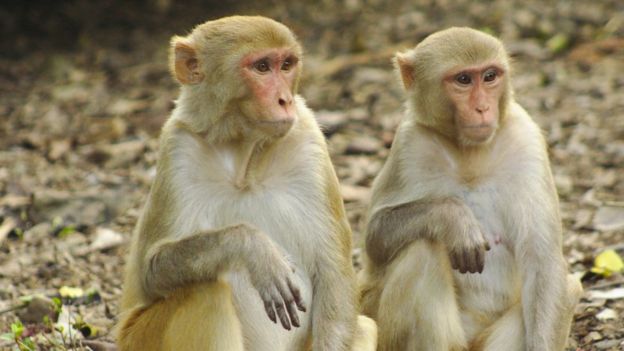
The captive Rhesus monkeys - who were all female, unrelated and had
never met before - were divided one-by-one into nine new groups of five.
The newest member nearly always ended up at the bottom of the social
order and became "chronically stressed", received less grooming and more
harassment from the other monkeys.
A detailed analysis of the monkeys' blood showed 1,600 differences in
the activity levels of genes involved in running the immune system
between those at the top and bottom.
It had the impact of making the immune system run too aggressively in
those at the bottom. High levels of inflammation cause collateral damage
to the body to increase the risk of other diseases.
One of the researchers, Dr Noah Snyder-Mackler, told the BBC News
website: "It suggests there's something else, not just the behaviours of
these individuals, that's leading to poor health.
"We know smoking, eating unhealthily and not exercising are bad for you -
that puts the onus on the individual that it's their fault.
"Our message brings a positive counter to that - there are these other
aspects of low status that are outside of the control of individuals
that have negative effects on health."
Further experiments showed the immune system was not fixed and could be
improved, or made worse, by mixing up the social rankings.
Sir Michael Marmot, one of the world's leading experts on health
inequalities and based at University College London, said the findings
were "extraordinarily interesting" and underpinned much of his own
research.
He told the BBC News website: "This is hard science saying there's a
plausible biological mechanism that results in clear differences
depending where you are in the hierarchy.
"The gateway through which the social environment impacts health is the
mind. Whether it is unhealthy behaviours or direct stress, the mind is
crucial and this study is lending real credence to that."
'Governments don't get it'
While Rhesus macaques do form strict societies, they are far more simplistic that human ones.
But Prof Graham Rook, from University College London, told the BBC News
website: "All the evidence is showing the findings are terrifically
applicable to humans."
He pointed to evidence suggesting people at the bottom end up with worse
health when the top gets richer, even if they themselves do not get any
poorer.
He said: "It is something governments just don't understand; they think
people at the bottom have got cars, have got TVs, so compared with
people in India they're enormously wealthy.
"But that really isn't the point, they feel they are at the bottom of the heap."
Hierarchies are a fixture of society. However, the researchers believe
more can be done to ease the health problems coming from being bottom of
the pile.
Dr Snyder-Mackler said: "Status is always relative, but if we could
flatten the slope so the differences between the highest and lowest
weren't as much, or find ways to focus attention on lower social
environments so they are not as 'crappy' we could mediate some of those
consequences.
"It's a hard problem that might never be fixed, but it might be possible to make it less worse."
Follow James on Twitter.
