
Peace for the World World ! Your War Our Lives

The Dalai Lama
A Brief Colonial History Of Ceylon(SriLanka)
Sri Lanka: One Island Two Nations
A Brief Colonial History Of Ceylon(SriLanka)
Sri Lanka: One Island Two Nations
(Full Story)
Back to 500BC.
Tuesday, November 22, 2016
Olive killer disease arrives on Mallorca
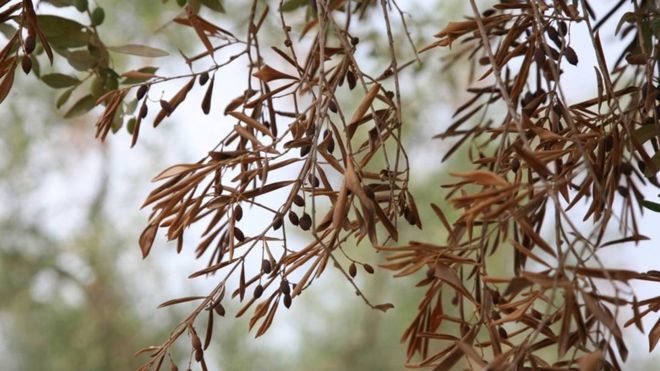
EPPO--Image captionThe invasive pathogen has affected thousands of hectares of olive plantations in Puglia, southern Italy
 By Mark Kinver-21 November 2016
A disease that poses a "very serious threat" to the EU's olive industry
has been recorded on the Spanish island of Mallorca for the first time.
Island officials said a movement ban covering 15,000 hectares had been
imposed and measures had been taken to "contain and eradicate its
spread".
Experts describe Xylella fastidiosa as one of the "most dangerous pathogens worldwide".
It was first recorded in the EU in 2013, and has since spread westwards.
'Ebola of olives'
Spanish newspaper El Mundo dubbed the bacterium the "Ebola of olive trees".
Officials from the Balearics' Department of Environment, Agriculture and
Fisheries said the subspecies of the pathogen had been detected in
three cherry trees at a garden centre during a routine check.
They added that the subspecies found on the island has only been
recorded infecting cherry and oleander plants, but measures were being
taken to eradicate it.
The Xylella fastidiosa bacterium invades the vessels that a
plant uses to transport water and nutrients, causing it to display
symptoms such as scorching and wilting of its foliage, eventually
followed by the death of the plant.
Since it was first detected in olive trees in Puglia, southern Italy, in
October 2013, it has been recorded in a number of other locations,
including southern France.
Experts warn that should the disease, which has numerous hosts and
vectors, spread more widely then it has the potential to devastate the
EU olive harvest.
Globally, the EU is the largest producer and consumer of olive oil.
According to the European Commission, the 28-nation bloc produces 73%
and consumes 66% of the the world's olive oil.
Reports suggested that the X. fastidiosa outbreak led to a 20% increase in olive oil prices during 2015.
