Peace for the World World ! Your War Our Lives

The Dalai Lama
A Brief Colonial History Of Ceylon(SriLanka)
Sri Lanka: One Island Two Nations
A Brief Colonial History Of Ceylon(SriLanka)
Sri Lanka: One Island Two Nations
(Full Story)
Back to 500BC.

Sunday, November 20, 2016
SRI LANKA: FOR THE FIRST TIME THERE IS AN EFFORT TO BUILD CONSENSUS ON DEVOLVING POWER – SAMPANTHAN
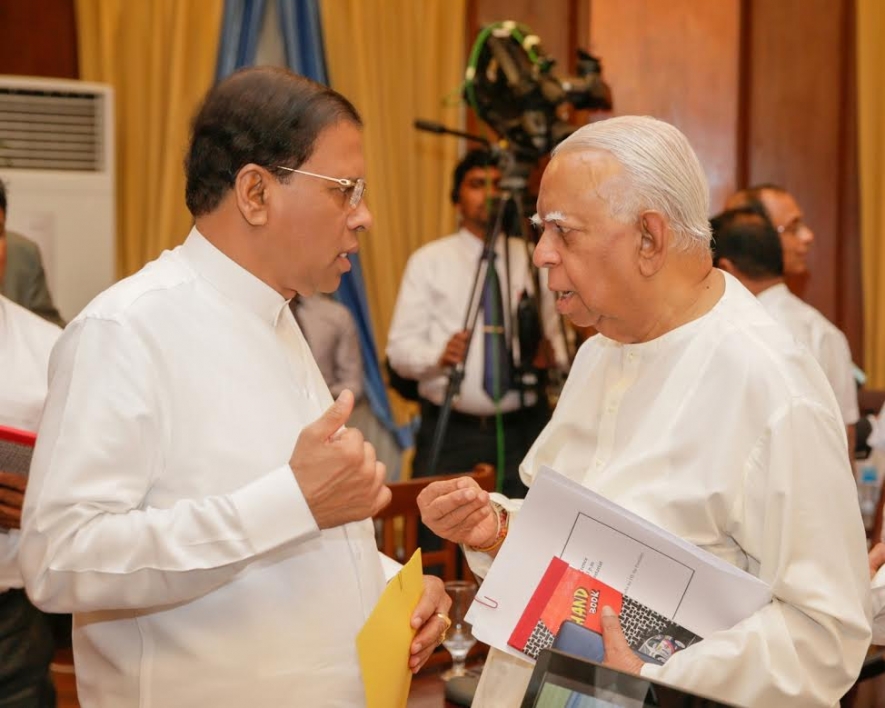
Image: President Sirisena and TNA leader Samapanthan.
 19/11/2016
Speaking at the budget debate at the Parliament leader of the TNA and
leader of the opposition R. Samapanthan said that ” It is anticipated
that, for the first time, within the framework of a single, undivided
and indivisible country, a Constitution evolved on the basis of a wide
consensus, will emerge and that this Constitution will reflect the will
of all the people in this country, and be the basis of the authority of
Government as stated in Article 21 of the Universal Declaration of Human
Rights. For the first time, Sir, in the history of this country the
political party substantially representing the Tamil people – that is
the Party which I happened to belong to, the Tamil National Alliance –
particularly in the North and the East of this country, will be a party
to the Constitution-making process. ”
Excerpts of the speech made by Hon. Sampanthan in Parliament on 17th Nov. 2016.
It is the objective of these two political parties to give the country a
new future – not merely economically but also politically and socially.
That indeed was the verdict of the country at both the Presidential
Election held in January, 2015 and the Parliamentary Election held in
September, 2015. The former regime and its leadership were prominent
participants in both those electoral contests. They sought at both
elections a further mandate to govern the country. The mandate so
sought by them was denied by the people. The people, in the exercise of
their sovereignty, have given President Maithripala Sirisena and the
Prime Minister Ranil Wickremesinghe the mandate to govern the country
for a period of time as stipulated in the Constitution. That is the
sovereign verdict of the people which can only be dislodged in
accordance with the Constitution and in no other way. Everybody in this
country wants this country to be governed in keeping with the tenets of
genuine democracy. These values, the Hon. Speaker, are sacred and need
to be protected and preserved.
I want, Sir, in this regard to quote from the Universal Declaration of
Human Rights adopted by the United Nations to which we have acceded.
May I quote Article 21 of the Universal Declaration of Human Rights,
which states:
“1. Everyone has the right to take part in the government of his country, directly or through freely chosen representatives.
- Everyone has the right to equal access to public service in his country.”
Unfortunately, that rule is not observed in Sri Lanka, particularly as far as the Tamil people are concerned.
The subparagraph (3) states, I quote:
“The will of the people shall be the basis of the authority
of government; this will shall be expressed in periodic and genuine
elections which shall be by universal and equal suffrage and shall be
held by secret vote or by equivalent free voting procedures.”
That is what, Sir, the Universal Declaration of Human Rights contains in
regard to the will of the people and the consent of the people in
regard to the governance of a country. The will of the people as
expressed in periodic and genuine elections which shall be by universal
and equal suffrage shall be the basis of the authority of Government
and that Mr. Speaker, is manifestly clear. In terms of our
Constitution, Mr. Speaker, the term of office of Parliament and the
President unless earlier terminated lawfully, in keeping with the
Constitution, is six years. Under the Nineteenth Amendment, which the
President was instrumental in introducing in Parliament, he reduced the
term of office of the President to five years though he had been
elected by the people for a period of six years. Through the Nineteenth
Amendment which was passed in Parliament after the Presidential
Election held on 08th January, 2015, the term of office of the
President was reduced to five years.
The Hon. Minister of Finance, in the course of his Budget Speech,
defined this Government’s economic, political and social vision. May I
read paragraph No. 2 of his speech. Sir, this is what he stated, I
quote:
“We will continue to progress in the noble endeavor to strengthen
democracy, fundamental rights, reconciliation and development for
lasting peace, freedom and national integration. Fundamentally, the
country is guided by a new vision of lasting peace, built on mutual
respect and dialogue. To cement this process, we have formulated an
ambitious reforms agenda encompassing all major spheres including
social, political, economic and international relations. This national
government of Yahapalanaya will focus on reforms to the constitution,
restoration and strengthening of the rule of law and independence of the
judiciary.”
The vision of the Government, Sir, in my respectful statement, has been
very lucidly stated in the statement made by the Minister of Finance in
the course of his Budget Speech. Sir, the Government, as I said earlier,
is committed to giving this country a new economic, political and
social future. We are, for the first time, seeking to evolve a
Constitution with the consent of the two main political parties, which
alternatively have ruled this country from the time we attained
Independence. It has been either of the United National Party or the Sri
Lanka Freedom Party which have ruled this country from the time we
attained Independence and there is a joint effort now for these two
parties to come together to frame a Constitution for this country with
the consent of other political parties and the people of this country.
This, Sir, is something new which had not happened before. It will be
based on the maximum possible consensus within the framework of a
single, undivided and indivisible country. We have had three
Constitutions earlier. The first Constitution in 1947 was framed at
Independence by our colonial rulers. The second Constitution in 1972 was
framed by the Sri Lanka Freedom Party and its left alliance partners
without the consent of the other major political party, the United
National Party, or the political party substantially representing the
Tamil people. The third Constitution was enacted in 1978 framed by the
United National Party without the consent of the other major political
party – the Sri Lanka Freedom Party -or the political party
substantially representing the Tamil people. In other words, Sir, both
the 1972 Constitution and the 1978 Constitution were partisan and framed
by one single political party with a few alliance partners, without the
consent of the other major political party in the country and more
particularly, without the consent or the consensus of the Tamil party
substantially representing the people in this country at those points of
time.
It is anticipated that, for the first time, within the framework of a
single, undivided and indivisible country, a Constitution evolved on the
basis of a wide consensus, will emerge and that this Constitution will
reflect the will of all the people in this country, and be the basis of
the authority of Government as stated in Article 21 of the Universal
Declaration of Human Rights. For the first time, Sir, in the history of
this country the political party substantially representing the Tamil
people – that is the Party which I happened to belong to, the Tamil
National Alliance – particularly in the North and the East of this
country, will be a party to the Constitution-making process. This would
enable the realization of the future vision for this country as
enunciated in Para 2 of Part I of the Budget Speech of the Minister of
Finance.
