Peace for the World World ! Your War Our Lives

The Dalai Lama
A Brief Colonial History Of Ceylon(SriLanka)
Sri Lanka: One Island Two Nations
A Brief Colonial History Of Ceylon(SriLanka)
Sri Lanka: One Island Two Nations
(Full Story)
Back to 500BC.

Thursday, November 24, 2016
Toronto reporter becomes Canada’s first hijab-wearing news anchor
Ginella Massa says greater diversity in Canadian media is needed to better reflect the country’s multicultural society
 Ginella Massa is the first Canadian news anchor to wear a hijab on air (Courtesy of Ginella Massa)
TJillian D'Amours-Wednesday 23 November 2016
ORONTO, Canada – Ginella Massa wasn’t always sure she wanted to be in front of a camera.

But bolstered by her mother’s support, Massa went for it, becoming the
first Muslim woman who wears a headscarf to report on camera for a
television news programme in Kitchener, Ontario, in 2015.
Last week, she added another important first to her resume: the first woman in a hijab to anchor a Canadian television newscast.
“As much as I knew that it was a milestone, I almost wasn’t prepared for
the overwhelming response,” Massa told Middle East Eye in a telephone
interview on Tuesday.
She filled in as the anchor of the 11 p.m. newscast on City News, a
local television news channel serving Toronto, Canada’s largest city,
and the Greater Toronto Area, on 17 November.
After posting a photo of herself on Twitter with the caption, “That's a
wrap! Tonight wasn’t just important for me. I don’t think a woman in
hijab has ever anchored a newscast in Canada,” the reaction was almost
immediate.
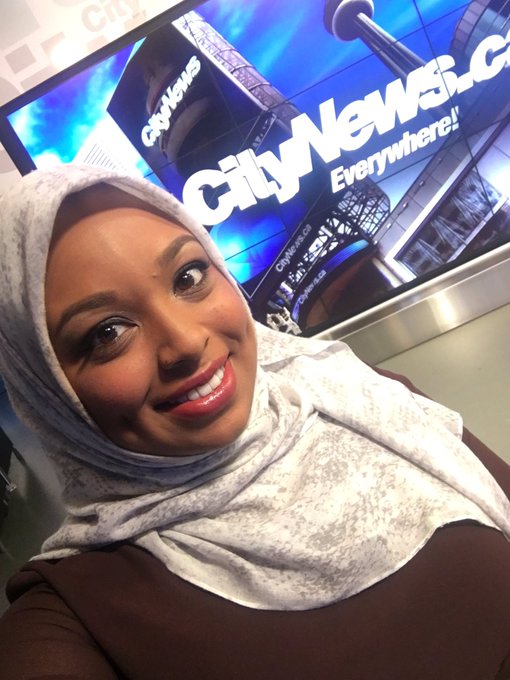


And it was overwhelmingly positive, Massa said, “from Muslims who feel
like this tells them that they belong in this society when they see
someone that looks like me reading their nightly news [and] from
non-Muslims who say, it’s about time that our newscasts look like our
community”.
Media diversity lacking in Canada
Toronto is one of the most diverse cities in the world. About 1.3 million people,
or 49 percent of the city’s total population, identified as a visible
minority in 2011, according to the last nationwide census.
Canada, meanwhile, prides itself on being a multicultural country. Approximately 6.3 million people in Canada (about 19.1 percent of the total population) identified as being members of a visible minority in 2011.
But that diversity is not reflected in Canada’s news media, or
television and film industries – and it hasn’t been for a long time.
In 1994, John Miller, professor emeritus at Ryerson University’s School
of Journalism, conducted a survey of racial diversity at 41 newspapers,
and found that only 2.6 percent of newsroom staff (67 of 2,620 staff
members) identified as minorities.
A decade later, Miller surveyed 34 daily newspapers across Canada, and
found that “that racial minorities are more than five times
under-represented in daily newsrooms,” while “the commitment of editors
to change their hiring patterns” actually declined between 1994 and
2004.
 For
Massa, the importance of media reflecting the communities they are
reporting from – from racial and gender diversity, to age, sexual
orientation and physical ability – cannot be overstate (Courtesy of
Ginella Massa)
For
Massa, the importance of media reflecting the communities they are
reporting from – from racial and gender diversity, to age, sexual
orientation and physical ability – cannot be overstate (Courtesy of
Ginella Massa)
“A majority of managing editors agreed with the statement that
‘minorities just don’t apply here.’ Yet only one mentioned taking any
steps to ensure that it was attracting minority candidates, such as
recruiting at journalism schools or ethnic publications,” the 2004
report found.
In a blog post from last June, Miller explained that while media
organisations in the US have kept track of diversity for over 30 years,
Canada does not. Reports on making Canadian broadcasting more diverse,
meanwhile, have been conducted, but go largely unimplemented.
“If newsrooms cannot stay in touch with the issues, the concerns, hopes
and dreams of an increasingly diverse audience, those news organisations
will lose their relevance and be replaced,” Miller wrote.
“That's not all. By denying media access to ethnic minorities, the
public gets a wrong perception of reality and the place ethnic
minorities have in society. And that's a recipe for social conflict -
the kind of blind fear of ‘the other’ that Donald Trump is stoking in
the US presidential election campaign.”
Efforts fall short
In the last year, several Canadian media organisations have sought to tackle diversity, from Colour Code,
a podcast on race produced by journalists at The Globe and Mail, to
columnists and reporters writing about racial and gender representation
more frequently.
But despite having these conversations, Canadian media outlets largely
remain under-representative of the larger communities they cover.
Last year, Davide Mastracci described “the unbearable whiteness of Canadian columnists” in the Ryerson Review of Journalism. Of 11 columnists at the Ottawa Citizen, all but one were white, a reality that Mastracci said reflects a wider trend in Canadian newspapers.
“Canadian columnists are predominately white, and this undermines the
relevance of the conversation they help shape on a daily basis,”
Mastracci wrote.
Most Canadian columnists are also disproportionately male and
middle-aged, according to a 2014 survey of Canada’s English-language
columnists conducted by J-Source, the Canadian journalism project. It
found that of 73 national columnists surveyed, only 27 percent were
female and 66 percent had a median age of 58.5 years.
Canadaland, a weekly podcast on media criticism and reporting, recently
attempted to get 18 of Canada’s largest daily newspaper to answer a
survey on diversity in their newsrooms. Only three newspapers responded.
Meanwhile, the nation’s public broadcaster, the Canadian Broadcasting Corporation (CBC), employs a staff that is about 90 percent white, despite a mandate to reflect the multicultural diversity of Canada’s population.
‘A voice of the people’
For Massa, the importance of media reflecting the communities they are
reporting from – from racial and gender diversity, to age, sexual
orientation and physical ability – cannot be overstated.
“If we want to truly be a voice for the people in our society, if we
want to tap into the stories of the people who live among us, then we
need to see diversity in our newsrooms,” she said.
“If we want to truly be a voice for the people in our society, if we want to tap into the stories of the people who live among us, then we need to see diversity in our newsrooms" - Ginelle Massa
She said the first step in making newsrooms more diverse is simply
creating opportunities for people who might not otherwise have easy
access to the industry.
Her work may also help open the door for others in the future, she said.
“For young Muslims, it’s really important for them to see themselves
not just in television, but also in positions of power, because it tells
them that those are the things they can do and achieve.”
“I’m trying to be the best journalist I can be,” Massa added, “and I just happen to wear a scarf while I’m doing it.”
