Peace for the World World ! Your War Our Lives

The Dalai Lama
A Brief Colonial History Of Ceylon(SriLanka)
Sri Lanka: One Island Two Nations
A Brief Colonial History Of Ceylon(SriLanka)
Sri Lanka: One Island Two Nations
(Full Story)
Back to 500BC.

Tuesday, November 22, 2016
World View: Sri Lankan Buddhist Monks Accused of Racist Hate Speech
- Sri Lanka Sinhalese Buddhist monks accused of racist hate speech against Hindu Tamils
- Sri Lanka says that ’32 élite, well-educated Muslims’ have joined ISIS in Syria
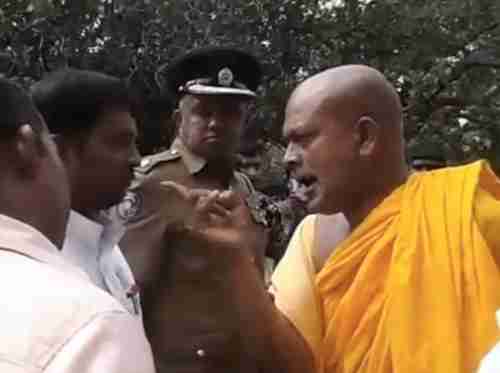
Image grab from video shows Buddhist monk using racist language to a Hindu Tamil civil servant, while policeman looks on and does nothing
 20 Nov 2016
Sri Lanka’s bloody generational crisis civil war between the
market-dominant mostly Buddhist ethnic Sinhalese and the mostly Hindu
ethnic Tamils ended in May 2009, and in the seven years since then, the
country has been devoted to achieving reconciliation between the two
ethnic groups.
So a number of people in both groups are alarmed at the sudden
occurrences of racist hate speech by Buddhist monks against Tamils. One
video that’s gone viral shows a Buddhist monk using extreme racist
expletives and abusive language to verbally assault and threaten a Tamil
public servant, as a (presumably Sinhalese) uniformed police officer
watched, without taking action.
In another incident, a Buddhist leader threatened a “bloodbath” in
protest over the arrest of a self-proclaimed “Savior of the Sinhalese.”
However, the racist attacks are apparently more ethnically than
religiously motivated, as Christian Tamils are also being targeted, as
well as Hindu Tamils and Muslim Tamils. More than 70 percent of Sri
Lanka’s 20 million people are Buddhists, about 13 percent are Hindu,
while Muslims make up around 10 percent.
A joint civil society submission to the Committee on the Elimination of
Racial Discrimination in August 2016 documented 132 incidents faced by
Christians and 141 incidents against the Muslims, in a span of one year,
since 2015. These incidents include attacks on places of religious
worship, and minority religious communities being disrupted during times
of worship and prayer. Even worse, no attempt has been made to
prosecute the offenders.
According to Father S. J. Emmanuel, president of the Global Tamil Forum,
the attacks are signs of increasing Sinhalese nationalism by Buddhist
monks:
While the Sri Lankan Constitution clearly guarantees all citizens the right to equality, non-discrimination and freedom of religion and religious worship, the number of attacks against religious and ethnic numerical minorities across Sri Lanka, by ethno-nationalist majoritarian groups, typically led by one or more Buddhist monks, remains unchecked. Civil society groups have consistently documented and reported such attacks to relevant authorities. However, charges have never been brought against the perpetrators, despite the conduct of these monks being in clear violation of hate-speech and anti-discrimination protections under Sri Lankan law.
Both Christian and Hindu Tamil groups have called on the government to
bring to justice all those in violation of Sri Lanka’s
anti-discrimination and hate-speech laws, including Buddhist monks. This
is not very likely to happen.
Sri Lanka is in a generational Recovery era, following the end of the
civil war. This is a period of austerity when rules and institutions are
devised by the survivors of the civil war to make sure nothing like it
ever happens again. These rules and institutions survive for several
decades until the Unraveling era, when younger generations have come to
power, and the generations that survived the war are no longer running
things.
These racist attacks by Buddhist Sinhalese against Hindu and Christian
Tamils are the first signs of what’s to come in few years, when the
first postwar generation comes of age, in the generational Awakening
era. Sunday Leader (Colombo, Sri Lanka) and The Hindu (India) and The Island (Colombo)
Sri Lanka says that ’32 élite, well-educated Muslims’ have joined ISIS in Syria
Sri Lanka’s justice minister Wijeyadasa Rajapakshe says that 32 Sri
Lankan Muslim have traveled to Syria to join the so-called Islamic State
(IS or ISIS or ISIL or Daesh). According to Rajapakshe:
All these (Muslims) are not from ordinary families. These people are from the families which are considered as well-educated and élite.There is a greater fear among the public about ISIS. If somebody tries to spread extremism in this country, we will not allow for that from today. The law of this country is no different to Buddhist monks or ordinary people.
However, the Muslim Council of Sri Lanka (MCSL) strongly objected to
this statement, saying that the referenced incidents occurred over a
year ago:
We strongly object to this misplaced statement. The facts given by the Minister were reported in the media more than a year ago when a Sri Lankan combatant died fighting with ISIS.There have been no new reports of any others getting involved since this was reported last year.It is believed that one family had gone to Syria to provide humanitarian support to the war wounded and refugees. Some of the men are alleged to have joined or forced to join the fighting forces of ISIS. The Muslim community, including the Muslim Council, Jamiathul Ulema and other organizations cooperated with the government in identifying the families to provide the necessary support for the intelligence agencies to investigate.
According to the MCSL, Sri Lanka is unlike other countries in that Sri
Lanka Muslims have been condemning un-Islamic comments by Muslims, and
there are no madrassas “indoctrinating its children with
fundamentalism.”
This is entirely believable, and a credible contrast to Muslims in
northern Africa, the Mideast and southeast Asia. All of those countries
are in generational Crisis eras, with their last generational crisis war
having been World War II or earlier, and so the popular mood in those
countries is highly nationalistic and xenophobic toward non-Muslims or
even Muslims in other branches (i.e., Sunni versus Shia).
But Sri Lanka is in a generational Recovery era, having just gone
through an extremely bloody civil war that encompassed Buddhists, Hindus
and Christians as well as Muslims. The population is war weary and
eager to apply “lessons learned” from the civil war, creating laws and
institutions to guarantee that no such horror will ever happen again.
There will always be exceptions, but for the time being, Muslims in Sri
Lanka are not jihadists and are not supportive of jihadists, as they are
in the other 80 or so countries that sent young men and women to Syria
to fight the genocidal actions of Bashar al-Assad. As years and decades
go by, and new generations come of age, this attitude will change, of
course, but right now there are few people who want to thwart the
country’s attempt at reconciliation. Reuters and New Indian Express
Related Articles
- Tamil Tigers surrender, ending the Sri Lanka crisis civil war (17-May-2009)
- Tamil Tigers renounce violence, to join Sri Lanka political process (25-May-2009)
- Sri Lanka has deep split with U.N. on war crimes report (23-Apr-2011)
- Sri Lanka follows a predictable pattern after its civil war (15-Jan-2015)
