
Peace for the World World ! Your War Our Lives

The Dalai Lama
A Brief Colonial History Of Ceylon(SriLanka)
Sri Lanka: One Island Two Nations
A Brief Colonial History Of Ceylon(SriLanka)
Sri Lanka: One Island Two Nations
(Full Story)
Back to 500BC.
Sunday, December 4, 2016
'It is time to make' three-person babies
 By James Gallagher-30 November 2016
It is time to start making babies from three people, according to scientists advising the UK's fertility regulator.
The move has been described as "historic", and the regulator will make its decision next month.
Doctors want to make babies from three people to prevent diseases that
starve the body of energy, leading to brain damage, muscle wasting and
heart failure.
However, fresh evidence suggests it will fail in one in eight pregnancies.
Three-person IVF replaces the defective power packs in the mother's egg -
called mitochondria - with healthy ones from a donor woman.
A three-person baby has most of its genetic inheritance from its parents, but also a tiny amount from the donor woman.
Parliament has already legalised the controversial procedure, and a baby has been born from the technique in Mexico.
However, there have been calls for extra checks on the science before it goes ahead in the UK.
Prof Robin Lovell-Badge, one of the researchers who reviewed the evidence, said the moment had come.
"We're not going to learn much more now unless you try it out for real basically - it's at that stage," he said.
"There's no reason why it shouldn't go ahead now, but do it cautiously
on selected patients where the risk of having a badly affected child is
very high."
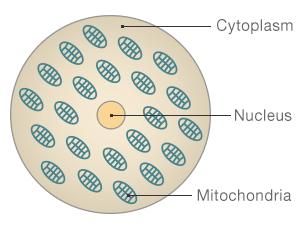
Thestructure of a cell
Nucleus: where the majority of our DNA is held - this determines how we look and our personality
Mitochondria: often described as the cell's factories, these create the energy to make the cell function
Cytoplasm: the jelly-like substance that contains the nucleus and mitochondria
A study, published in Nature, suggests those defective mitochondria could still take over in one in eight babies and cause disease.
Researchers at Oregon Health and Science Unit created embryos from four women who had children with mitochondrial disease.
Samples of those embryonic cells were then grown in the laboratory.
Prof Paula Amato, who published her findings in the journal Nature,
said: "Some embryonic stem cell lines did revert back to the mutant
mitochondrial DNA."
The scientific review team has recommended extra checks during pregnancy to ensure the baby is healthy.
Prof Lovell-Badge said: "It's likely to be something we have to worry
about if the experiments that have been done on embryonic stem cells are
representative of embryos that were re-implanted.
"That's why we recommend a pre-natal diagnosis method to check whether reversion is occurring in the developing foetus."
A team in Newcastle has pioneered research in the field and is likely to
be the first to be given a licence to make three-person babies.
Prof Doug Turnbull, from Newcastle University, said: "This is obviously great news, and I agree with the report conclusions.
"I think the report highlights the very careful way in which the UK has
proceeded with this new IVF technique and hope the HFEA [Human
Fertilisation and Embryology Authority] approve this at their meeting in
December."
Commenting on the report, Prof Bert Smeets, from Maastricht University,
said: "It is historic that the independent science review panel
concludes that it is appropriate to offer mitochondrial donation
techniques as clinical risk reduction treatment for carefully selected
patients."
Follow James on Twitter.
