Peace for the World World ! Your War Our Lives

The Dalai Lama
A Brief Colonial History Of Ceylon(SriLanka)
Sri Lanka: One Island Two Nations
A Brief Colonial History Of Ceylon(SriLanka)
Sri Lanka: One Island Two Nations
(Full Story)
Back to 500BC.

Friday, December 30, 2016
One Belt And One Road Initiative Of China & Its Implications In Sri Lanka

By Mohamed Shareef Asees –December 29, 2016

Dr. Mohamed Shareef Asees
One Belt and One Road (OBOR) initiative has become the centerpiece of
China’s economic diplomacy in the recent years. The essence of OBOR is
to promote regional and cross-continental connectivity between China and
other developing countries. The ‘One Belt’ and ‘One Road’ refer to
China’s proposed ‘Silk Road Economic Belt’ and ‘Maritime Silk Road’.
Connectivity covers five major areas of interest: Policy coordination,
infrastructure construction (including railways and highways), unimpeded
trade, financial integration and people-to-people ties. Among these,
infrastructure construction is the dominant feature of the New Silk
Road. It is reported that the proposed OBOR has connected around 78
countries from East (Philippines) to West (Europe). The OBOR is not only
benefit to China but also central to other developing countries where
it connects all countries physically and make economic cooperation with
them.
Although the OBOR has started in 2013, it has over 2000 years history.
China’s imperial envoy Zhang Qian who was a Chinese diplomat who served
as an imperial envoy to the world outside of China during the 2nd
century helped to establish the Silk Road (A network of trade routes
that linked China to Central Asia and the Arab world). The name came
from one of China’s most important exports—silk. And the road itself
influenced the development of the entire region for hundreds of years.
In 2013, China’s president, Xi Jinping, proposed establishing a modern
equivalent, creating a network of railways, roads, pipelines, and
utility grids that would link China and Central Asia, West Asia, South
Asia and parts of South East Asia. This initiative, One Belt and One
Road (OBOR aims to create the world’s largest platform for economic
cooperation, including policy coordination, trade collaboration and
social & cultural cooperation. OBOR can be a economic platform to
create benefits for everyone.
The State Council authorized an OBOR action plan in 2015 with two main
components: The Silk Road Economic Belt and the 21st Century Maritime
Silk Road (exhibit). The Silk Road Economic Belt is envisioned as three
routes connecting China to Europe (via Central Asia), the Persian Gulf,
the Mediterranean (through West Asia), and the Indian Ocean (via South
Asia). The 21st Century Maritime Silk Road is planned to create
connections among regional waterways. More than 60 countries, with a
combined GDP of $21 trillion, have expressed interest in participating
in the OBOR action plan.
The effort has already made some practical achievements. China has
signed bilateral cooperation agreements related to the project with
Hungary, Mongolia, Russia, Tajikistan, and Turkey. A number of projects
are under way, including a train connection between eastern China and
Iran that may be expanded to Europe. There are also new rail links with
Laos and Thailand and high-speed-rail projects in Indonesia. China’s
Ningbo Shipping Exchange is collaborating with the Baltic Exchange on a
container index of rates between China and the Middle East, the
Mediterranean, and Europe. More than 200 enterprises have signed
cooperation agreements for projects along OBOR’s routes. Following map
shows the various economic routes of China.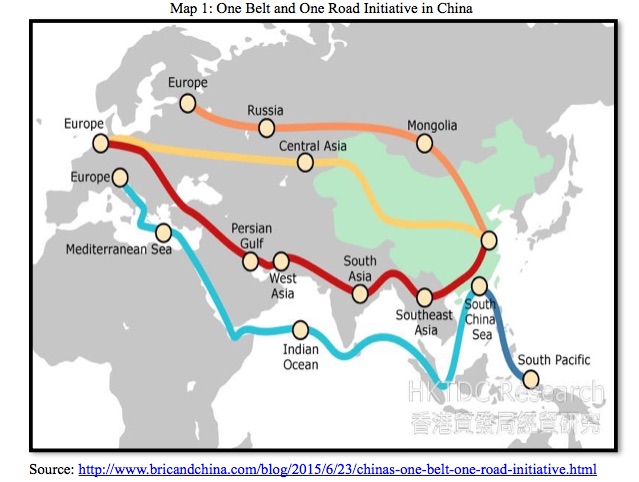
The Initiative aims to consolidate and upgrade existing infrastructure
and build new transport routes to improve cross-border trade. It also
includes efforts to promote a greater financial integration with foreign
countries and create a “Digital Silk Road” of international
communication and information distribution. The “Silk Road Economic
Belt” connects China via land with Central Asia, Russia, Europe and
Southeast Asia. The “21st Century Maritime Silk Road” makes a link from
the Indian Ocean, through the South China Sea to the South Pacific Ocean
(see map). Geographically positioned in the middle of both the Belt and
the Road, China has emerged as the facilitator in developing a
connection between Europe and Asia. All roads lead to China; the
Initiative has given major priority to infrastructure. Plans are already
in place to build railway networks, port facilities, airports, highways
and electronic communication networks to guarantee smoother and more
efficient transportation of goods and people, from Southeast Asia to
Western Europe.
