Peace for the World World ! Your War Our Lives

The Dalai Lama
A Brief Colonial History Of Ceylon(SriLanka)
Sri Lanka: One Island Two Nations
A Brief Colonial History Of Ceylon(SriLanka)
Sri Lanka: One Island Two Nations
(Full Story)
Back to 500BC.

Thursday, January 12, 2017
Four Brothers Who Ran The Country…Avarice Personified

“The lust of avarice has so totally seized upon mankind that their
wealth seems rather to possess them than they possess their wealth.” ~Pliny the Elder
The guns fell silent. Victory cries echoed in the skies while jubilant
Sri Lankans celebrated the war victory with Kiribath (milk-rice),
Lunu-Miris (chili-peppered onion-chutney) and plain tea. The country at
large, those who lived south of Vavuniya, claimed, in all rightful
sense, a historic military victory over the forces of Tamil extremists
who brought unspeakable terror, anguish, pain and death to many a
Sinhalese-Buddhist community. The celebrations were justifiable; the
claims were authentic and lofty hopes for a dawn of a new era with
peace, prosperity and stability reached beyond the frontiers of reality.
That was May 19th 2009. Now it looks so far and distant and the
victory’s gleaming rays have paled into the dim-light of time.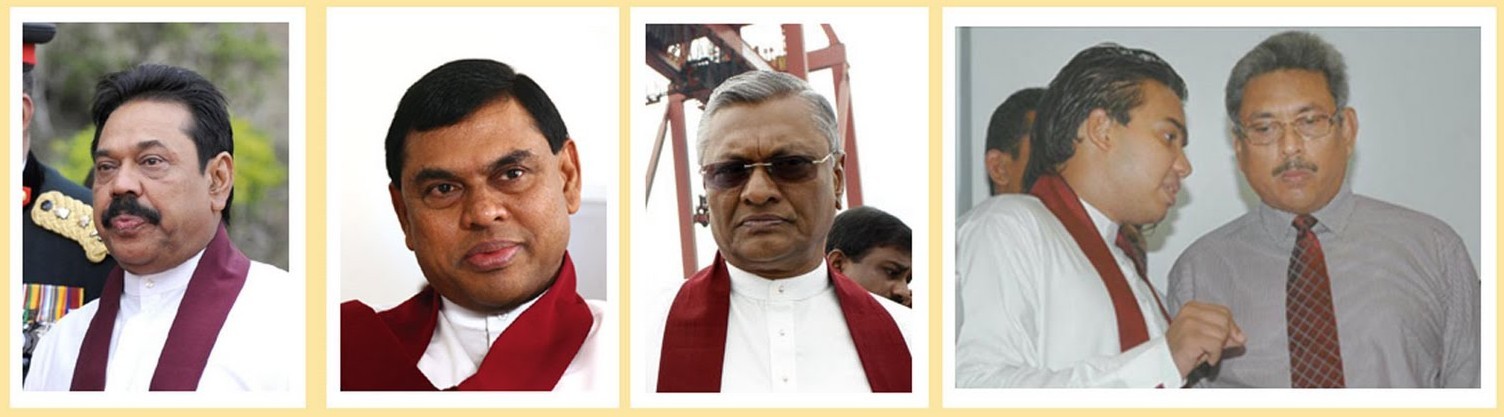
People’s priorities changed; victors were rejected by the very people
who hailed a modern Caesar who did not fire single bullet nor stopped
one to shield the brother-soldier behind; the field commander who
marshaled his men, the commander who planned and designed every single
attack and counter-attack, the commander who led his brave soldiers in
the trenches, the commander who nearly died from a suicide-bomber
attack, became the first victim of the peace. While the siblings of the
Commander-in-Chief claimed ownership of the victory, not of the war that
consumed hundreds of the children of ordinary families of our nation,
the Army Commander was found guilty of flimsy charges and put behind the
unkind bars of Welikada prisons. Such were the great and cruel ironies
of our times that followed the so-called victory.
From 1994 to 2014, twenty long years, on the military side, were filled
with stories of great bravery; yet they were filled with unspeakable
grief for innocent masses of our land who lived on the south side of
Vavuniya. They tell a story of a nation, at times meandering between
what to do and what not to do, sometimes making advances on the
battlefield and retreating other times, a story of utter disbelief when
their children didn’t come home on time; of tormented residents along
border villages not knowing whether they would live or die the night
they go to sleep, these were the years some would like to forget, yet
they would be etched in their memories for a long time. The political
leadership provided at that time switched from a Bandaranaike to a
Rajapaksa.
But the pattern of politics did not change. The SLFP carried on with
their caravan of populist measures on the economy and ultra-nationalist
on the socio-ethnic issues. The policies and postures so adopted
portrayed a regime hell-bent on teaching a lesson, not only to a
terrorist army, but also to a segment of our own people, Tamil
civilians. These are the years in which an emotion against terrorism
turned into a war against a whole people. The divide between the
Sinhalese and Tamils took root and those who controlled the coffers of
the country controlled the mass psyche.
The tragic feature of this period is that no politician, no pundit, no
NGO, no state institution, no civil organization, no media outlet, no
segment of the clergy, took notice of the fact that the nation’s
character is receiving irrevocable alteration, its culture is being
debased, its inner soul is being consumed by the marketplace, its
education is being neglected beyond any chance of a ‘correction’ and its
role- model politicians were wining dining and in five-star hotels in
the company of that new class of crony-capitalists. It was indeed a
spectacle of macabre consumerism.
 Those
political leaders who used to pontificate about the purity of our
cultural values have discarded those very values like early morning
spit. And when the Rajapaksas assumed the mantle of power after
Chandrika Kumaranatunga Bandaranaike, all focus was on the war in the
North and thanks mainly to the incredible leadership of the commanders
on the field and adequate political leadership at the center, the
dreaded Prabhakaran and his Liberation Tigers of Tamil Elam passed into
history.
Those
political leaders who used to pontificate about the purity of our
cultural values have discarded those very values like early morning
spit. And when the Rajapaksas assumed the mantle of power after
Chandrika Kumaranatunga Bandaranaike, all focus was on the war in the
North and thanks mainly to the incredible leadership of the commanders
on the field and adequate political leadership at the center, the
dreaded Prabhakaran and his Liberation Tigers of Tamil Elam passed into
history.
What followed this historic war victory is what destroyed the political
victors. This war victory, the ruling family assumed, was an open
license to use their political power to use it to accumulate wealth, to
suppress the media, allegedly eliminate political critics and generally
run amok with unlimited power. The notorious 18th Amendment was a
byproduct of this great avarice the ‘Four Brothers’; their vulgar
pursuit of physical pleasures manifested themselves in midnight race car
rallies; their crude indulgences were of the ‘other worldly’ sort . The
first decade of the Twenty First Century represented some of the best
and worst in our short history from Independence to present. The
beginnings of the winds of victory are lost in the reeking mists of
corruption, nepotism and cruelty. This land of ours has a long history, a
history that is rich with magnificent kings and reasonably steadfast
democratic rulers; her history could boast about being magnanimous in
victory because her victorious kings decreed that her subjects adhered
to noble rituals of respecting defeated enemy-kings, her history built
colossal stupas upon the sacredness of the teachings of the Thathagatha,
the Enlightened One. For the first time in her long and cherished
history, she submitted herself to the rule of ‘Four Brothers’. The eldest was the Speaker of the House of Parliament; next was the President and the other two controlled the most vital sectors of the country, Defence and the Economy. Among themselves was disbursed nearly 70% of the country’s budget.
