Peace for the World World ! Your War Our Lives

The Dalai Lama
A Brief Colonial History Of Ceylon(SriLanka)
Sri Lanka: One Island Two Nations
A Brief Colonial History Of Ceylon(SriLanka)
Sri Lanka: One Island Two Nations
(Full Story)
Back to 500BC.

Saturday, January 7, 2017
Lessons From Fidel For 2017 & After

By Sarath de Alwis –January 5, 2017

Sarath de Alwis
In a recent missive, Dr. Dayan Jayatilleka has offered some ‘Lessons from Fidel for the Lankan Left.’
Let us first unravel the term ‘left’. The ‘left’ comprehends
‘oppression’ and identifies the ‘privileged’. The ‘left’ also
understands the nature of ‘power’. Demolishing power dynamics is the
task of the ‘left.’
In these confused times, terms ‘left’ and ‘right’ are best defined in
context. Who uses them? For what purpose? Where are they being used?
The playwright and sharp-witted history scholar Allen Bennett explains
what contextualising does. “Putting something in context is a step
towards saying it can be understood and that it can be explained. And if
it can be explained then it can be explained away.”
The wave of idolizing, idealizing, derision and damning of Fidel Castro after his death, confirms what Frederic Nietzsche asserted with brevity. ‘There are no facts, only interpretations.’
Castro led a revolution that ousted a brutal Dictator. The American Mob
owned Havana’s vice industry and American corporates owned the island’s
Sugar industry. Castro with his revolution ousted Batista the overseer
of plantations and pimp of the Cuban brothels.
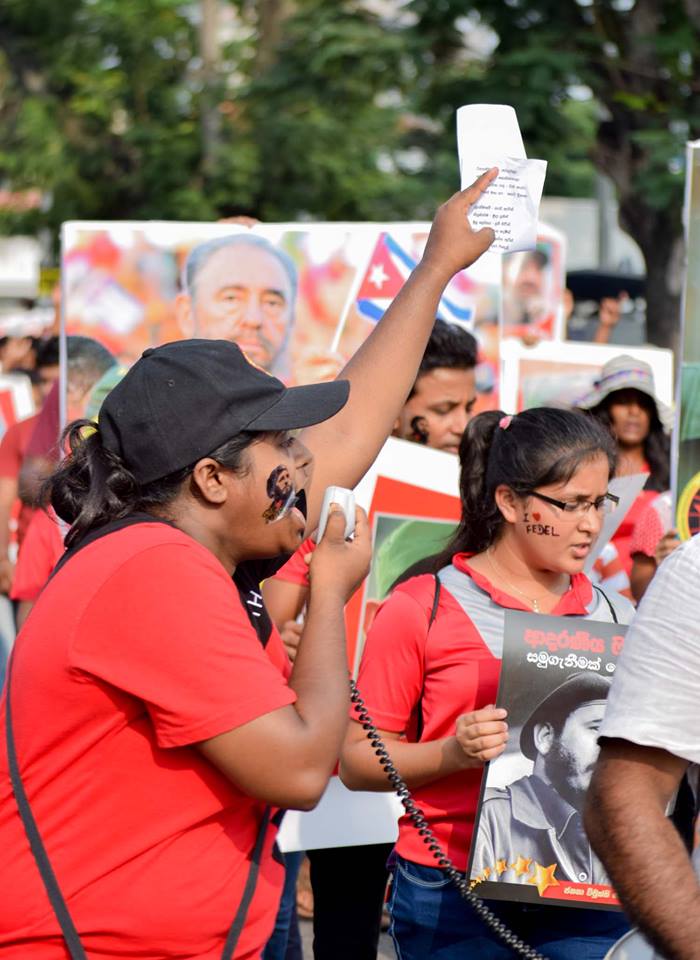
Fidel commemoration in Sri Lanka | Photo via JVP Facebook
In 1959, hardly three months in power, the new Prime Minister of Cuba,
Fidel Castro addressed a group of students and faculty members of the
Woodrow Wilson School at Princeton.
Castro told his audience that he was neither a theorist nor a historian
or chronicler of revolutions. His knowledge on the subject of revolution
was the sum total of his engagement with a revolution that took place
in the island of Cuba in close proximity to the United States. He told
his avid listeners – the left of center elite intellectuals gathered at
Princeton that the Cuban revolution had debunked several myths
propagated by the Latin American Right: that a revolution was impossible
if the people were hungry, and that a revolution could never defeat a
professional army equipped with modern weapons.
At Princeton, Castro remembered Batista the cruel overseer of
plantations and degenerate pimp of Havana brothels. He saw himself as
the product more in line with the American Revolution of 1776 than
either the French Revolution of 1789 or the Russian revolution of 1917.
The two later upheavals had been driven by “force” and “terror” wielded
by minorities. The groups that took power in France and Russia “used
force and terror to form a new terror.”
Hannah Ardent too had been in the audience. It was Arendt’s first year
at Princeton, after she became Princeton’s first woman to be awarded a
professorship. In her 1964 essay ‘Revolutions – Spurious and Genuine’
she wrote that the Cuban Revolution, “even though we don’t yet know the
outcome” was most certainly a revolution.
In ‘Critique of Political Economy, Marx tells us “It is not the
consciousness of men that determines their existence, but, on the
contrary, their social existence that determines their consciousness”.
That said we must agree that Cuba has spectacularly managed to maintain
universal repute as an ‘alternative model of development with a ‘society
that builds the welfare of its citizens on the twin pillars of health,
and education, driven by the principle of equality’.
Rafael Rojas one of Cuba’s renowned scholars of Latin American History
has described Castro’s encounter at Princeton in his 2016 book Fighting
over Fidel – The New York Intellectuals and the Cuban Revolution.
Professor Rojas says that Fidel in his remarks in 1959 ‘situated his
ideology well within the scope of a democratic American humanism shared
by the United States and Latin America. The two regions, despite their
cultural specificities, did not constitute “different people,” he
assured his audience.
He had also assured his American audience that elections would soon be
held in Cuba and political parties would also be allowed. However it was
first necessary ‘to implement a social transformation in order to
eradicate unemployment and illiteracy and to construct schools and
hospitals.
The United States, Castro suggested, could assist in social development
of Cuba by implementing friendly policies and by rejecting any fear of
communism. An authentic social revolution on the island would make
democracy a “real” process and ward off the communist danger. “I advise
you not to worry about Communism in Cuba. When our goals are won,
Communism will be dead.”
I am still reading the book that is focused more on left wing
intellectuals affected, dejected and influenced by the Cuban revolution.
I do not know at what point Fidel decided to turn from emancipator to
Marxist Leninist dictator. Our Utopias are often shaped by events beyond
our control. Early in the revolution Fidel was taken hostage by the
hemispheric hegemony of the United States. In the bleak years of the
cold war, he made his choice. After Gorbachev it was too late. The
obstinacy of an old man was the lot of the Cuban people.
The struggle to understand Fidel Castro has not ended but his relevance has reached the end.
In fairness to Fidel Castro it has to be said that his authoritarian
governance was not for personal aggrandizement. It was not to enrich
himself, his family or his cronies. It was his simplicity that sustained
a messianic charisma among his people. Towards the end, he may not have
commanded the same admiration. It seems that his state apparatus
retrained the same loyalty.
This writer shares the birthday 13th August with Fidel Castro. There is a
compelling reason for this commentary. I spent my 20th birthday on 13th
August 1962, watching from a window of a youth hostel in West Berlin,
the communist regime erecting the wall overnight dividing Berlin the
city of Rosa Luxembourg who told us the essence of socialist democracy.
“Without general elections, without freedom of the press, freedom of
speech, freedom of assembly, without the free battle of opinions, life
in every public institution withers away, becomes a caricature of
itself, and bureaucracy rises as the only deciding factor.”
I watched parliamentarian Sunil Handunneththi – Chairman of COPE with an
undoubtedly razor sharp mind romanticizing Fidel Castro’s achievements
in health care and education for the people of Cuba on a TV program.
[Derana 360º]. That triggered alarm bells.
The JVP – the alternative to the establishment needs to discover
scientific socialism. Marxism is a science. Fidel Castro is a brand. The
two should not be confused.
I am completely in agreement with Dr. Dayan Jayatileka on Castro
brothers and Rajapaksa brothers. Mahinda and Gotabaya Rajapaksa are the
closest we have to Fidel and Raul Castro. I would even go further. Our
duo are infinitely better than their Caribbean counterparts.
Fidel combined Latin machismo, Catholic dogma and Communist rhetoric
with Raul as enforcer of regime discipline. Mahinda combined Sinhala
machismo, Buddhist scripture and progressive rhetoric. Gota was master
enforcer of regime discipline.
Fidel in the sixties, faced the same dilemma faced a decade later by our
comrades Colvin and Doric with plantations. Castro opted to
collectivize the sugar plantations. What is Fidel Castro’s legacy? Sugar
was the sole source of economic sustenance of Cuba when he took over.
At the time of his death Sugar remains the only source of economic
sustenance of the land he liberated from his dictator predecessor.
The Afro Cubans remain time warped and trapped as their ancestors were
in the ‘Sugar’ conundrum ‘wounded and shattered like the cane of the
fields and like cane are ground and crushed to extract the juice of
their labour’ with one difference. They have accesses to a doctor and
all can read and write. Cuba still relies on Sugar and hopes to promote
tourism.
