Peace for the World World ! Your War Our Lives

The Dalai Lama
A Brief Colonial History Of Ceylon(SriLanka)
Sri Lanka: One Island Two Nations
A Brief Colonial History Of Ceylon(SriLanka)
Sri Lanka: One Island Two Nations
(Full Story)
Back to 500BC.

Sunday, January 8, 2017
Progressing, Not Knowing Where

By Ranil Senanayake –January 7, 2017
Dr Ranil Senanayake
Sri Lanka has opted to enter the global economic system with a very poor
appreciation of the scientific considerations of the different options
and paths available. In the global financial system, growth is seen as
engine of development, but the source of power that has been chosen to
propel that growth is making this nation dangerously vulnerable to the
emerging global reality of Climate Change.
Power, as is used in the present context, is energy in a state
utilizable for our uses. It is inexorably tied to the economy of any
nation. However, power should be categorized into two distinct groups:
Internalized power or power that can be generated locally within the
boundaries of a given nation and externalized power or power that has to
be obtained from outside the nation and has to be imported.
If the rate of growth is constrained by internalized power, it will
produce excellent effects vis-à-vis inflationary trends in the economy.
Conversely, if growth is dependant on externalized power, the economic
system becomes hopelessly locked into whatever inflationary cycle that
the external suppliers are prone to, and any internal attempts in
controlling it are useless. Given the exponential rise in the
environmental and social cost of fossil energy, the wisdom of attempting
to develop based on the consumption of externalized fossil power is
questionable.
The promotion of the current perverted vision of ‘development’ where
massive projects, consuming huge quantities of cement (sixteen times
more potent than gasoline in producing fossil carbon dioxide), steel
where every ton of is responsible for 1.2 tons of CO2 form the basis of
this ‘development’ must be questioned.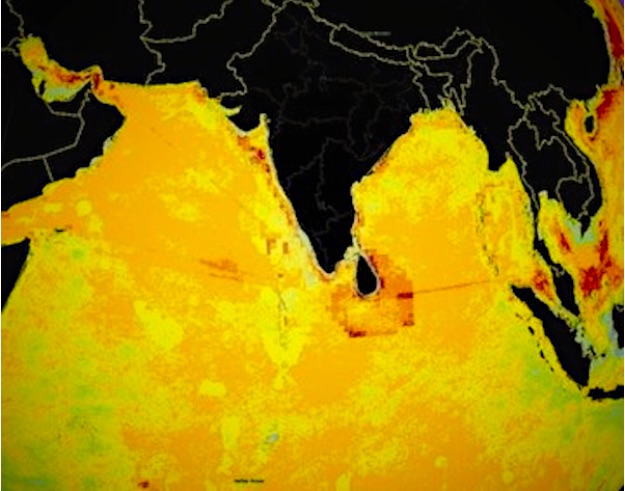
Pollution in the Indian Ocean
It is such uninformed ideas of development, of unplanned construction
and undervalued human health that seek the creation urban centers
carrying a massive fossil carbon footprint. Growth for the sake of
growth without directing it towards a nationally accepted plan reeks of
self-interest. An example is the promotion of a megapolis without
considering the Carbon cost of the air conditioning and coolants needed
for such a megapolis. This jump in our Carbon footprint makes us
irresponsible in terms of our international obligations to address
Climate Change.
As an island state we have not been responsible by the sea around us either. Sri Lanka is exposed as the worst polluter of the Indian Ocean. The new maps on human impact on the world’s oceans are now on the web.
Although there had been regular commentary on the need of every
government and various authorities to be cognizant of oceanic health, it
was a shock to see the evidence that is now before us. The map of the
Indian Ocean shows an ugly halo of pollution and ocean impact that rings
the ocean around Sri Lanka.
The irresponsible use of our land, cutting the forests, eroding the soil
and drenching it with artificial fertilizers and agro/ industrial
toxins, finally result in polluting the ocean. The biological indicators
of a healthy shoreline are the rock pools, once the rock pools that
fringed our shores were alive with fishes and even corals, all the rock
pool corals were lost by the 80’s. The inshore corals and the fringing
shallow reef was next and finally the deep reef. We saw this national
patrimony degrade and disappear within our lifetime. Those who have
experienced the biodiversity of the Welawatte canal, before the advent
of the textile mills pumping their affluent into it, will know the
changes. It was a time when coral reef fish such as Butterfly Fish
(Cheatodons ) could be seen under the road bridge at Welawatte. The
toxic affluent changed the clear waters to a dark, opaque hue and
destroyed all the things that lived in and along the canal. Even at that
time, many of us realized the damage that was being done to our inland
waters by irresponsible industrialists, predictably the politicians and
bureaucrats ignored public concern, but the extent of the damage to the
ocean around us was not even remotely realized until the advent of
satellite sensing.
A study of the satellite data also indicates that a major source of
marine pollution comes from the shipping that goes through our waters,
polluting without any care, what will happen, when the dirty, bunker
fuel burning, cheap freighters begin to call in at Hambantota?
