(New York) –
Sri Lanka’s government should promptly implement recommendations on transitional justice proposed by the
Consultation Task Force (CTF) in
a report released on January 3, 2017, Human Rights Watch said today.
The report reflects the first broad survey of Sri Lankan citizens on
their aspirations for truth and justice, as called for by the October
2015 resolution of the
United Nations Human Rights Council (UNHRC).
Key among the task force’s recommendations is the creation of a war
crimes court comprised of both international and national judges and
other officials, with no time limit on its jurisdiction. Support for
this court included ethnic Sinhalese, whose population suffered
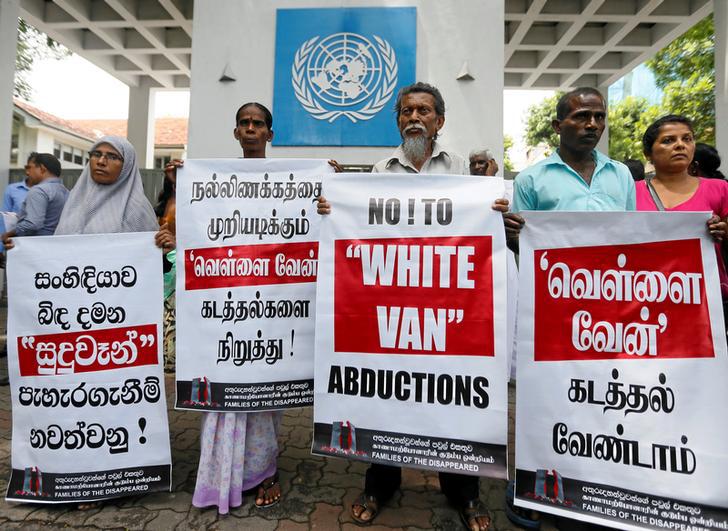
thousands of enforced disappearances three decades ago for which there
has been no accountability. The task force also recommended a
countrywide response to disappearances, financial and symbolic
reparations, a constitutional and political settlement, resolution of
longstanding land disputes, and attention to psychosocial needs.
“The task force report is remarkably comprehensive and clear in setting
out the concerns and needs expressed by Sri Lankans across all
communities on the transitional justice process,” said
Brad Adams,
Asia director. “The government should now own the report’s
recommendations and set out a framework for putting them into action, in
line with its pledges at the Human Rights Council.”
The Consultation Task Force was
formally appointed in February 2016, and began receiving submissions in April 2016 on the proposed mechanisms outlined in
Human Rights Council Resolution 30/1,
in which the government promised to deliver justice, accountability,
and reconciliation in the aftermath of Sri Lanka’s 26-year-long civil
war. The task force, aided by civil society representatives, received
7,306 submissions from the Sinhalese, Tamil, Muslim, and other
communities, as well as the security services during the course of their
hearings.
The CTF concluded its consultations in August 2016. The task force
reported that there had been no government interference or attempts to
impede their work, and that the report reflected the views of all 11
members. In a news conference held after the report’s release, CTF
members noted that concerns about justice and accountability were raised
both in the country’s north and south by many in all communities.
Sri Lankan governments have avoided addressing wartime accountability
despite credible reports of thousands of enforced disappearances,
extrajudicial executions, torture, and sexual violence committed by both
government forces and the secessionist
Liberation Tigers of Tamil Eelam (LTTE).
A new government, elected in January 2015, undertook a more
conciliatory approach to domestic and international efforts to address
the matter, and in October 2015 agreed at the Human Rights Council to
establish at least four mechanisms on
transitional justice, of which the consultations were part.
Sri Lanka is on the March 2017 agenda of the Human Rights Council, where
High Commissioner for Human Rights Zeid Ra’ad Al Hussein is expected to
report on Sri Lanka’s compliance with the resolution.
The government should recognize that its commitments were not only to
concerned governments in Geneva, but to its own citizens seeking justice
and reconciliation after a terrible war.
Brad Adams
Asia Director
This will include the government’s willingness to promptly implement the
CTF report recommendations. However, the immediate response by senior
officials has been disappointing.
Justice Minister Wijedasa Rajapaksa and
Health Minister Rajitha Senaratne both separately ruled out the
participation of foreign nationals on the special court, while Finance
Minister Lakshman Yapa Abeywardene said that President Maithripala
Sirisena rejected the inclusion of foreign judges and would not allow
the government to prosecute “
war heroes.” The cabinet spokesperson claimed that Al Hussein had agreed that there should be
no foreign involvement in the court during a previous meeting – a claim that Al Hussein himself
immediately rejected.
The report recommendations also contain important confidence-building
measures that the government could adopt immediately. These include a
robust victim-witness protection law, meaningful outreach by the
government across all communities, symbolic gestures to allow public
grieving and memorialization, and a minority rights commission.
“The Sri Lankan government took the bold step of agreeing to a
multi-ethnic task force for broad consultations on transitional
justice,” Adams said. “Now that the task force has listened to the
country, it’s crucial that the government doesn’t drop its key
recommendations. The government should recognize that its commitments
were not only to concerned governments in Geneva, but to its own
citizens seeking justice and reconciliation after a terrible war.”