Peace for the World World ! Your War Our Lives

The Dalai Lama
A Brief Colonial History Of Ceylon(SriLanka)
Sri Lanka: One Island Two Nations
A Brief Colonial History Of Ceylon(SriLanka)
Sri Lanka: One Island Two Nations
(Full Story)
Back to 500BC.

Sunday, January 8, 2017
The 1982 Referendum & July 1983

By Rajan Hoole –January 7, 2017

Dr. Rajan Hoole
We pause here to describe the atmosphere of repression and insanity that
prevailed during the run-up to the infamous Referendum which in many
direct ways set the stage for July 1983 and for the JVP’s insurgency of
1987-90.
The 4th Amendment over extending the life of parliament was submitted to
the Supreme Court by the Attorney General Shiva Pasupathy in early
November 1982. The AG maintained that the Court had no jurisdiction over
the Amendment if it had the backing of at least two-thirds in the House
and was approved at a referendum.
Chief Justice Neville Samarakoon then asked why it was referred to the SC if the SC had no jurisdiction over it.
The Attorney General replied that such a ref- erence was mandatory under Article 122 of the constitution.
CJ asked: “What do you want me to do?”
AG : “…to say that you have no jurisdiction.”
When one comes across such an exchange in the highest court of the land
over a major amendment to the Constitution, it was a sign that a black
comedy was being played out in the affairs of the nation.
In challenging the 4th Amendment S. Kanagaratnam appeared for C.V.
Vivekanandan and Felix Dias Bandaranaike (FDB) appeared for himself. A
key point in FDB’s case was proviso (a) to Article 75 which said:
“Parliament shall not make any law suspending the operation of the
Constitution or any part thereof.” (Sun 4.11.82)
To an ordinary layman this was a clear pro- hibition against not holding
elections and ex- tending the life of parliament, as ought to be the
case in any decent constitution. However, the Supreme Court of the new
era approved the Amendment by a majority of 4 against 3.
FDB then came back with a second challenge to the Amendment citing
Article 123(3) of the Constitution: “If the Supreme Court entertains a
doubt regarding an urgent bill, then it shall be deemed to have been
determined that the bill is in- consistent with the Constitution.”
FDB argued that the narrow majority by which the Supreme Court gave its
approval en- tailed a doubt. This turned out to be of no avail.
In presenting the 4th Amendment to Parliament on 4th November, Prime
Minister Premadasa declared that “the Bill seeks to ensure a prosperous
and righteous society!”
It would have been a comedy if not for the grave consequences for the nation.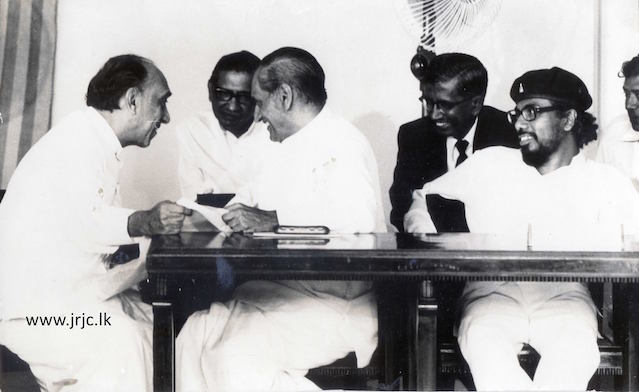
On 3rd November 1982, the day before the 4th Amendment was presented to
Parliament, the Communist Party paper Aththa, the only effective
opposition daily, was sealed at 8:30 PM. The next issue had already been
printed, and its editorial was titled, ‘The dictatorship of J.R.
Jayewardene is already here’.
The sealing of the Aththa was raised in parliament by Sarath
Muttetuwegama the next day. He pointed out that under the sealing order
made by the Competent Authority Douglas Liyanage acting for the Ministry
of State, no time limit had been given.
Anandatissa de Alwis, Minster of State, replied that he would not enter
into an argument on this matter, but would merely point out that the
Competent Authority has decided that this paper [Attha] violates
security and causes public disorder. This reply made a mockery of
accountability before Parliament, where ministers are answerable. It was
as though Parliament had abdicated to shadowy officials. As to
Competent Authority Liyanage’s democratic credentials, he was a leading
figure in the coup attempt in 1962!
Prime Minister Premadasa added his own argument: The Aththa was sealed
under Emergency Regulations, and since Muttetuwegama had voted for the
emergency, he has consented to the sealing of the paper!
The sealing of the Aththa, the passing of the 4th Amendment, and the
unprecedented repression that ensued and lasted until the end of the
Referendum, were orchestrated by the UNP in the most unscrupulous
manner. The pattern had a plan and organisation reminiscent of the man-
ner in which the July 1983 violence was staged.
