Peace for the World World ! Your War Our Lives

The Dalai Lama
A Brief Colonial History Of Ceylon(SriLanka)
Sri Lanka: One Island Two Nations
A Brief Colonial History Of Ceylon(SriLanka)
Sri Lanka: One Island Two Nations
(Full Story)
Back to 500BC.

Sunday, March 5, 2017
90% OF WOMEN HAVE BEEN SUBJECTED TO SEXUAL HARASSMENT ON BUSES AND TRAINS IN SRI LANKA.

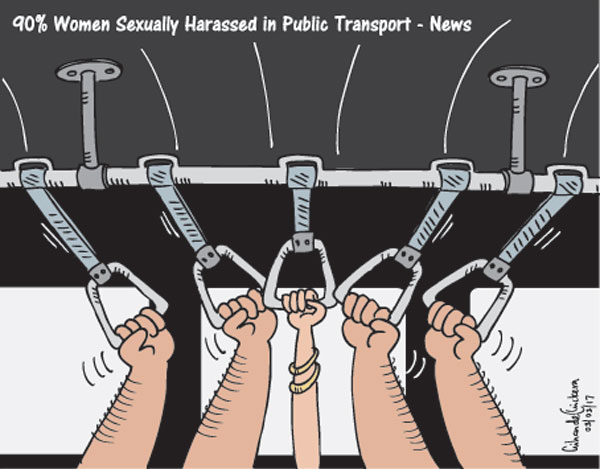
image-DM
 04/03/2017
Ninety percent of women have been subjected to sexual harassment on
buses and trains. But many were unaware that perpetrators can be
punished because the offense is a crime, says a new study conducted by
United Nations Populations Fund in Sri Lanka.
By Anushiya Sathisraja.
A national campaign is needed to tackle the pervasive culture of sexual
harassment of women on public transport, an official says.
Such a campaign must include a national dialogue, efforts to raise
awareness, and educating people on the consequences of sexual
harassment.
Swarna Sumanasekera, who chairs the National Committee on Women under
the Ministry of Women and Child Affairs, said campaigns must highlight
that sexual harassment is a form of sexism and a criminal offence under
Sri Lanka’s Penal Code. Public service messages should emphasise “zero
tolerance to sexual harassment”.
Ms. Sumanasekera said sexual harassment in public transport,
discriminates against women and girls, and affects them physically,
psychologically, and economically.
Principles of gender equality should be taught to children early, she said.
A study by the United Nations Populations Fund, involving 2,500 people
between 15 and 35 years of age, representing all administrative
districts in the nine provinces of the country, show that more than 25
per cent of women are sexually harassed every month on public transport.
Every day 12.1 per cent of women are reported being sexually harrassed.
And every week, 16.4 per cent said they suffered.
But cases go largely unreported because women feel they would not be taken seriously, the Sunday Times learns.
The study also reveals that, 92 per cent of the respondents never sought
help from law enforcement. It was also noted that 74 per cent were
unaware about a hotline to report sexual harassment on public transport.
Ninety percent of women have been subjected to sexual harassment on
buses and trains. But many were unaware that perpetrators can be
punished because the offense is a crime.
The study identified 35 different actions that can be categorized as
acts of sexual harassment, ranging from physical contact to verbal and
visual actions of a sexual nature. The findings show that sexual
harassment is largely physical.
The focus on sexual harassment conceals data that demonstrates that the
largest proportion of violence against women take place in public
places, usually on public transport.
Almost 30 per cent of students said their studies were negatively
affected, while 37 per cent said that the incidents negatively-affected
their performance at work.
The study also found that 82 per cent had noticed others being sexually
harassed on public transport, but it is rare that other passengers in
buses or trains intervene. The main reason for this, as noted in focus
group discussions, was the ‘unwillingness to take the risk of causing
conflict’ and ‘fear of drawing attention to oneself’.
Kumudini Samuel, the Founder of Women and Media Collective, said the
survey data were not a suprise. “The top most reason for the increase in
sexual harassment, is the absence of fear of the law.” She adds that
laws and policies are needed in public transport and workplaces.
Police say perpetrators must be forced to change.
“We don’t want anyone to change their behaviour to avoid being a
victim,” said the head of the Children and Women Bureau of the Sri Lanka
Police L R Amarasena. “The only people who should change their
behaviour are the perpetrators.”
(Original caption : National campaign should target perverts on buses and trains, says official)
