Peace for the World World ! Your War Our Lives

The Dalai Lama
A Brief Colonial History Of Ceylon(SriLanka)
Sri Lanka: One Island Two Nations
A Brief Colonial History Of Ceylon(SriLanka)
Sri Lanka: One Island Two Nations
(Full Story)
Back to 500BC.

Monday, March 6, 2017
Concluding Chapter On Thomas More’s Utopia: Was It Really Ceylon?

By Laksiri Fernando –March 5, 2017

Dr. Laksiri Fernando
This is the final chapter of ‘Thomas More’s Socialist Utopia and Ceylon (Sri Lanka)’ where two major conclusions are made. First is the possibility that Thomas More drew his inspirations largely from pre-colonial Ceylon, through a Portuguese travel manuscript, where the social system was akin to what Karl Marx later identified as the Asiatic Mode of Production (AMP). It was an inspiration for More to design a ‘utopian socialist society’ in which people lived collectively and there was no private property.
Second is the possibility of designing a future society, taking inspirations from Thomas More and others, where ‘basic needs of all such as food, shelter, health, education and comforts’ are equally met, as the bottom line, and then ‘allow reasonable social variations based on merit and equal competition’ beyond that threshold. Otherwise, all what we talk about democracy and human rights are not worth of their names.
However, as common to many socialist thinkers, some of Thomas More’s political notions were defective. For example, freedom of expression and freedom of movement were restrictive. This means his ideas should be taken with a critical mind, as of all others. In this case, what might be the best for the future of Sri Lanka or any other country would be ‘socialism mixed with liberalism’ or liberal values in their political sense. This is about ‘liberal socialism’ that I would advocate.
In this series, ‘American’ spelling was used purposely to promote such in Sri Lanka. For a ‘language revolution,’ that would be the best and simpler. Part II of the book, which contains Thomas More’s original ‘Utopia’ (in an edited form for easy reading) is not serialized, but available as PDF from the following link for anyone to read and come to her/his conclusions. Click here.
This series was possible courtesy of Colombo Telegraph and Sri Lanka Guardian. The publication link to the original book is: https://www.createspace.com/4688110 Following is the final chapter.
WAS IT REALLY CEYLON?
May AvalokitesvaraRefuge of the VirtuousOcean of CompassionRemove my sufferingHe who endeavors, day and nightTo deliver beings, plunged in samsaraMay this AvalokitsvaraWho has compassionFor the lowly and the poorProtect theeAvalokitesvara Stanza[1]
THE ABOVE stanza originally in Sanskrit was supposed to be popular in the 15th century Ceylon especially adoring King Parakramabahu VI (1415-1467) as Avalokitsvara, or bodhisattva, a Buddha to be, who cared for ‘the lowly and the poor’ and who was considered ‘virtuous and compassionate’ by the learned men and priests of the period. Parakramabahu VI was the chief king at Kotte, and according to the tradition and politics of that time surrounded by several Princes governing various parts of the country. There were of course internecine conflicts and even warfare between various rulers or administrators in Ceylon throughout history, but the reign of Parakramabahu, at least at the end, was exceptionally peaceful and tranquil which lasted for 52 years. There were nearly 50 prominent cities or divisions in the country all were well contrived and supplied for.
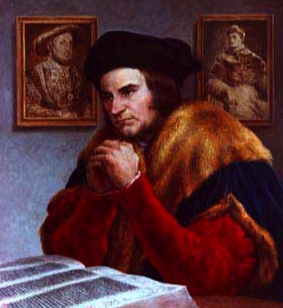
Thomas Moore the Thinker
Along with the kingship was the priesthood. The Chief Priest, Sri Totagamuwe Sri Rahula was in fact was the king’s close relative and a prominent poet. There were over a dozen of outstanding monasteries, called Pririvenas, in the country in charge of a high priest each. They all were learned men, conversant with several languages and the highest achievement in languages was called Shad Bhasa Paramesvera (doctor in six languages). There were visitors to these ancient universities mainly from India, both as students and teachers. The curriculum of these places were quite vast, giving prominence to the study of Sanskrit, Pali, Prakrit, Magadha, Parsi (Persian) and Saurasini, not to speak of the two local languages of Sinhala and Tamil.[2] The learned also appeared to excel in Astrology, Auyrvedic Medicine etc. The most characteristic intellectual achievement of this period pertained to literature.
The legacy of Parakrambahu which was well-known even during the early 16th century swore that he was a benevolent king. His nephew and famous poet, Sri Rahula, popularized the following poem on his behalf that became popular in every household thereafter.
Where else there is a KingWho calls a toddler like me andEnquire my grief and joy?
Social Base
The society or polity in the medieval or the ancient Ceylon, prior to the advent of colonialism is of course a long spell to generalize. There had been different formations, ups and downs, chaos and periods of stability, but the general tendency had always been to forge a cohesive society based on a ‘community spirit’ and ‘reasonable living standards’ for every family, on which the society was based. Individualism from the West had not yet invaded. Even in terms of politics, there had been variations, at times the people were cursed with brutal rulers but again the general tendency had been to construct a system of politics with ‘benevolence’ and ‘kindness’ while maintaining customary rules of a disciplined society.
