Peace for the World World ! Your War Our Lives

The Dalai Lama
A Brief Colonial History Of Ceylon(SriLanka)
Sri Lanka: One Island Two Nations
A Brief Colonial History Of Ceylon(SriLanka)
Sri Lanka: One Island Two Nations
(Full Story)
Back to 500BC.

Thursday, March 9, 2017
Russian destabilisation of Balkans rings alarm bells on eve of EU summit
Top MEP David McAllister says bloc must be more visible in the region to counter Kremlin’s growing influence
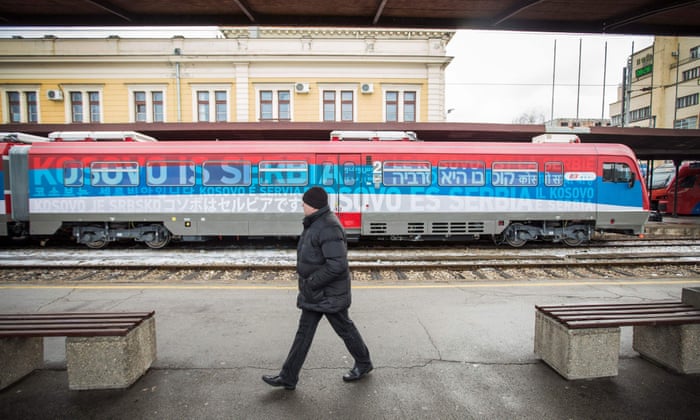
A
train with a sign reading ‘Kosovo is Serbia’ was sent to Kosovo,
plunging relations in the region into a crisis. Photograph: Oliver
Bunic/AFP/Getty Images
 The European Union needs to be more visible in the western Balkans to counter Russian attempts to destabilise the region, a leading MEP has said.
“Geopolitics has returned to the Balkans,” said David McAllister, a
German MEP and chair of the European parliament’s foreign affairs
committee.
“We are seeing the growing Russian influence, we are seeing growing
Turkish influence, the United States is a player, the European Union is a
player, so there are different interests at stake,” he said.
But it was Russia’s role that he described as negative, citing the Kremlin’s suspected involvement in a failed coup in Montenegro and Moscow’s support forhardline nationalist leaders in the region.
Russia was
also exerting influence on political debate by organising anti-western,
and anti-EU propaganda, McAllister said, especially in Serbian-language
media outlets that promoted the Kremlin’s world view, as well as
“conspiracy theories and Serbian ultranationalism”.
EU leaders will discuss the growing tension in the Balkans at a summit
in Brussels on Thursday. According to a draft memo seen by the Guardian,
the leaders will renew their promise that the door of membership
remains open while stressing the importance of reforms and “good
neighbourly relations”.
Member states are divided over whether the summit communique should
identify the “outside forces” carving out a bigger role in the region.
Russia is a particular concern, but officials are also wary of Turkey’s
growing role.
“There is third country interference,” one EU diplomat said.
EU diplomats are also worried about Balkan citizens heading to Iraq and
Syria to fight for Islamic extremist groups. A disproportionately high
number of Kosovans, Albanians and Bosnians have been fighting in Middle
Eastern war zones, according to the Balkan Investigative Reporting
Network.
Balkan countries were given the green light to begin the long road to EU membership in 2003, but progress has been mixed. Croatia joined the EU in 2013,
and Montenegro and Serbia have embarked on formal membership talks.
Albania, Bosnia-Herzegovina, Kosovo and Macedonia are further behind in
the process.
The EU’s foreign policy chief, Federica Mogherini, visited the region
last week, in an attempt to revive momentum towards EU integration.
Speaking after her visit, she laid out her “profound concerns” but also
optimism that all countries could eventually join the EU. “The Balkans
can easily become one of the chessboards where the big power game can be
played,” Mogherini said.
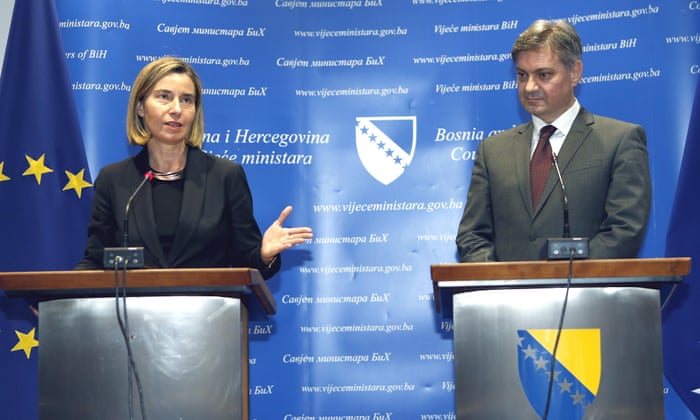
Federica Mogherini visits Bosnia-Herzegovina. Photograph: Fehim Demir/EPA
Her trip was also aimed at reassuring the region it had not been
forgotten. While the EU has been rocked by one existential crisis after
another, from Brexit to Greek debt to coping with migrants and refugees, nationalist and inter-ethnic tensions have been bubbling away in the western Balkans.
In January, a Serbian train bearing signs reading “Kosovo is Serbian” was sent towards Kosovo, plunging relations between the countries into a crisis. Meanwhile, Macedonia is entrenched in an increasingly bitter political crisis that
has pitted neighbours against each other, and Montenegro was shaken by
the assassination attempt against its pro-western prime minister last
October. The failed coup has been linked to Russian authorities,
although Moscow has denied any involvement.
Tensions have also flared in Bosnia, where the Bosnian-Serb leader,
Milorad Dodik, is accused of flouting the 1995 peace agreement that
ended a four-year civil war.
McAllister disputed the view, held by some regional leaders, that the
Balkans have been forgotten by Brussels but said it was time for the EU
to increase its visibility. A recent poll showed Serbians were more
likely to assume Russia was the country’s biggest aid donor, rather than
the EU, although the estimated €3bn (£2.6bn) received from Brussels
since 2000 far exceeds sums from Moscow.
Citing this poll,
McAllister said the EU needed to increase its efforts “to make the
European Union and its good work more visible in all the six western
Balkan countries”.
The MEP was elected to lead the foreign affairs committee in January. In
early April, MEPs are to vote on a resolution drafted by McAllister
calling on Serbia to align its foreign policy to Europe.
McAllister said he regretted that Serbia had
not chosen to join in EU sanctions against Russia, although pointed to
its support for UN peacekeeping operations. “Serbia will have to fully
align its foreign policy with the European Union to become a member,” he
said.
