Peace for the World World ! Your War Our Lives

The Dalai Lama
A Brief Colonial History Of Ceylon(SriLanka)
Sri Lanka: One Island Two Nations
A Brief Colonial History Of Ceylon(SriLanka)
Sri Lanka: One Island Two Nations
(Full Story)
Back to 500BC.

Monday, March 6, 2017
Slavoj Zizek: We Must Rise from the Ashes of Liberal Democracy
Trump is a threat to global stability—only a new Left international can beat him.
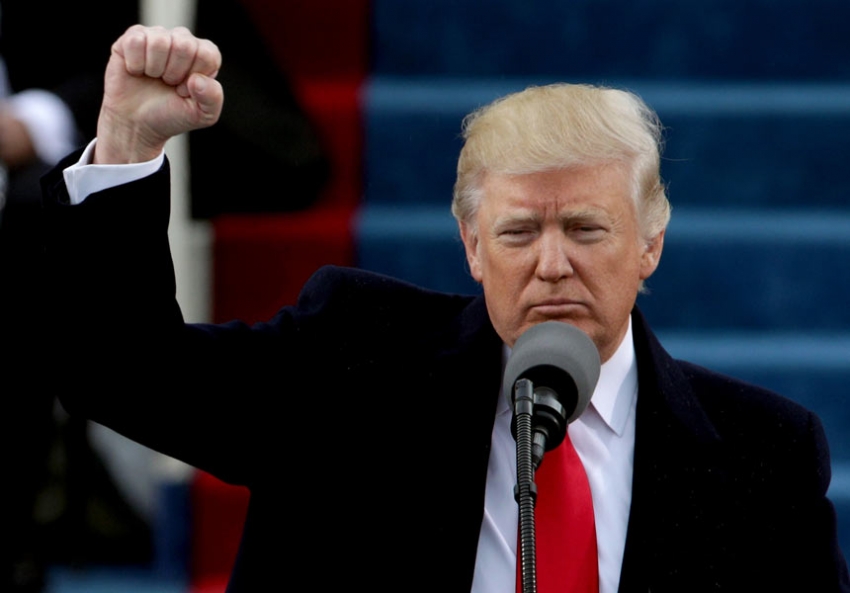 MSNBC's Chris Matthews said he detected in Donald Trump's inaugural address a "Hitlerian background."
 MARCH 3, 2017
Donald Trump's January 20 inaugural address was ideology at its purest,
its simple message relying on a series of obvious inconsistencies. At
its most elementary it sounded like something that Bernie Sanders could
have said: I speak for all you forgotten, neglected and exploited
hardworking people. I am your voice. You are now in power. However,
beyond the obvious contrast between these proclamations and Trump’s
early nominations (Rex Tillerson, the voice of exploited, hardworking
people?), a series of clues give a spin to his messaging.
Trump talked about Washington elites, not about capitalists and big
bankers. He talked about disengaging from the role of the global
policeman, but he promises the destruction of Muslim terrorism.
At other times, he has said he will prevent North Korean ballistic tests
and contain China’s occupation of South China Sea islands. So what we
are getting is global military interventionism exerted directly on
behalf of American interests, with no human-rights and-democracy mask.
Back in the 1960s, the motto of the early ecological movement was “Think
globally, act locally!”
Trump promises to do the exact opposite: “Think locally, act globally.”
In the 20th century, one need not proclaim “America first!” It was a
given. The fact that Trump proclaimed it indicates that in the 21st
century American global interventionism will go on in a more brutal way.
Ironically, the Left, which has long criticized the U.S. pretension to
be the global policeman, may begin to long for the old days when, in all
its hypocrisy, the United States imposed democratic standards onto the
world.
Yet, the most depressing aspect of the post-electoral period in the
United States is not Trump’s policies, but the Democratic Party
establishment’s reaction to its historic defeat: an oscillation between
two extremes, the horror at the Big Bad Wolf called Trump and its
obverse, the normalization of the situation, the idea that nothing
extraordinary happened. On the one hand, MSNBC’s Chris Matthews said he
detected in Trump’s inaugural address something “Hitlerian.” On the
other, Politico’s John Bresnahan reported that Nancy Pelosi “repeatedly
brings up the events of a decade ago. For her, the lesson is clear—past
is prologue. What worked before will work again. Trump and the
Republicans will overreach, and Democrats have to be ready to jump at
the opportunity when they do.”
In other words, Trump’s election is just another reversal in the normal
exchange of Republican and Democratic presidents—Reagan, Bush, Clinton,
Bush, Obama and now Trump. Such a stance totally ignores the real
meaning of Trump’s election: the weaknesses of the Democratic Party that
rendered this victory possible and the radical restructuring of the
entire political space that it announces.
But what if his project of moderate protectionism, large public works
and job creation, combined with anti-immigrant security measures and a
new perverted peace with Russia, somehow works and gives some short-term
results? That is what horrified left liberals really fear: that Trump
will somehow not be a catastrophe.
We should not succumb to such panic. Even if Trump will appear
successful, the results of his politics will be ambiguous at best for
ordinary people, who will soon feel the pain of this success. The only
way to defeat Trump— and to redeem what is worth saving in liberal
democracy—is to detach ourselves from liberal democracy’s corpse and
establish a new Left. Elements of the program for this new Left are easy
to imagine. Trump promises the cancellation of the big free trade
agreements supported by Clinton, and the left alternative to both should
be a project of new and different international agreements. Such
agreements would establish public control of the banks, ecological
standards, workers rights, universal healthcare, protections of sexual
and ethnic minorities, etc. The big lesson of global capitalism is that
nation states alone cannot do the job—only a new political international
has a chance of bridling global capital.
An old anti-Communist leftist once told me the only good thing about
Stalin was that he really scared the big Western powers, and one could
say the same about Trump: The good thing about him is that he really
scares liberals.
After World War II, Western powers responded to the Soviet threat by
focusing on their own shortcomings, which led them to develop the
welfare state. Will today’s left-liberals be able to do something
similar?
