Blast near the German embassy leaves more than 460 injured, Afghan interior ministry says
A massive explosion in a highly secure diplomatic area of Kabul has
killed at least 90 people and wounded more than 461, Afghan officials
have said.
The attack is the deadliest in the Afghan capital since an Isis suicide
bomber killed nearly 100 people at a protest last summer, and one of the
largest to hit Kabul since the 2001 intervention. Most of the
casualties are expected to be civilians.
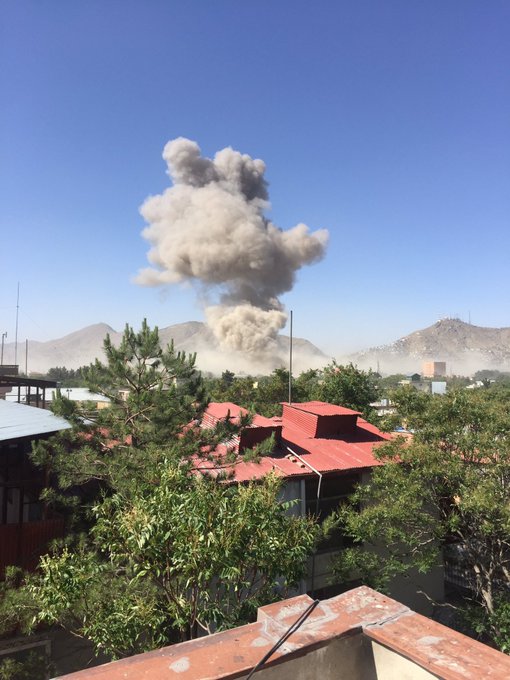
The huge blast of a bomb hidden in a sewage tanker occurred close to the
German embassy in the Wazir Akbar Khan area of the capital on Wednesday
morning, sending clouds of black smoke spiralling into the sky near the
presidential palace and foreign embassies.
It took place at the peak of Kabul’s rush hour when the streets were
packed with commuters and just days into the Muslim holy month of
Ramadan.
Witnesses described dozens of cars choking the roads as wounded
survivors and panicked schoolchildren sought safety, with people
struggling to get through security checkpoints to search for loved ones.
No group has claimed responsibility but both the Taliban and Isis have
staged large-scale attacks in the city. The Afghan president, Ashraf
Ghani, condemned the attack. “The terrorists, even in the holy month of
Ramadan, the month of goodness, blessing and prayer, are not stopping
the killing of our innocent people,” he said in a statement.
On Wednesday evening, the country’s intelligence agency, the NDS,
accused the Taliban-affiliated Haqqani network, with Pakistani support,
of being behind the attack.
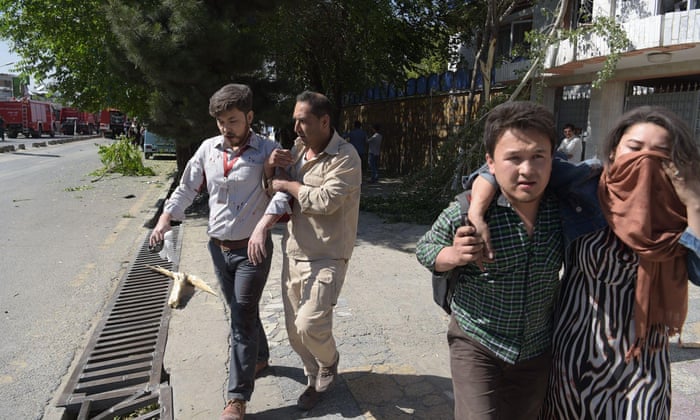
Afghan
men provide assistance to the wounded at the site of the car bomb
attack in Kabul. Photograph: Shah Marai/AFP/Getty Images
Basir Mujahid, a spokesman for Kabul police, said the bomb had struck close to the fortified entrance to the German embassy.
“It was a car bomb near the German embassy, but there are several other
important compounds and offices near there too. It is hard to say what
the exact target is,” Mujahid said.
The explosion site is on the road leading to the American embassy as
well as the US and Nato military headquarters. It was unclear whether
the attacker intended to target the German embassy or was perhaps
stopped on the way to compounds further ahead, and detonated
prematurely.
The German foreign minister, Sigmar Gabriel, said an Afghan security
guard was killed in the blast and embassy employees wounded. He said all
embassy workers were now safe and offered his condolences to the family
of the slain guard.
The US Department of State said 11 American contractors working for the
US embassy were injured. Eleven members of the Afghan national police
and eight Afghan soldiers were among the dead.
The BBC said in a statement that one of its Afghan drivers, Mohammed
Nazir, who was in his late 30s and had a young family, was killed in the
blast. Four journalists were wounded and treated in hospital. Their
injuries are not thought to be life threatening.
A French minister, Marielle de Sarnez, said its embassy had been damaged but it was not known if there were any French victims.
Najib Danish, deputy spokesman for the Afghan interior ministry, said
the blast was so large that more than 30 vehicles were either destroyed
or damaged.
While embassies and government buildings in the area are located behind
fortified security walls, the road where the bomb detonated is open to
the public. Connecting two main traffic circles, the strip is always
busy with civilian pedestrians and drivers, particularly in the morning.
Houses hundreds of metres away from the explosion were damaged, with
windows and doors blown off their hinges. Reports from journalists
inside Kabul said the explosion shook their houses and shattered
windows.
Shortly after the explosion, police had closed off the bomb
site over a radius of a few hundred metres. Outside the police barrier,
close to the Emergency hospital, bystanders assessed the damage.
Entezar,
a barber, said he was inside his shop when the explosion happened. “The
whole window blew out,” he said, pointing to his facade.
The Taliban denied responsibility for the attack, although it came as the group is stepping up its annual “spring offensive”.
Self-declared Isis affiliates have also claimed
responsibility for several recent bombings in the Afghan capital,
including a powerful blast targeting an armoured Nato convoy that killed
at least eight people and wounded 28 on 3 May.
The US secretary of defence, James Mattis, has warned of “another tough year” for both foreign troops and local forces in Afghanistan, where more than a third of the country is outside of government control.
The blast was the latest in a long line of attacks in the Afghan
capital. Kabul province had the highest number of casualties in the
first three months of 2017 due to multiple attacks in the city, with
civilians bearing the brunt of the violence.



 Blast near the German embassy leaves more than 460 injured, Afghan interior ministry says