Peace for the World World ! Your War Our Lives

The Dalai Lama
A Brief Colonial History Of Ceylon(SriLanka)
Sri Lanka: One Island Two Nations
A Brief Colonial History Of Ceylon(SriLanka)
Sri Lanka: One Island Two Nations
(Full Story)
Back to 500BC.

Monday, October 2, 2017
Global ‘learning crisis’ looms due to failing school systems – World Bank


 Our NEW WDR report says that #education leads to longer lives and enables better life choices #WDR2018 wrld.bg/U1Yi30fk7aP
Rohingya refugee children attend
an open air Arabic school at Kutupalang Unregistered Refugee Camp, where
they learn to read the Quran, in Cox's Bazar, Bangladesh, February 4,
2017. Source: Reuters/Mohammad Ponir Hossain
By
MILLIONS of young students in low and middle-income countries face the
prospect of lost opportunity and lower wages in later life due to
failing schooling systems, in what the World Bank warns is a global
“learning crisis.”
The World Development Report 2018 entitled ‘Learning to Realize Education’s Promise’ explains
how schooling without learning is not just a wasted development
opportunity, but also a great injustice to children and young people
worldwide.
Released Wednesday, the report details how, even after several years in
school, millions of children cannot read, write or do basic mathematics.
It warns that this deficiency in learning will result in the
exacerbation, rather than the reduction, of extreme poverty throughout
developing countries and lead to a widening of the social gap as
children are robbed of opportunity and young students who are already
disadvantaged by poverty, conflict, gender or disability reach young
adulthood without even the most basic life skills.
“This learning crisis is a moral and economic crisis,” World Bank Group President Jim Yong Kim said.
Recognising the immense benefits of good education in tackling social
issues and inequalities, including its ability to “spur innovation,
strengthen institutions, and foster social cohesion,” Kim also points
out the dangers of poor education.
Our NEW WDR report says that #education leads to longer lives and enables better life choices #WDR2018 wrld.bg/U1Yi30fk7aP
“These benefits depend on learning, and schooling without learning is a
wasted opportunity,” he said. “More than that, it’s a great injustice:
the children whom societies fail the most are the ones who are most in
need of a good education to succeed in life.”
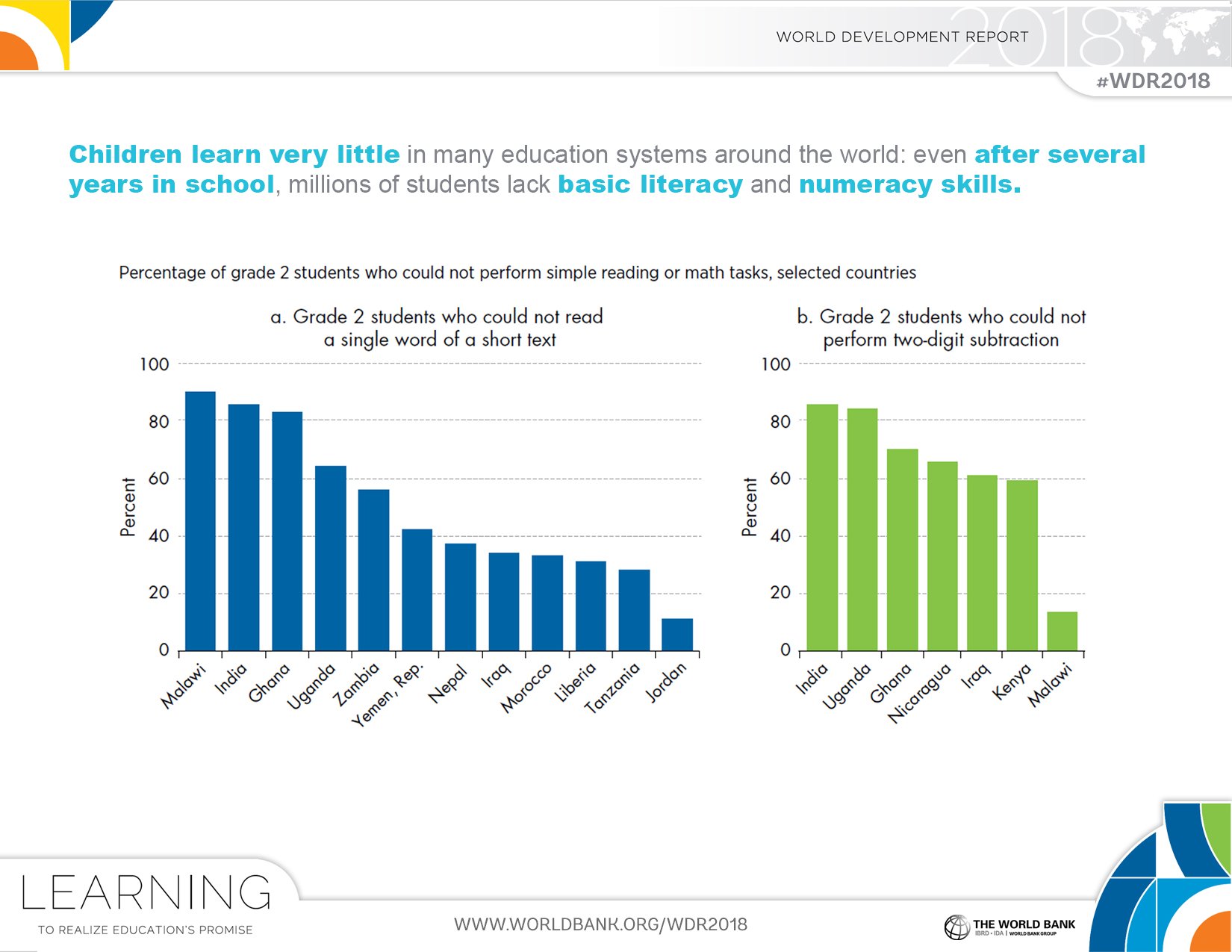
Taking a closer look at India, the report shows that over 80 percent of
grade 2 students could not read a single word of a short text. The same
was true for maths in which over 80 percent could not perform a simple
two-digit subtraction.
There were improvements in some countries, such as Brazil that saw both
reading and maths skills of 15-year-olds improve, but the report warned
that at the current rate of improvement they won’t reach the “rich
country average score” in maths for 75 years. In reading, it will take
more than 260 years.
An emphasis on learning rather
than just schooling is needed, as the report shows that students in
school often learn little from year to year, and early learning deficits
are magnified over time.
These statistics do not account for 260 million children who, for
reasons of conflict, discrimination, disability, and other obstacles,
are not enrolled in primary or secondary school.
#Didyouknow? Hundreds of millions of children reach young adulthood w/o the most basic skills for life. #WDR2018 wrld.bg/U1Yi30fk7aP

While not all developing countries experience extreme learning gaps, the
difference between poor and high-income countries is evident.
Leading international assessments on literacy and numeracy show that the
average student in poor countries performs worse than 95 percent of the
students in high-income countries.
Also, many high-performing students in middle-income countries – those
who achieve in the top quarter of their groups – would rank in the
bottom quarter in a wealthier country.
In order the close the gap and level the playing field, the report makes
three recommendations to get countries advancing in the right
direction.
First, is to assess learning so it can become a measurable goal.
Finding that only half of all developing countries have metrics to
measure learning at the end of primary and lower secondary school, the
report suggests widespread and reliable student assessments so teacher
quality and progress can be objectively measured. This information can
then go on to inform national and international policy and prevent some
students from being left behind.
The report also encourages crafting schools that work for all children
by promoting “nutrition and stimulation so children start school ready
to learn.” The use of technologies in the classroom and the management
of schools is also suggested.
And finally, to mobilise everyone who has a stake in learning, increase
accountability and create political will for education reform. It
suggests involving all stakeholders, including the business community,
in all stages of education reform, from design to implementation.
“Developing countries are far from where they should be on learning,”
said Jaime Saavedra, a former Peruvian Education Minister, and now the
World Bank’s Senior Director for Education.
“Many do not invest enough financial resources and most need to invest
more efficiently. But it is not only a matter of money; countries need
to also invest in the capacity of the people and institutions tasked
with educating our children.”
**This article originally appeared on our sister website Study International
