Peace for the World World ! Your War Our Lives

The Dalai Lama
A Brief Colonial History Of Ceylon(SriLanka)
Sri Lanka: One Island Two Nations
A Brief Colonial History Of Ceylon(SriLanka)
Sri Lanka: One Island Two Nations
(Full Story)
Back to 500BC.

Wednesday, November 1, 2017
Balfour Declaration At 100: Some Pertinent Reflections

Lukman Harees
 For centuries long our land enslaved- by Turkish kings with sharpened blade.
We prayed to end the Sultan’s curse, the British came and spoke a verse.
“It’s World War One, if you agree- to fight with us we’ll set you free.”
The war we fought at Britain’s side,-our blood was shed for Arab pride.
At war’s end Turks were smitten,-our only gain, the lies of Britain.
This
Stephen Ostrander’s simple verse manages to cut through a mountain of
rhetoric to the root cause of the Arab-Israeli conflict. The question of
giving Palestinians their own homeland
has commanded the attention of the UN since the organization was
founded. Since resolutions 242 and 338, the Security Council has taken
no significant steps to end the Israel-Palestine conflict, in the light
of continued Israeli arrogance and US hegemony. As we reflect on origins
of this conflict, we cannot overlook “the single most destructive
political document of the 20th century on the Middle East” (as the
leading Palestinian historian Walid Khalidi described it), – the
Balfour Declaration, the centenary of which falls in November this year.
Incidentally,
Britain sponsored the Zionist project through the Balfour Declaration
to transform Arab Palestine into a ‘Jewish state’ in November 1917. The
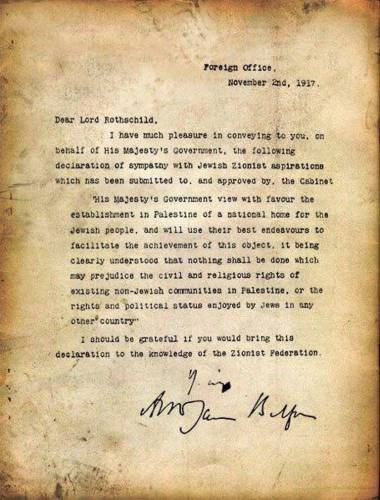
Declaration was actually a letter written on November 2, 1917, by the
then foreign secretary of Britain, Arthur James Balfour, to Baron Walter
Rothschild, a leader of the British Jewish community, for transmission
to the Zionist Federation of Great Britain and Ireland. Although it did
not offer partition, it sowed the seeds for it, which eventually allowed
the Zionist movement to occupy Palestine.
The
letter promised the Jews a “national home” in Palestine, which was then
a part of the Ottoman Empire but was soon to be ruled under a British
mandate, without prejudicing the “civil and religious rights of existing
non-Jewish communities in Palestine”. It was later incorporated into a
peace treaty with the Ottoman Empire and the British Mandate for
Palestine, despite contradicting other agreements. This Declaration was a
prime example of colonial arrogance shown by Britain; which Arthur
Koestler witheringly summarised as a document in which ‘one nation
solemnly promised to a second nation the country of a third’. No wonder
Palestinians casted aside the Mandate as the illegitimate exercise of
British imperialism. It is worth our while to re-read Edward Said’s wise
words about the Balfour Declaration.
“What
is important about the Declaration is, first, that it has long formed
the juridical basis of Zionist claims to Palestine, and second, more
crucial for our purposes here, that it was a statement whose positional
force can only be appreciated when the demographic, or human realities
of Palestine are clearly understood. For the Declaration was made (a) by
a European power (b) about a non-European territory (c) in a flat
disregard of both the presences and the wishes of the native majority
resident in that territory, and (d) it took the form of a promise about
this same territory to another foreign group, that this foreign group
might, quite literally, make this territory a national home for the
Jewish people.”.In fact, it was more than that: It allowed a settler
colonial movement, appearing very late in history, to envisage a
triumphant project even before it set proper foot in the land or had a
meaningful geographical and demographic presence there”.
Read More
