Peace for the World World ! Your War Our Lives

The Dalai Lama
A Brief Colonial History Of Ceylon(SriLanka)
Sri Lanka: One Island Two Nations
A Brief Colonial History Of Ceylon(SriLanka)
Sri Lanka: One Island Two Nations
(Full Story)
Back to 500BC.

Monday, December 18, 2017
- President to give top priority to polls campaign and address meetings in all districts
- Rajapaksa hits out at Sirisena accusing him of helping the UNP win the last parliamentary election
- Malaysian PM coming today, but three major foreign investment projects withdrawn by Sri Lanka at the last moment

Personal initiatives by President Maithripala Sirisena to re-unify the
Sri Lanka Freedom Party (SLFP) ahead of the local polls have all ended
in failure.
Now, he has declared political war on the rival faction for repeatedly snubbing his overtures. Sirisena told his ministers and other SLFP stalwarts this week he would nominate a person for each electorate to monitor the activities of the rival group. Their tasks include gathering audio and video evidence of those taking part in the ‘Joint Opposition’ campaign on behalf of the Sri Lanka Podujana (People’s) Party (SLPP). At the same time Sirisena also declared that other than attending weekly Cabinet meetings, his priority in the coming weeks would be to take part in every district level meeting for the local polls. He will address 22 meetings countrywide.
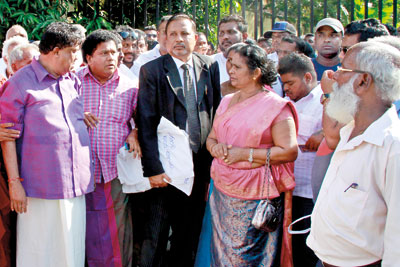
Several nomination lists were rejected for the elections to 93 local
councils. One of the major rejections was the Sri Lanka Podujana
Pakshaya (SLPP) list for Maharagama, a stronghold of ‘JO” and MEP leader
Dinesh Goonewardene. Pic by Indika Handuwala
In the wake of his inability to reunite with the rival faction of the
SLFP, a fuller involvement in the campaign has become imperative for
him. Though his rationale is based on the premise that every candidate
has been named by him and he had to therefore to back them to the
fullest, there are even more important reasons. He is conscious of the
impact of the polls’ outcome on the Presidency and the need for his
party to perform equally well if not better than his coalition partner,
the United National Party (UNP).
The move to deal with SLFP dissidents is a prelude to initiating
disciplinary inquiries prior to expulsion from the SLFP. Whether he
could face the fallout of such a mass scale expulsion remains a critical
question and he has threatened to do this many times before, but
Sirisena is quite clearly piqued by the snub at the hands of leaders of
the rival group. It was only last week, as revealed exclusively in these
columns, that he spoke on the telephone with Sri Lanka Podujana Party
(SLPP) chief strategist Basil Rajapaksa, seemingly on his own
initiative. This was after Ven. Medagoda Abeytissa Thera, the chief
incumbent of the Sunethra Devi Pirivena in Kohuwala and one of the many
emissaries, took a call and handed over the mobile phone to Sirisena. It
was one final throw of the dice. “That is now over. There are larger
sections of the public who expect our party to give voice to their
concerns and highlight their grievances. They are looking to us in
confidence,” Basil Rajapaksa told the Sunday Times this week He had
confided in a close friend that Sirisena spoke to him after four and
half years, which meant they were not on talking terms even when they
were ministers in the Mahinda Rajapaksa cabinet. Strange enough Sirisena
was General Secretary of the SLFP and Rajapaksa the National Organiser
of the same party.
An emissary who has been equally active last week was Ven. Athureliye
Rathana Thera. Though regarded as representing the Jathika Hela Urumaya
(JHU), he is on the National List of the United National Party (UNP) in
Parliament. He made last ditch attempts throughout last Sunday,
shuttling between Sirisena and many ‘JO’ leaders. That was to ensure an
electoral deal just 24 hours before last Monday when nominations began
for 93 local authorities. In fact, Sirisena had awaited a response
before Monday. He had ensured that the SLFP candidates including those
from the rival faction could contest under the Chair symbol. This is the
symbol of the People’s Alliance (PA) where Mahinda Rajapaksa is the
leader and former Prime Minister D.M. Jayaratne the General Secretary.
This is besides the SLFP which is also fielding candidates under the
Hand and Betel Leaf symbols. This was not to be.
Premajayantha’s last-ditch efforts
One of the official Government spokesperson’s (SLFP) Dayasiri Jayasekera told Wednesday’s news conference that he was among those who also held talks with Basil Rajapaksa. “Dilan Perera (SLFP spokesperson and State Minister) pleaded for re-unity. I did not plead. There are people who did not want this to happen. G.L. Peiris has said so publicly. He was at the talks. Peiris said ‘we don’t have time, work is done’. Then he said he is sleepy and left the talks,” Jayasekera told the media.
One of the official Government spokesperson’s (SLFP) Dayasiri Jayasekera told Wednesday’s news conference that he was among those who also held talks with Basil Rajapaksa. “Dilan Perera (SLFP spokesperson and State Minister) pleaded for re-unity. I did not plead. There are people who did not want this to happen. G.L. Peiris has said so publicly. He was at the talks. Peiris said ‘we don’t have time, work is done’. Then he said he is sleepy and left the talks,” Jayasekera told the media.
The reunification effort did not end there. With nominations due for 248
more local authorities from December 18 to 21, Minister Susil
Premajayantha made another desperate attempt last Wednesday. He met ‘JO’
leader Mahinda Rajapaksa to ascertain whether there was still a
possibility of an electoral alliance. Rajapaksa not only rejected the
new overtures brought by Premajayantha but the very next day (Thursday),
issued a strongly worded three-page statement that roundly criticised
the Sirisena-Wickremesinghe Government and its allies.
Noting that the local council elections had been delayed for nearly
three years “due to the Government’s fear of the voting public,”
Rajapaksa accused President Sirisena of ensuring “the victory of the UNP
at the last parliamentary election.” This is why “the Joint Opposition
is contesting this local government election under a different symbol
and a different political alliance,” he said. Rajapaksa also charged
that the Janatha Vimukthi Peramuna (JVP), which is also fielding
candidates at the local polls, has “fully co-operated in every
anti-democratic measure taken by this Government. It was the JVP that
provided the two thirds majority that the Government needed to change
the electoral system and avoid holding the provincial council elections
which should have been held by now,” Rajapaksa added.
Another significant assertion by Rajapaksa related to the change brought
about by the introduction of the 19th Amendment to the Constitution.
Pointing out that the term of office of the President was reduced to
five years, he contended that this “change has been specifically
applicable to the incumbent President as well”. Hence, he declared, “the
term of office of the incumbent President ends on January 9, 2020.” He
said therefore, “a Presidential election has to be held not more than
two months and not less than one month before the incumbent President’s
term of office expires.”
Hence, the next Presidential election will have to be held between
November 9 and December 9, 2019. However, protagonists of Sirisena argue
to the contrary saying the Presidential elections are not due till end
2020. Mahinda Amaraweera, General Secretary of the United People’s
Freedom Alliance (UPFA), the umbrella organisation under SLFP majority,
told a news conference this week, “We are only planning to work for an
SLFP Government in 2020.” He noted that “even though other parties say
about the continuation of the ‘Yahapalana’ or good governance Government
till 2025,” adding that “we take this as a compliment.”
Fuller details of Thursday’s nominations appear elsewhere in this newspaper. As is always the case, internecine issues have dogged practically all political parties in the fray. The inability to adhere to procedures led to 23 nomination papers from different contestants being rejected. The majority of them, 19 were from registered political parties whilst others belonged to independent groups. The Mahajana Eksath Peramuna (MEP) fielded a woman candidate for Maharagama Urban Council but a silly error described her as a male. The entire list was rejected, and Maharagama is the pocket borough of its leader Dinesh Gunawardene and therefore a very strong constituency for the MEP.
Fuller details of Thursday’s nominations appear elsewhere in this newspaper. As is always the case, internecine issues have dogged practically all political parties in the fray. The inability to adhere to procedures led to 23 nomination papers from different contestants being rejected. The majority of them, 19 were from registered political parties whilst others belonged to independent groups. The Mahajana Eksath Peramuna (MEP) fielded a woman candidate for Maharagama Urban Council but a silly error described her as a male. The entire list was rejected, and Maharagama is the pocket borough of its leader Dinesh Gunawardene and therefore a very strong constituency for the MEP.
The Sri Lanka Podujana Peramuna (SLPP) had its nomination papers
rejected in respect of the Urban Councils of Maharagama, Panadura and
Weligama. Also rejected were its nomination papers for the Pradeshiya
Sabhas in Badulla, Agalawatte and Mahiyangana. These would, therefore,
see a straight forward UNP-SLFP contest. The SLFP also had its
nomination papers rejected for the Pradeshiya Sabhas in Padiyathalawa
and Dehiattakandiya. The same fate befell the Tamil United Liberation
Front (TULF) in the Trincomalee Town Gravets Council and the Pradeshiya
Sabha in Valachchenai. The Ilankai Thamil Arasu Katchi had two of its
nomination lists rejected in the Pradeshiya Sabhas of Alawediwembu and
Sammanthurai.
“Admittedly, there were errors in a few nomination papers. However, some
of the rejections raise questions. We are moving to courts to seek
redress,” Dinesh Gunawardena, leader in Parliament for the ‘Joint
Opposition’ told the Sunday Times. He said their campaign would centre
on many issues including the Government’s incompetence in managing the
economy, not delivering on the promises made to the people and the
soaring cost of living.
Gunawardena said, “We (Joint Opposition) are the only ones who can
publicly criticise this Government. The Janatha Vimukthi Peramuna (JVP)
and the Tamil National Alliance (TNA) have become appendages of the
Government,” he charged. He also said that the Government was facing a
financial crisis, a fact admitted by Prime Minister Ranil
Wickremesinghe. The International Monetary Fund (IMF) is extending
piecemeal support. “People are helpless and corruption is at
unprecedented levels,” he added.
The United National Front (UNF), the umbrella organisation of the UNP
which is fielding candidates together with its allies under the elephant
symbol, has also had its share of issues. This week, UNF leader Premier
Wickremesinghe insisted that the prospective mayoral candidate for
Colombo Rosie Senanayake should contest a ward. She had been exploring
the possibility of being nominated from the proportional representation
list after the elections are concluded.
Mano Ganesan’s United Progressive Alliance (UPA), sought the office of
Deputy Mayor and found the request rejected. The party has now declared
it will field its own candidates. Ganesan told the Sunday Times ; “The
coalition of political parties representing Up Country, Tamil community
and Colombo based minority communities have decided to field candidates
in selected areas including for the Colombo Municipal Council (CMC)
under the United Progressive Alliance (UPA). The decision to go it alone
in some areas came after extensive discussions with the UNP to contest
under their alliance United National Front (UNF) were not successful.
The UNP is not willing to allocate more seats to our party candidates
where multi-member wards now exist.
“Therefore we have decided to contest under our own United Progressive
Alliance (UPA) under ladder symbol. “This doesn’t mean we won’t work
with other major parties in future. We are of the view that we will face
the election in certain areas alone. We will extend our support to
other parties to form the majority in local authorities after polls. We
will bargain with them on the basis of the number of seats we win.”
Barring two, the Janatha Vimukthi Peramuna (JVP) will contest local
authorities throughout the country, JVP frontliner Vijitha Herath said
yesterday. In the Bandarawela Urban Council and the Pradeshiya Sabha, we
have formed a united front with a group which has been campaigning
against the huge environmental damage caused by the Uma Oya Project. The
JVP has invited non-political interest groups in various towns and
villages to join it in the elections.
Herath told the Sunday Times, “Our campaign slogan will be ‘Gama
Godanagana, Dushanaya Paradana Jawaya (The force that defeats corruption
and builds the village). We have a mixture of candidates including
professionals such as doctors, artistes and also those representing the
village level such as farmers. We will be telling the voters that the
main parties have failed to uplift the standards of villages and
therefore give an opportunity for our party to serve the villages. Our
campaigns have already started at village level and we have had several
major meetings. The campaign will be stepped up in the next few weeks.”
After the parliamentary elections in August 2015, this is the first time
that countrywide polls are taking place to elect members to local
bodies. That again is after more than two years during which councils
have been run by Special Commissioners, causing immense hardship to the
public. Local bodies are regarded as nurseries for politicians who
aspire for greater heights leading to their becoming Members of
Parliament. But with the advent of Provincial Councils these local
bodies have become a third tier and not the second tier of political
leaders of the future. However, the upcoming local polls, now likely on
February 10, has other manifold ramifications. It is the first
popularity test for the SLFP-UNP coalition, the ‘JO’ and other
opposition parties. More importantly, the sequence of political events
that preceded the local polls, particularly the inordinate delays in
conducting them, has placed President Sirisena’s own popularity to the
test. A win, no doubt, will bolster his position and consolidate his
leadership of the SLFP. A loss, on the other hand, will become a serious
challenge which portends many ramifications.
Malaysian PM’s visit and projects
The local polls are not the only issues for Sirisena. The Government has been forced this week to take off from the agenda three different foreign investment projects totalling US$ 350 million (over Rs 5.3 billion) from Malaysia. The Foreign Ministry in Colombo and its counterparts in Kuala Lumpur had worked assiduously in the past many weeks and listed them on the agenda for talks between President Sirisena and Malaysian Prime Minister Dato’ Sri Mohamed Najib bin Tuan Abdul Razak.
Originally scheduled to arrive tonight, Premier Abdul Razak will now
arrive in Colombo by private jet this morning. The first visit by a
Malaysian Premier in 33 years, it marks the 60th anniversary of
diplomatic relations between Sri Lanka and Malaysia.
The Malaysian Prime Minister will be received with a guard of honour
opposite the Presidential Secretariat tomorrow ahead of talks. The three
collaboration projects listed for signing and unceremoniously pulled
out from the agenda are:
1 Supplementary Agreement for an additional investment in the cellular
mobile telephone network in Sri Lanka such as mobile data, coverage
enhancements, digital services and analytics, charging and customer
agreement network, monitoring, quality of service enhancement and
others. The project to be undertaken by Dialog PLC (whose parent company
Axiata is Malaysian) with the Board of Investment. The cost of the
project is US$ 196 million.
2 Memorandum of Understanding to obtain approval/authorisation to
operate as an independent company in Sri Lanka. Agreement to be signed
between Edotco Services Lanka (Pvt.) and the Telecom Regulatory
Commission of Sri Lanka (TRCSL). The cost is US$ 150 million.
3 Supplementary Agreement for an additional investment and project
expansion in Television Network Equipment in Sri Lanka. Agreement was to
be signed between Dialog Television (Pvt.) Ltd and the Board of
Investment. The cost of the project is US$ 4 million.
As a result of the exclusion of these three projects, the official
statement from the Foreign Ministry issued on Friday spoke only of
“talks covering a wide range of subjects” and declared that only “Three
MoUs will be signed in Science, Technology and Innovation; Bio Economy
Development Co-operation; and Training for Diplomatic Personnel.” These
do not involve any direct investment of funds.
The Sunday Times learnt that the exclusion of the three projects came on
the strong protests raised by Sri Lanka Telecom reportedly on the claim
that it would lead to a monopoly by one single service provider.
Whether this is unfounded or not remains unclear. However, a source at
Dialog PLC said there was no barrier whatsoever for any other entity,
foreign or local, to invest in their own projects if they so wish.
“After all, we have obtained prior approval,” the source added. Raising
alarm over the matter are reports that the Board of Directors of the
People’s Bank approved a temporary overdraft of Rs 500 million to Sri
Lanka Telecom for payment of yearend bonus to employees. Is the SLT now
cash strapped? Attempts to reach SLT Chairman P.G. Kumarasinghe to
obtain his response were not successful. Telephone calls and SMS
messages went unanswered.
The three projects in question were the ones which were to draw foreign
investment from Malaysia. The MoU for Science, Technology and
Innovation, Foreign Ministry sources said, was between the Government of
Sri Lanka and the Malaysian Industry-Government Group for High
Technology (MIGHT). Their objectives are (1) the Parties shall encourage
and support cooperation between the two countries in the fields of
Foresight and S2A in accordance with the provisions of this MoU and in
accordance to the prevailing laws and regulations of each country. (2)
The parties shall promote the development co-operation in Foresight and
S2A between the Parties on the basis of equality, mutual advantage and
mutual consent. (3) The Implementing Agencies of this MoU will be COSTI
(and its successorss) and MIGHT (and its successorss).”
The MoU for the Bioeconomy Development Cooperation will be a tieup
between the Malaysian Bioeconomy Development Corporation and the Coconut
Development Authority, Foreign Ministry sources said. The Malaysian
company is entrusted to identify value propositions for the bio-based
and bio technology ventures via financial support, development and
facilitation services.
The training of Sri Lankan diplomatic personnel will be a Government to
Government MoU. For the Government of Sri Lanka, it will be through the
Bandaranaike International Diplomatic Training Institute of the Ministry
of Foreign Affairs. Training for diplomats will be in the fields of
international relations, international organisations, international law,
international economic relations, regional issues, consular issues and
political science.
According to a Foreign Ministry source, Dialog PLC had obtained Board of
Investment approval on November 24 this year to undertake Network
Expansion Project as recommended by the Telecom Regulatory Commission of
Sri Lanka (TRCSL). This is with an additional investment of US$ 196
million to include 3280 new sites within 24 months.
The Board of Investment had also given approval on November 28 for
Dialog Television (Pvt) Ltd to undertake Network Expansion Project as
recommended by the TRCSL. The additional envisaged investment is US$ 4
million. For this purpose too, an agreement was to be signed with the
Board of Investment.
The third project between Edotco Services Lanka (Private) Ltd. and the Central Environmental Authority of Sri Lanka. Edotco Group Sdn Brhd (EGSB), is an investment holding company operating assets and overseeing the provision of infrastructure solutions for telecommunication and network operators across the Asian region.
The third project between Edotco Services Lanka (Private) Ltd. and the Central Environmental Authority of Sri Lanka. Edotco Group Sdn Brhd (EGSB), is an investment holding company operating assets and overseeing the provision of infrastructure solutions for telecommunication and network operators across the Asian region.
The CEA will be the monitoring body for the TowerCo Project and will be
responsible for the environmental assessment of the project.
The purpose of this MoU is to outline the roles and conditions of the Participants in promoting the overall Telecommunication and ICT growth in Sri Lanka. Among the arrangements made between the parties to this MoU are:
The purpose of this MoU is to outline the roles and conditions of the Participants in promoting the overall Telecommunication and ICT growth in Sri Lanka. Among the arrangements made between the parties to this MoU are:
- Acquire existing tower (ground based, rooftops, street level coverage and camouflage structures) portfolios from other licensed operators.
- Build, own and operate new tower structures and related energy systems; and
- Encourage the commercial sharing of existing and new structures. ESELL and the EDOTCO Company will employ 1,000 persons directly and indirectly.
The investment on the project over three years is US$ 150 million.
At a time when the Government is clamouring for foreign investment to shore up the balance of payments position, the urgent withdrawal from the agenda of projects involving US$ 350 million coming from Premier Abdul Razak’s visit within hours, to say the least, is highly deplorable.
At a time when the Government is clamouring for foreign investment to shore up the balance of payments position, the urgent withdrawal from the agenda of projects involving US$ 350 million coming from Premier Abdul Razak’s visit within hours, to say the least, is highly deplorable.
That it sends a wrong signal to would-be investors is one thing. Worse
is the fact that the taxpayer would be called upon to pay more taxes to
settle foreign debts when a situation worsens.
There are more questions than answers over this week’s developments
relating to Premier Abdul Razak’s agenda for talks. It is insulting a
guest when he and his Foreign Ministry had been made to believe one
thing and they learn it has been changed at the eleventh hour. The
repercussions over such issues, like the outcome of the local polls,
would reverberate for a long, long time and President Sirisena would
have to take note of them. No country in the world bluntly rejects
foreign investment but Sri Lanka seems an exception.

Sirisena declares war on SLPP, disciplinary action threatened against party dissidents