Peace for the World World ! Your War Our Lives

The Dalai Lama
A Brief Colonial History Of Ceylon(SriLanka)
Sri Lanka: One Island Two Nations
A Brief Colonial History Of Ceylon(SriLanka)
Sri Lanka: One Island Two Nations
(Full Story)
Back to 500BC.

Thursday, January 25, 2018
'Apartheid state': Israel condemned by South Africa at UN
Over 100 countries shed light on Israeli violations against Palestinians during periodic review

'Israel is the only state in the world that can be called an apartheid state,' says South Africa (Reuters)


GENEVA - A fiery
exchange between Iran and Israel broke out at the United Nations in
Geneva on Tuesday, while South Africa labelled Israel an “apartheid
state” over its treatment of Palestinians.
The exchange came during a major review of Israel’s human rights record
by more than 100 country delegates, including the 47-strong United
Nations Human Rights Council which spearheaded the session.
Countries were given just over a minute to suggest recommendations, which Israel would later decide whether to accept.
Known as a Universal Periodic Review (UPR), the assessment is held every
five years and is seen as a barometer of the state of human rights in a
given country.
The rights of Palestinians and the treatment of children were at the top
of recommendations put forward by several countries at what was a
largely uneventful session held in the Palace of Nations overlooking
Lake Geneva in Switzerland.
 Emi
Palmor, Israeli delegation leader and Director-General of the Ministry
of Justice, speaks after the UPR session (MEE/Amandla Thomas-Johnson)
Emi
Palmor, Israeli delegation leader and Director-General of the Ministry
of Justice, speaks after the UPR session (MEE/Amandla Thomas-Johnson)
But when it was South Africa’s turn to speak, sparks began to fly.
“Israel is the only state in the world that can be called an apartheid
state,” the South African delegate said. “We remain deeply concerned at
the denial of the right of self-determination to the Palestinian people,
in the absence of which no other human right can be exercised or
enjoyed.”
The Israeli delegation fired back: “We came with the intention of having
a serious discussion of human rights issues. Unlike what some
delegations seem to believe, the Israeli-Palestinian conflict will not
be solved in the Human Rights Council and certainly not during today's
UPR.
"We ask that delegates stick to the appropriate language of the UN, and
that the discussion is steered in the direction of human rights rather
than politicised issues.”
Later in the session, Israel rebuked its regional arch-rival, Iran,
after the Iranian delegation referred to it as “the Israeli regime”.
“It is bad enough that the representative of the Islamic republic of
Iran with its dismissal of human rights pretends to be in a position to
give Israel lessons in human rights,” a member of the Israeli delegation
said, before calling on Iran to refer to Israel by its official name.
At #UPR on #Israel at UN HR Council, South Africa uses allotted 85 secs to say #Israel is only state that can be called an apartheid state, lists violations of rights of #Palestinians. Israel granted intervention to say "conflict won't be solved here..don't politicise session".

In a strongly worded statement, Iran, which does not recognise Israel as
an official state, also demanded that it end its “continuous atrocities
through the enormous destruction of civilian property in Gaza Strip”
and the “forced displacement of civilians, arrest and detention of
Palestinians”.
The Israeli delegation was not expecting an easy ride. It had failed to
turn up to its UPR in 2013, and has had a difficult relationship with
the Human Rights Council, which has passed more resolutions condemning
it than the rest of the world combined.
For its part, Israel has accused the council of bias, arguing that the
UN body is politicised and claiming that other countries are pointing
the finger at Israel to create a smokescreen for their own rights
abuses.
“Clearly some countries will choose to take advantage of today’s
discussion to wage political attacks against Israel,” Israeli ambassador
to the UN Aviva Raz Shechter said in her opening remarks.
Country delegations raised the issue of Palestinian rights, and when
given the opportunity to speak, Israel did little to address their
concerns.
The harshest criticism came from other Middle East countries, with Israel’s allies in the West taking a softer stance.
Jordan expressed deep concern at violations committed against
Palestinians and called on Israel to respect the historic status of the
Al-Aqsa mosque in Jerusalem.
The United States, Israel’s closest ally, praised it for its commitment
to “democratic traditions and values” and requested additional resources
to improve the conditions of Palestinian citizens of Israel.
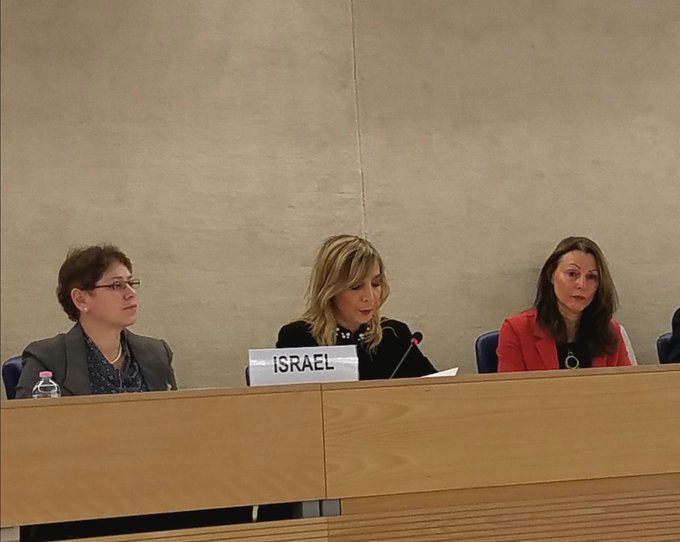
#UPR29 #HumanRights review of #Israel at the #UPR Working Group session of the #HRC at #Geneva. Delegation headed by Amb. Aviva Raz Shechter and Emi Palmor of the Ministry of Justice. Watch on webtv.un.org and read reports here goo.gl/h9xgK8

France, another close ally, requested that Israel bring its practice of
administrative detention - where suspects are held without charge for an
indefinite amount of time - in line with international standards.
The State of Palestine delegation also weighed in, demanding an end to
the “colonial occupation against Palestinians” and a recognition of a
right of return for them.
Rights groups condemn Israel
Rights groups that attended the session, and who had submitted documents
as part of the UPR process, also criticised Israel’s approach.
“Israel focused mostly on internal policies and did not raise any issue
related to the Occupied Palestinian Territories,” said Ines Osman, legal
coordinator at the Geneva-based Alkarama Foundation.
“The specificity of Israel’s review is that its human rights record
needs to be assessed not only in Israel but also in the territories it
occupies. What was striking is the fact that Israel did not address this
issue at all but - and that is positive - most countries did.
“Ultimately, as long as the situation of occupation remains, human
rights violations will continue to be perpetrated by Israel and one can
wonder how efficient the UPR can be when what lies behind is the
pressing need to find a political solution (to the conflict)."
Sarah Pritchett, a spokesperson for Euromed, a Geneva-based human rights
monitor, warned against the "politicisation" of the country review
process, but said that Israel’s failure to implement recommendations
made at previous UPR sessions had led to frustration.
“We’re not seeing anything particularly new coming from the different
countries compared with previous reviews. What we are seeing is quite a
lot of frustration particular because it’s the third review and a lot of
countries are coming back with the same remarks.
“States are taking the political route, going with their state policy
towards that country. What we want to see is more focus on human rights
but as separate from political issues. People have to take the priority.
“Certainly there have been some accomplishments in areas of rights of
disabled and LGBT. But they are on paper improvements; we’re not seeing
enough mechanisms in place to make those improvements substantial.”
