Peace for the World World ! Your War Our Lives

The Dalai Lama
A Brief Colonial History Of Ceylon(SriLanka)
Sri Lanka: One Island Two Nations
A Brief Colonial History Of Ceylon(SriLanka)
Sri Lanka: One Island Two Nations
(Full Story)
Back to 500BC.

Saturday, January 27, 2018
The rise of Indonesian nationalism in response to illegal fishing
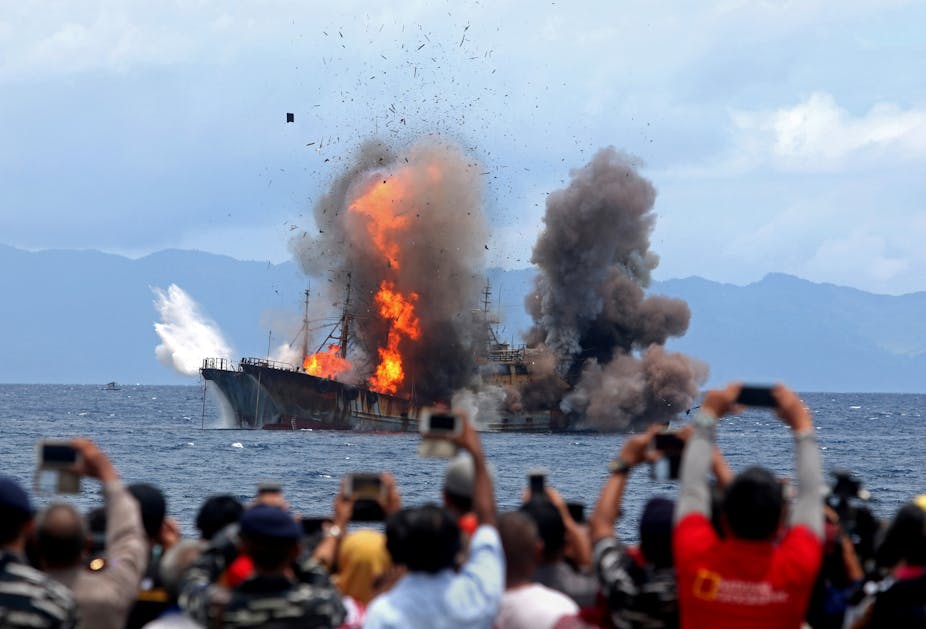
People
take pictures of a burning ship as the government destroyed foreign
boats that had been caught illegally fishing in Indonesia waters, at
Morela village in Ambon island, April 2017. Antara Foto/Izaac Mulyawan via Reuters

January 25, 2018 5
Amid the South China Sea dispute and the sinking of foreign fishing
vessels, the narratives of nationalism in the national media have
strengthened over the past three years.
Illegal fishing occurs in many places in Indonesia’s vast ocean
territory, not only in South China Sea. But it has been closely linked
to the South China Sea dispute. Some news coverage reporting on illegal
fishing during the President Joko “Jokowi” Widodo administration
emphasises “our” sovereignty and the future of “our” nation. Several
national media outlets — Kompas, The Jakarta Post, Jakarta Globe, CNN
Indonesia, and BBC Indonesia — have shown a shift in their coverage of
South China Sea disputes.
From law to defence
My recent study found
that the South China Sea disputes were initially portrayed in
mainstream media as political or law related topics (45.8%). However, in
2016 several incidents occurred on the disputed maritime borders and
the dominant media coverage changed to portray the issue as defence
related (48.4%).
Another significant change in the media coverage was the increasing
reliance on military personnel as sources of information. In the first
year, beginning in October 2014, they represented 10.9% of sources which
rose to 15.06% in the second year. Former Indonesian Military (TNI)
commander Gen. Gatot Nurmantyo was the most dominant source.
On October 29 2017, Maritime Affairs and Fisheries Ministry sank 17
foreign vessels in Indonesian waters. Ten of them were sunk in Natuna
waters, a section of Indonesia’s exclusive economic zone which overlaps
with the South China Sea. In a news article published
by The Jakarta Post, she was quoted saying “the sinking is evidence
that we are dedicated to safeguarding our waters for the future of our
nation”. On the same day, the minister also highlighted the need for Indonesia to boost its naval defence system in order to protect its waters and sovereignty.
Only days before, The Jakarta Post published an article reflecting on the successes of the ancient kingdom of Sriwijaya. The advertorial was part of the Jalur Rempah (Spice
Trade) campaign on Indonesia’s old maritime trade routes. It reminisces
about the glorious era for the kingdom and how it maximised the
potential of the sea.
Beginning by quoting a common folk song, “Nenek Moyangku Orang Pelaut”
(My Ancestors were the Sea People), the author continues to argue that
since the demise of Sriwijaya kingdom Indonesia seems to have lost its
maritime strength.
Furthermore, The Jakarta Post, a media partner of the Jalur Rempah campaign,
connects the Sriwijaya story to the importance of protecting maritime
sovereignty. It implies the minister’s tough sinking policy will
strengthen Indonesia’s identity as a maritime country.
Nationalism appears more under Jokowi
Nationalism narratives in the mainstream media began to appear more in
the first year of Jokowi’s administration. Articles in Kompas widely
used words relating to hegemony and maritime colonialism. One such
example is opinion piece by senior Kompas journalist Rene
Pattiradjawane, “Diplomasi Maritim Konsesi Asia”
(Maritime Diplomacy of Asian Concession) published in 2015. The article
wrote about gunboat diplomacy and linked the story to maritime
colonialism.
Nationalism is, in essence, a consciousness and an expression of
belonging to a nation. Narratives of nationalism often operate to
challenge colonialism and demand greater international recognition of
Indonesia’s power and status.
According to a book entitled Global Media Spectacle: News War over Hong Kong,through
the organisation of its coverage, the media can frame the nation as an
extension of family . What’s more, family-nation narratives can be woven
into media narratives. Ruud Koopmans from Humboldt University of Berlin and Paul Statham from University of Sussex said
the framing of “us and them” is also significant as a defence of
political sovereignty and as an expression of civic nationalism.
Although foreign vessels from various countries conducted illegal
fishing activities, the issue was dominantly presented in the media as a
defence issue in relation to China. At this point, China can be
considered Indonesia’s biggest security challenger as well as its
largest trading partner.
In another case, to mark Indonesia Independence Day in 2016, 60 foreign
ships were seized and symbolically sunk. They were sunk at eight
different locations. However, the coverage of
this celebration was linked to territorial disputes with China. The
article stated the Jokowi government’s hard-line stance on combating
illegal fishing was part of showing neighbouring countries that
Indonesia was in control of its vast territory. In this statement China
was singled out as an example.
The nationalistic symbolism behind the Natuna Sea is also evident in the renaming of part of South China Sea into the North Natuna Sea by
the Indonesian government in July 2017. Similarly, in 1963 former
President Sukarno renamed West New Guinea as Irian and Borneo as
Kalimantan, endorsing Indonesian nationalism.
Over the past three years nationalism in the media has risen when
covering issues of illegal fishing and the Natuna islands. The issues
were often framed in relation to tensions in South China Sea. This
nationalistic stance, had manifested itself through government actions
against illegal fishing, such as the relocation of fisherman to Natuna.
It is worth considering whether nationalism will have negative
implications for regional stability. Obviously so when nationalism
reaches a frenetic level, however Indonesia would not want it to affect
the country’s reputation as a respected and honest broker in the region.
