Peace for the World World ! Your War Our Lives

The Dalai Lama
A Brief Colonial History Of Ceylon(SriLanka)
Sri Lanka: One Island Two Nations
A Brief Colonial History Of Ceylon(SriLanka)
Sri Lanka: One Island Two Nations
(Full Story)
Back to 500BC.

Monday, January 29, 2018
'I get you're transgender, but what's up with your face?'


28 January 2018
Called
feminine by some people, and "fish face" by others due to her facial
difference, it took Stef Sanjati a while to realise why she felt so
uncomfortable in her own skin. Stef - now a trans woman - shares her
story with Lucy Edwards.
Fans of YouTube vlogs may already be familiar with 22-year-old Stef
Sanjati, known for her make-up tutorials - a popular theme on the video
site.
She has over half a million subscribers known as her Breadsquad, a name
born from a running joke involving baguettes and how great bread is.
As a child, Stef was diagnosed with a genetic condition which has caused
her to be deaf in her left ear, have bone mutations on her face, very
blue eyes which appear further apart than on an average person, and
pigmentation of hair and skin - a collection of symptoms known as
Waardenburg syndrome.
Though she looked different from her peers, it was never something she
worried about until she started getting bullied at school.
"Fish face, frog face or any aquatic animal that has wide spread eyes," became the go-to insults for the then male teenager.
"I remember when I was learning to draw faces in art class they would
tell me 'put one finger-space between the eyes' and I was always, like -
that's not my face, that's not true... for me it's two and a half."
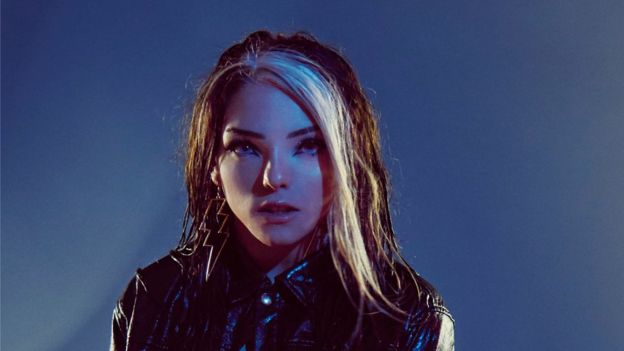 STEF SANJATI
As well as being called unkind names because of her face, Stef was also bullied for not being very masculine.
"I had this moment when I was a kid when this bully was picking on me
for being a little bit feminine. He was insinuating that I was a scary
homosexual."
Being a feminine boy with a non-standard face led her to struggle with
identity and appearance throughout her school years - she knew she was
different but couldn't work out exactly why.
Growing up in a small town in Southern Ontario, Canada, she says there
were no resources to help her explore her "true self". At that point the
web, where she now thrives, wasn't the seemingly endless and diverse
source of information it now is.
Knowing little about gender identity, she figured she must be gay and so
"came out" in ninth grade at the age of 13 - and lost all her male
friends as a result.
"The first day of the second semester of ninth grade, I went to sit next
to my best friend in my science class and he told me - he looked me
dead in the eye with a stone face - he said 'If you sit next to me I
will kill you'."
Stef describes herself as a "ball of self-loathing" at this time, and "hated" everything about herself.
"I couldn't look in the mirror without hyperventilating. I kind of just withdrew from the community and from my peers."
She felt abandoned, isolated and confused and so turned to her computer as a "digital escape".
"I pretty much took my life and moved it from the small town I grew up in and onto the internet."
While online, she played a lot of games that were very different to real
life. She says: "I plunged myself into fantasy worlds, where there were
people with faces like mine and people that were a little gender
divergent - and it was cool."
Stef got into social media because it was a place where she could
express herself away from the bullies. But, despite trying hard, reality
kept seeping in.
 STEF SANJATI
Still identifying as a young man, though not feeling it, she felt
isolated and, when she reached college, she adopted what she calls a
"hyper masculine image" by growing a beard and wearing blazers. But it
didn't make her feel better.
"That is when I ended up falling back into the femininity. That's when I
realised this has to mean something and I had to do some research," she
says.
Part of Stef's self-exploration was facing the discomfort, or dysphoria, she had with her body.
But it was only when her mind wandered onto matters of parenthood that she started to realise the problem.
Stef found herself asking "Why am I so uncomfortable with the word
father or dad though I want to be a parent so badly?" She says that it
was in realising she wanted to be a mother, not a father, that made her
appreciate that all her discomfort was about gender.
"Then I realised I was transgender. Then I understood what I needed for myself to be truly happy."
It was at this point she started to document her transition to becoming female on her YouTube channel.
After making videos about it for a while, Stef began to get a different
type of question - not about gender, but "what happened to your face?"
She responded with a video called My face: Waardenburg syndrome.
It went viral and presently has over eight million views. Stef believes
the syndrome hadn't been represented in media before she created the
video, and it also got her noticed.
"I'm very grateful for that video," she says. "It gave me my audience."
Stef continues to be a role model for people struggling with appearance and gender.
One fan comments: "I've been watching since you came out, and it's so
buck-wild to see you through your transition and become happier and
excited about your progress. I can't wait until I go on HRT so I can
start feeling more like myself too."
Stef uploads every week on her YouTube channel where she tells her
Breadsquad to "embrace" who they are, and gives updates on her next
surgery.
Viewers hear a lot about her self-exploration. In hindsight, she says,
the difficulties she had with her appearance were never about those
syndrome traits she was born with - she still has eyes which are
slightly further apart than other people and she has a white stripe of
hair at the front of her head.
She says it was about her gender and the way puberty affected her face -
and that was what her facial-feminisation surgery addressed, not her
impairment, as she has come to love the other-worldly look she has.
"I was very specific with my surgeon to not alter any of my Waardenburg syndrome features."
Listen to Lucy Edwards interview with Stef on the BBC's Ouch podcast.
