Peace for the World World ! Your War Our Lives

The Dalai Lama
A Brief Colonial History Of Ceylon(SriLanka)
Sri Lanka: One Island Two Nations
A Brief Colonial History Of Ceylon(SriLanka)
Sri Lanka: One Island Two Nations
(Full Story)
Back to 500BC.

Wednesday, January 24, 2018
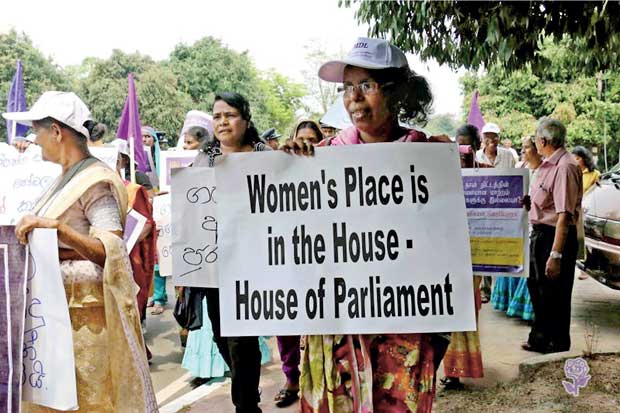
Statement issued by Women Action Network (WAN) on attacks on women candidates Women at war Violence against women is a key factor in preventing their political participation
 2018-01-24
A woman candidate who was involved in election campaign activities in
the Wellawaya area of Moneragala District has been admitted to the
hospital in a serious condition after she was brutally attacked.
In Selvanagar, Arayampathy in the Eastern Province, a woman candidate’s house was attacked.
A woman candidate in the Puthukudiyiruppu area of Mullaithivu District has been physically assaulted, kept locked in a house, and threatened to withdraw the complaint she made to the Police.
A woman candidate in the Puthukudiyiruppu area of Mullaithivu District has been physically assaulted, kept locked in a house, and threatened to withdraw the complaint she made to the Police.
Women candidates in Puttalam and other districts have been verbally
humiliated by religious leaders and their families and have been
subjected to revolting comments.
A woman candidate in the Puthukudiyiruppu area of Mullaithivu District has been physically assaulted, kept locked in a house, and threatened to withdraw the complaint...
Vulgar comments on women candidates and disgusting opinions on their
race and religion are increasingly being shared in social networks and
circulated leaflets.
The above mentioned are some of the most recent news reports of violent
acts against woman candidates who are contesting in the upcoming Local
Government elections. Apart from these, many incidents of physical and
psychological assault on woman candidates that have not been reported to
the police or the Elections Commission are being reported through
women’s organisations and activists.
Women are subjected to more criminal incidents than men during
elections, most of which are referred to as violence against women in
elections. Such violent incidents can be defined as follows:
The threat of harm or harm against women during the election period that are intended to cause confusion or impact on the independent and equal roles of women in the electoral process.
These include harassment, intimidation, physical harm, coercion, threats and financial pressures. Moreover, they can be made in private places or public places.
The threat of harm or harm against women during the election period that are intended to cause confusion or impact on the independent and equal roles of women in the electoral process.
These include harassment, intimidation, physical harm, coercion, threats and financial pressures. Moreover, they can be made in private places or public places.
Women candidates in Puttalam and other districts have been verbally humiliated by religious leaders and their families and have been subjected to revolting comments.
Election violence becomes a violent act against women when the time of
the incident is related to the electoral circulation (e.g. Planning for
elections, preparing for election, election campaign) and when it is
aimed at a woman candidate, voter, Elections Commission member, etc
because she is a woman.
Thus, all the above incidents fall into both gender-based violence and political violence categories. Such instances are doubly damaging because they harm the individual and undermine a peaceful democracy in Sri Lanka. Women continue to be subjected to subtle, silent, and hidden forms of violence, and as such these violent acts violate their rights and negatively affect the credibility of the election.
Thus, all the above incidents fall into both gender-based violence and political violence categories. Such instances are doubly damaging because they harm the individual and undermine a peaceful democracy in Sri Lanka. Women continue to be subjected to subtle, silent, and hidden forms of violence, and as such these violent acts violate their rights and negatively affect the credibility of the election.
In 2016, a 25 percent mandatory quota for women in Sri Lankan local Government was passed into law.
This creates the possibility of a minimum number of 1,991 women from 341
local councils becoming locally elected members. The mixed electoral
system introduced through the Local Authorities Elections Act mandates
that 10% of ward nominations and 50% of the proportional list in the
nomination paper submitted by a political party or an independent group
should be allocated to women.
In post-war Sri Lanka, especially in the North and East, ..women are engaging in this election with great enthusiasm ..as usual, the patriarchal political community and religious groups are trying to nullify their political contribution by subjecting them to violence.
Otherwise the nomination will be rejected. The number of members elected
to 341 local councils, including 24 municipal councils, 41 urban
councils and 276 Pradeshiya Sabhas, are 8356 members. Although 52 per
cent of the total population in Sri Lanka are women, so far, their
representation is 5.3 per cent in parliament, 4 per cent in provincial
councils, and 1.9 per cent in local councils.
Violence against women is a key factor in preventing their political
participation. Ethnic, religious, and cultural barriers, along with
structural violence, persecution, sexual bribery, physical assault,
threats to family members, financial pressures, warnings and threats
from religious heads, vandalized media reports, humiliation in social
networks, and open public challenges from people with patriarchal
attitudes are what prevent women from participating in politics.
In post-war Sri Lanka, especially in the North and East minority
community, women are engaging in this election with great enthusiasm.
However, as usual, the patriarchal political community and religious
groups are trying to nullify their political contribution by subjecting
them to violence.
While taking other countries, especially post-war societies into
account, we observe that the political role of women is problematic and
unacceptable. In our country where similar conditions prevail, we should
be ready to face any obstacle in our way with the help of the law and
the society and should never allow gender, race, religion, caste, and
party-based discriminations to limit our progress and political
participation.
Important to focus on the representation of women to take the lead in such a society. (…) We need not only to bring patriarchal but also matriarchal values...
Video clips of Moulavis Niyas Siddiqi Siraj and Murshid Abbasi verbally
attacking Muslim woman candidates and their family members in a
disgusting manner for their recent campaign speeches in Puttalam have
gone viral in social media. The Moulavis preached their own opinions,
for example, ‘Men can never be administered by women.’, and ‘Women are
only for performing household duties and to look after their husbands
and children,’ They cast these as teachings from Quran in their
degrading speeches and used words that violate human dignity such as,
‘Husbands and family members of these woman candidates should be ashamed
of them.’
It is a painful and problematic fact that so far, none of the political
parties these woman candidates belong to, the police who are responsible
to uphold the law, the Elections Commission, or any political party
leaders have condemned the open, public, and disgusting hate speech
towards woman candidates or verbal and psychological violence by men
with religious and political backgrounds towards them. Their silence
makes one question whether women’s participation in politics is truly
welcomed, or merely a formal act.
In November 2017, President Maithripala Sirisena launched a national
campaign to strengthen women’s participation titled ‘Women for Change’.
Speaking at the launch, the President said: “In order to establish a
better country, better society, and to establish a society with love,
compassion and moral values, it is important to focus on the
representation of women to take the lead in such a society. (…) We need
not only to bring patriarchal but also matriarchal values, ideas and
concepts, suggestions to create an ideal society.”
Nevertheless, women candidates have been subjected to different kinds of
violence and the religious leaders and politicians acting in a way that
affects their family’s honor has created a situation where women cannot
play their part in politics with freedom and self-respect.
“Complete electoral safety goes beyond physical and armed violence. It
means creating an environment in which all individuals could use their
political rights freely and justly. The Women Action Network reiterates
that the 25 percent mandatory quota for women in local Government should
not only be nominal. It must be an obligation for the present
Government, the President, and the electoral structures.
**WAN is a network of eight women organisations operating in the North and East.
