Peace for the World World ! Your War Our Lives

The Dalai Lama
A Brief Colonial History Of Ceylon(SriLanka)
Sri Lanka: One Island Two Nations
A Brief Colonial History Of Ceylon(SriLanka)
Sri Lanka: One Island Two Nations
(Full Story)
Back to 500BC.

Wednesday, January 24, 2018
Yahapālana Government As A Hyper-Debt Regime
By Milton Rajaratne –January 23, 2018

 Government
debt, as an important topic, was highly exploited by the Yahapalana
coalition to come to power in 2015 and to remain in power during the
past three years. The coalition government describes ‘Rajapaksa Regime’
as debt driven and has caused an immense debt burden on the country and
its people. The Rajapaksa rule ended on 9th January
2015 and by that time (end of 2014) the total government debt stood at
Rs.mn. 7,390,899. The domestic and foreign debt components remained at
Rs.mn. 4,277,783 and Rs.mn. 3,113,116 respectively. As a result the debt
burden of the country, as a percentage to GDP, stood at 71.3%. The per
capita debt burden had reached Rs. 357,000 while the gap between per
capita income and per capita debt remained as Rs. 142,000. While
criticizing borrowings of the previous government, the present
government has borrowed surprising amounts. This encouraged the writer
to compare between the Rajapaksa and Sirisena debt regimes and to
inquire into the government debt scenario analyzing its economic
perspectives.
Government
debt, as an important topic, was highly exploited by the Yahapalana
coalition to come to power in 2015 and to remain in power during the
past three years. The coalition government describes ‘Rajapaksa Regime’
as debt driven and has caused an immense debt burden on the country and
its people. The Rajapaksa rule ended on 9th January
2015 and by that time (end of 2014) the total government debt stood at
Rs.mn. 7,390,899. The domestic and foreign debt components remained at
Rs.mn. 4,277,783 and Rs.mn. 3,113,116 respectively. As a result the debt
burden of the country, as a percentage to GDP, stood at 71.3%. The per
capita debt burden had reached Rs. 357,000 while the gap between per
capita income and per capita debt remained as Rs. 142,000. While
criticizing borrowings of the previous government, the present
government has borrowed surprising amounts. This encouraged the writer
to compare between the Rajapaksa and Sirisena debt regimes and to
inquire into the government debt scenario analyzing its economic
perspectives.
Table-1 indicates that the government debt burden
remained at 71.3% at the time of Rajapaksa’s defeat. New policy measures
that were introduced to overcome debt burden with effect from early
2015 have continued for good three years so far. In spite of debt
curtailing alleged by the new government, the debt burden has rapidly
increased from 71.3 to 79.3 within two years and it can be estimated,
based on government debt statistics reported by the Central Bank for
eight months until August 2017, that this figure would reach 90.0 by the
end of 2017. This indicates that the debt volume prevailed by the end
of 2014 would grow by an amount of Rs.mn. 4,000,000 making the total
debt as Rs.mn. 11,000,000 by the end of 2017. This is a growth of almost
50% since 2014 or all time total government debt.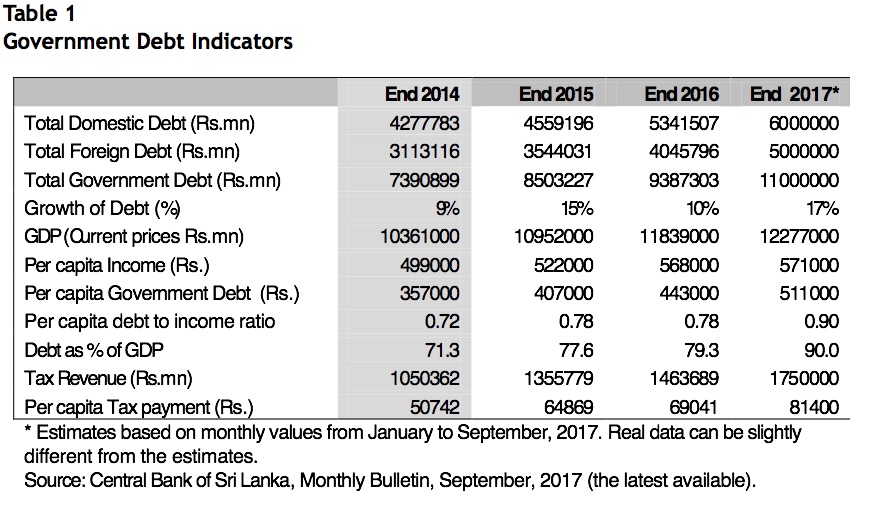
During the same three year period, per capita income
has increased by Rs. 72,000 while per capita government debt has
increased by Rs. 154,000. This reveals that as the economic growth has
been much slower than the growth in borrowing. In consequence, the
government debt has outgrown the per capita income at a rate of more
than 200%. Therefore the gap between per capita income and per capita
government debt has narrowed significantly from Rs. 142,000 to Rs.
60,000 as indicated in the Figure-2. This explains that there is a debt
component of 90% in per capita income at present compared to 72% in
2014. The slow growth of per capita income is connected to economic
slowdown from 6% to less than 4% between in 2014 and 2017 due to
incapacity of the present economic policies. Increase in debt while
decrease in economic growth eventually leads to a debt trap.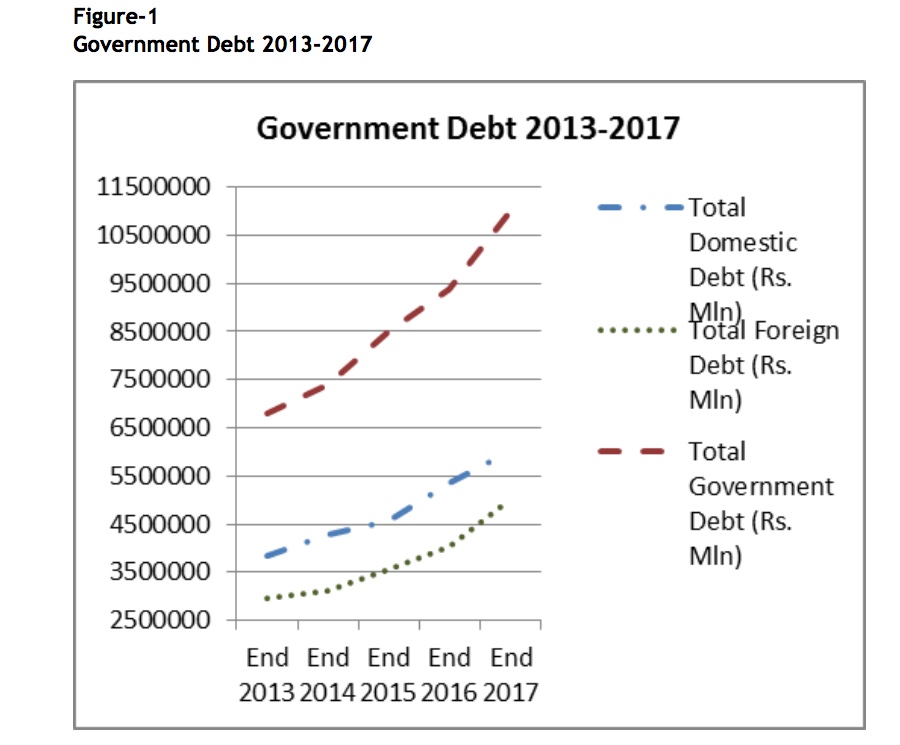
The foreign debt has grown faster than that of the
domestic debt between 2014 and 2017 which is much significant in 2017.
While domestic debt has increased from Rs.mn. 4,277,783 to
Rs.mn. 6,000,000 which is a growth of 40% foreign debt has grown from
Rs.mn. 3,113,116 to Rs.mn. 5,000,000 or 60% which is an alarming growth.
This is due to new debt as well as debt adjustments to depreciating
exchange rate of the Rupee. Sri Lankan rupee has depreciated from Rs.
130 per US$ to Rs. 155 per US$ by 18% during the past three year period
due to poor exchange rate management and unfavorable trade balance. The
increase in foreign debt component has not only intensified the debt
burden but has heavily increased external dependency also. The situation
has been aggravated by trade gap which in turn requires further foreign
borrowing to settle it.

Read More
