Peace for the World World ! Your War Our Lives

The Dalai Lama
A Brief Colonial History Of Ceylon(SriLanka)
Sri Lanka: One Island Two Nations
A Brief Colonial History Of Ceylon(SriLanka)
Sri Lanka: One Island Two Nations
(Full Story)
Back to 500BC.

Monday, March 12, 2018
Syrian army splinters rebel enclave in Ghouta onslaught
 MARCH 10, 2018
 BEIRUT (Reuters) - The Syrian army broke apart the rebel enclave in eastern Ghouta on Sunday, cutting off two major towns from the rest of the area, state media said, after a fierce battle waged under cover of an unrelenting bombardment.
State television on Sunday broadcast from the eastern Ghouta town of
Mudeira, which state television and a war monitor said the army had
captured to link up with units on the other side of the enclave.
A military media unit run by the Iran-backed Lebanese group Hezbollah,
an ally of the Syrian government, said the army had also entirely
surrounded the town of Douma.
Footage showed several massive plumes of smoke in the distance behind a
war-ravaged townscape with big holes in walls and roofs, and yet more
smoke wafting across the streets. The sound of blasts could be heard.
More than 1,100 civilians have been killed in the onslaught on the
biggest rebel stronghold near Damascus since it began three weeks ago
with a withering bombardment, said the Syrian Observatory for Human
Rights.
It said there was intense fighting on several fronts accompanied by a
government artillery barrage, continuous air raids and attacks by
helicopters.
The advance on Mudeira, after the capture of the neighbouring town of
Mesraba on Saturday, has driven a wedge deep inside the insurgent
territory, leaving the major towns of Douma and Harasta cut off.
Rebel groups in eastern Ghouta have vowed they will fight on. A
statement issued by Free Syrian Army factions there late on Saturday
said they had taken a decision not to accept a surrender and negotiated
withdrawal.
After the army advances split up the enclave, Jaish al-Islam emerged as
the strongest group in the town of Douma, Ahrar al-Sham in the town of
Harasta and Failaq al-Rahman in the new southern pocket of eastern
Ghouta.
Syrian state media also reported army advances near Jisreen and Aftaris in the southeastern part of the rebel-held territory.
Syrian President Bashar al-Assad and his ally Russia see the rebels as
terrorist groups, and say their offensive is needed to end the rebels’
rule over eastern Ghouta’s large population.
But the violence of their assault has prompted condemnation from Western
countries and repeated calls by United Nations aid agencies for a
humanitarian ceasefire.
Activists and fighters in eastern Ghouta in recent days have said the
bombardment has included incendiary material that causes fires and burn
injuries. Local doctors have also reported several incidents of bomb
attacks followed by the smell of chlorine and choking symptoms.

Smoke rises from eastern Ghouta in Damascus, Syria March 10, 2018. Sana/Handout via REUTERS
The government denies using either incendiary weapons or chlorine gas
bombs, and said on Saturday it had information that the rebels were
planning to stage a fake chemical attack to discredit the army.
GUNFIRE
In Muscat, U.S. Defense Secretary Jim Mattis said it would be “very
unwise” for Syrian government forces to use weaponized gas, citing
unconfirmed reports of chlorine attacks in eastern Ghouta.
Visiting Oman, Mattis stopped short of threatening to retaliate against
Syrian forces if a chlorine attack were confirmed. But he noted
America’s cruise missile strike on April 6, 2017, on a Syrian air base
over a sarin gas attack and said President Donald Trump had “full
political manoeuvre room” to take whatever decision he believed was
appropriate.
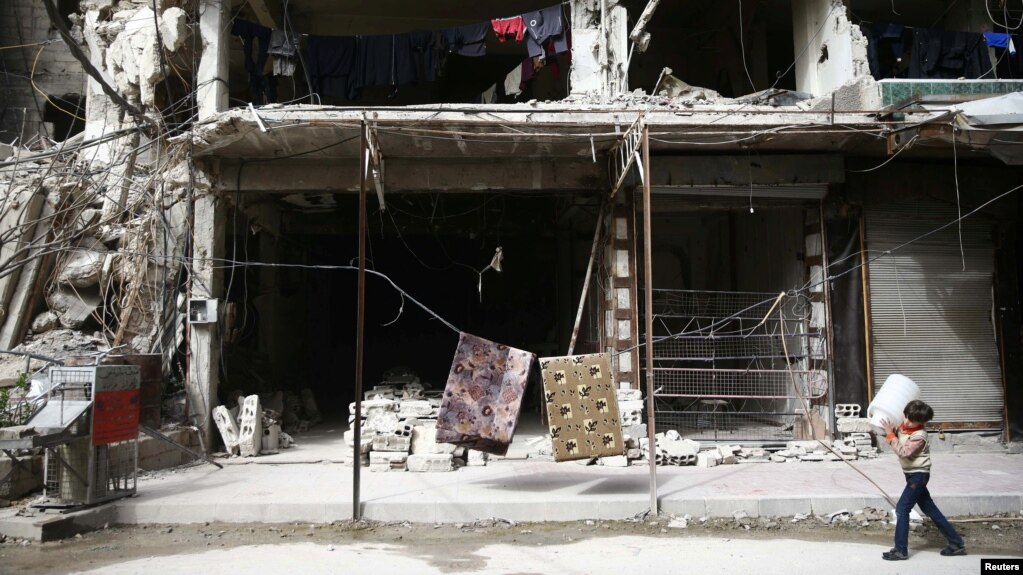
A boy is seen in the besieged town of Douma, Eastern Ghouta, in Damascus, Syria March 8, 2018. REUTERS/Bassam Khabieh
While the government and Russia say they have set up safe routes into
government-held territory, no civilians are known to have crossed
through them yet.
Damascus and Moscow accuse rebels of firing on anybody who tries to
leave, something the insurgents deny though a Reuters witness said there
was shelling and gunfire near one exit route on Friday.
Rebels and some eastern Ghouta residents contacted by Reuters have said
people there do not want to come back under Assad’s rule for fear of
persecution, an idea the government says is groundless.
On Saturday, the army found 60 civilians cowering in a basement in
Mesraba. Activists in eastern Ghouta said thousands of people from
Mesraba had already fled into Douma, further into the rebel territory,
before the army took it.
Syrian state television reported on Sunday that rebel mortar fire had
killed four people after hitting a taxi. Assad has sworn to end
insurgent shelling of the capital.
Defeat in eastern Ghouta would deliver the rebels their biggest blow
since December 2016, when a government offensive drove them from Aleppo,
their largest urban stronghold.
Backed by Russian war planes and other military assistance since 2015,
Assad has gained momentum on several fronts across the country, driving
rebels from numerous pockets and recapturing swathes of the east from
Islamic State.
But he is still far from regaining control over the entire country.
Rebel groups hold large areas of the northwest and southwest, while
northeastern Syria is in the hands of Kurdish fighters and allied
militias.
Meanwhile, the increasingly global nature of the war means that military
attempts to regain several of those areas could pit Assad and his
Russian and Iranian backers against forces that are also directly
supported by powerful foreign countries.
