Peace for the World World ! Your War Our Lives

The Dalai Lama
A Brief Colonial History Of Ceylon(SriLanka)
Sri Lanka: One Island Two Nations
A Brief Colonial History Of Ceylon(SriLanka)
Sri Lanka: One Island Two Nations
(Full Story)
Back to 500BC.

Sunday, April 22, 2018
Blood and gold: Now Sudan's land wars have spread to mining
Khartoum wants to make Sudan more enticing to investors - that is also causing widespread disputes.

Sudan
is Africa's third-largest producer of gold, but the extraction of
precious metals often comes at the expense of locals (AFP)


KHARTOUM - The protesters always wanted their rally to be peaceful, they said. But by the end of the day at the gold mine in Sudan's remote Wadi Alsingair region, one man was dead and five more injured.
The workers had gathered at the site, 400km north of Khartoum, to protest against a government deal in October that assigned mineral rights to Russian company Miro Gold.
The mine is in a small valley inhabited by a few thousand residents who
are without access to hospitals, schools or properly maintained roads.
What little arable land there was is now mostly used for mineral
extraction.
The Russian guards included a sniper, supported by the Sudanese police, who suddenly fired on us without prior warning- Ahmed Alsaim, proteste
Ahmed Alsaim, one of the protesters, told MEE that the land belongs to
them and that they demonstrated peacefully because they had not been
consulted before work began.
"The Russian guards included a sniper, supported by the Sudanese police,
who suddenly fired on us without prior warning," he said.
Al-Habob Farah, 28, one of the protest leaders, was killed. Alsaim says
he was singled out and blamed the River Nile State, in which the mine is
based, for not defusing the tension.
Hatim Alwasila, the state governor, denied that the Russian guards opened fire at the protest on 5 March.
"The police force at the site was responsible for protecting the company
and its staff," he said. "They tried by all means to avoid using their
power, but the locals started to attack the company, so the police
enforced their powers.”
Middle East Eye contacted Miro Gold but it had yet to respond at time of publication.
The race for land
The death of Farah and the involvement of a foreign company sparked
anger across Sudan, drawing criticism from opposition politicians and
activists.
Some compared it with US private security firm Blackwater, since 2011
known as Academi, whose employees killed 14 Iraqi civilians in Baghdad
in 2007.
One Twitter user called Mosab Martin posted images of a man alleged to
be the guard raising his rifle as well as of the dead and injured.


He wrote that "an immediate investigation should be opened, the Russian
company should be expelled from the area, or otherwise we will see the
blood everywhere in the River Nile state".
The death and protest also reignited debate about who owns the rights to
natural resources in Sudan, as Khartoum intensifies its efforts to
attract external investors.
Sudan is poor: its estimated GDP per capita in
2017 was only $1,428 - less than a quarter, for example, of Jordan's.
The inflation rate for the same period was 26.9 percent, placing it 222nd out of 227 territories and below Syria and Yemen.
Yet Sudan is rich in resources: the tragedy is how ownership of these has often fuelled conflict.

Internationally, Khartoum is in a decades-long dispute with Egypt over
the Halaib Triangle to the north of Sudan, which has been run in effect
by Cairo. The region is rich in minerals and oil: in January 2016, Sudan
put its forces on standby as tensions increased.
In 2017 the country produced 107 tonnes of gold, compared with 93 tonnes
in 2016, making it the third-biggest gold producer in Africa after
South Africa and Ghana. Those figures are likely an under-estimate and
do not account for gold produced illegally.
Disputes over land are traditional: historically they have occurred
during the dry season, as nomads, seeking fertile lands on which to
graze their cattle, come into conflict with farmers. Usually such
tensions are resolved through tribal negotiations.
But land ownership laws in Sudan are not clearly defined. In some parts
ownership is defined under laws issued by the British colonial
administration but for the most part it is defined by centuries-old
custom between tribes and community leaders.
Government intervention has exacerbated the situation during the past
two decades, most notably in Darfur. There, Khartoum backed Arab nomads
in a land conflict that spiralled into ethnic clashes and then a war that has left at least 300,000 people dead and at least 2.7 million displaced.
 Gold mine workers climb out from a mine in Al-Ibedia, River Nile State, Sudan in July 2013 (Reuters)
The conflict resulted in international sanctions against Sudan, which
were lifted only last October. In March 2017, former financial
minister Badr Eldin Mahmoud put the cost of 20 years of sanctions at $45bn.
The economy was also badly hit when South Sudan became independent in
2011, taking three-quarters of the country's oil revenue with it.
Currently it is undergoing severe austerityas part of an economic reform plan in line with International Monetary Fund (IMF) recommendations
The result: Khartoum has to rely even more on external investors exploiting natural resources to maximise its income.
Disputes have erupted between the government and landowners over dam construction in
northern Sudan, including at the Marawi dam in March 2009. The dam is
being built through loans from China, Saudi, Oman, Abu Dhabi and Kuwait
among others. Construction of the Dal and Alshiraik dams, for which Saudi Arabia is supplying grants, has been delayed due to protests.
Four people were killed in 2007 when landowners protested against the construction of the Kajbar dam near the border with Egypt.
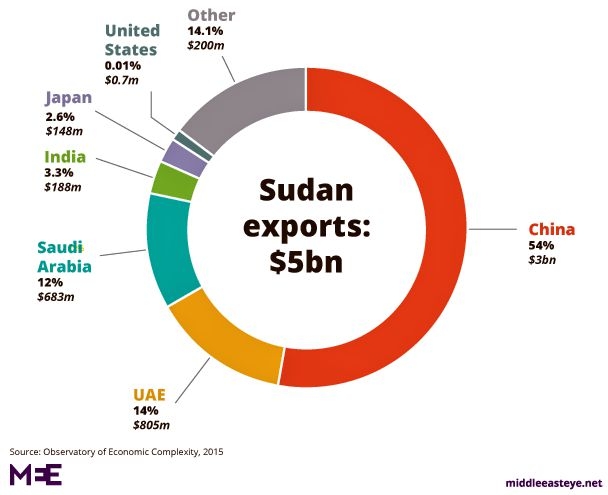
Khartoum has tried to make international alliances where it can, most
notably with China, which takes more than half its exports. In December 2017, Turkish President Recep Tayyip Erdogan said the two countries aimed to eventually boost two-way trade to $10bn.
But it is gold which offers the biggest opportunities. There are 170
gold mining companies working in Sudan, although this does not take
account of unofficial mine operations.
Khartoum plans to raise production in 2018 to make the country the ninth-biggest producer in the world and the second-biggest in Africa.
Power and corruption
But promises of future trade are of little comfort to the gold workers
of Wadi Alsingair. Abdullah Mohamed, a community leader, told MEE that
the tension began when the government signed the deal with Miro Gold.
"We met the governor of the state and raised our concerns," he said. "We
have been mining in our area for 10 years. The contract with these
investors will inflict big losses on us.
"The governor promised to consult us before the company began working,
about compensating us. But surprisingly, the authorities have allowed
the company to begin working, bringing their equipment and even
expelling the local miners from the area."
The government, Mohamed said, was more concerned about foreign investors than about its own citizens.
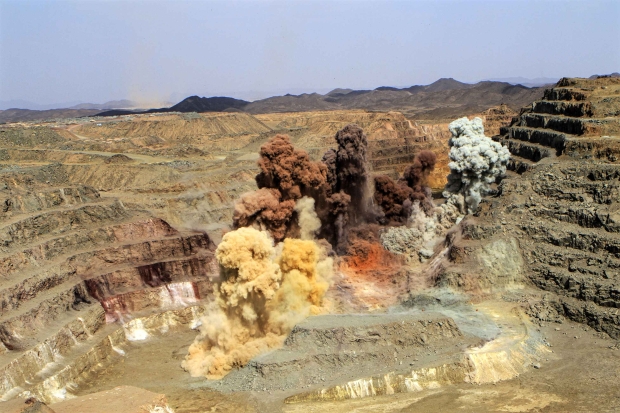 Smoke rises after a blast in a quarry at the Ariab mine in in Sudan's Red Sea state in September 2011 (Reuters)
Oshiek Mohamed Tahir, the minister of state at the Ministry of Minerals,
told MEE that the government was keen to guarantee the interests of the
citizens "but within the laws".
But last year the US-based Enough Project said in its report "Sudan's Deep State" that
the country's federal and local elites and armed groups commit "acts of
violence that result in the dispossession of local populations".
"Revenues from oil, gold and land allocation in Sudan are often affected
by conflict. An inner circle within Khartoum has privately expropriated
oil, gold, and land for self-enrichment and to maintain control through
corruption and violence."
The Sudan Democracy First Group (SDFG) has previously warned that incidents of clashes over land, between the government and the local owners, have sharply increased during the past few years, leading to the deaths of dozens of locals.
Alshafia Khidir, the author of The Tribe and Politics in Sudan,
said that Sudanese elites are using the power of the state and allying
themselves with local and international investors to loot the lands of
the locals.
The government is using the laws to confiscate the lands of the small farmers, traditional owners and nomads in favour of the investors- Alshafia Khidir, writer
"The government is using the laws to confiscate the lands of the small
farmers, traditional owners and nomads in favour of the investors."
He said that this had led to the collapse of the agricultural sectors, such as the El Gezira scheme,
once one of the world's biggest irrigation projects and responsible for
much of biggest areas for cultivating cotton in Africa.
It failed when the government focussed too much on oil and sidelined
agriculture, privatising irrigation services and the provision of seeds.
A strategy to grow more wheat, which fails to thrive in hot climates,
also flopped.
"With the economic deterioration and the appearance of oil and gold, the
traditional conflict over resources and wealth in Sudan has reached an
advanced and serious point."
The risk of gold
Mohamed Salah, a researcher in the socio-economic and environmental
impact of gold mining in Sudan, told MEE that the desire to increase
gold mining carries two inherent risks.
The first was that the government, by making deals with outside investors, was pitting itself against locals.
The use of mercury and cyanide in the purification process makes miners more vulnerable to respiratory diseases and cancer- Mohamed Salah, researcher
"Accordingly, the government has no choice but to defend the interests
of the investors," he said, "using the power of the state to confiscate
the land through many tricks including changing the law."
The second, Salah said, was environmental and the processing of gold,
one of the main sources of mercury contamination in Africa.
Fine particles from the processing of gold pollute water and air,
becoming a serious health hazard if inhaled by humans and animals. The
most common use for mercury is in small-scale mining operations, according to Human Rights Watch.
Salah said: "The use of mercury and cyanide in the purification process
makes miners more vulnerable to respiratory diseases and cancer."
In November 2017, one person was killed amid protests in Kologi, South
Kordofan, against gold mining companies using toxic chemicals, according to local media.
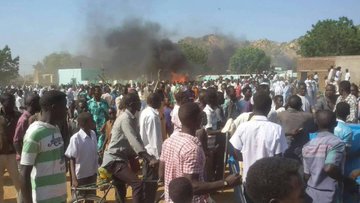
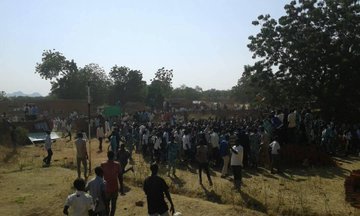
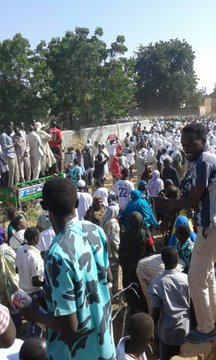
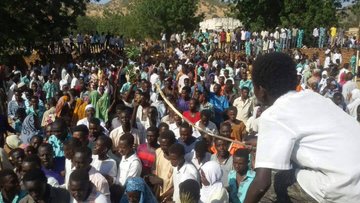
مقتل طالب وجرح اخرين في اطلاق نار على مظاهرة ضد شركات الذهب ب #كالوقي بولاية #جنوب_كردفان #SudanNews #Sudan #السودان

Translation: A student was killed
and others wounded when shots were fired at a demonstration against gold
companies in Kologi, South Kordofan
The protests are likely to continue. Abdul Majeed leads a coalition
representing land-confiscation victims in the Khartoum suburbs of
Aljiraif, Alshajara, Alhamadab and Alhalfaya, using protests, meetings
and sit-ins to get their message across.
In recent years the group has attracted support from those impacted by
dam-building projects in the north of the country. Now it's gold-mine
workers.
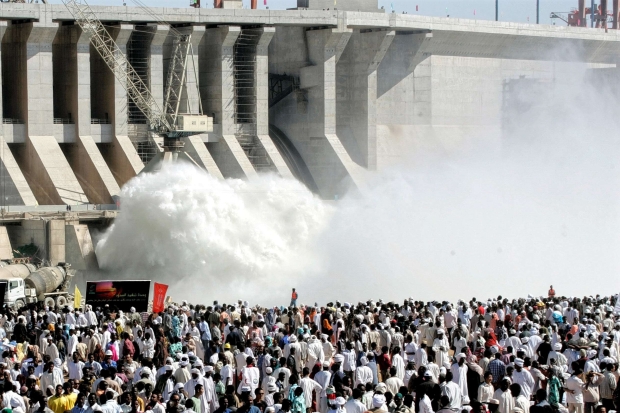 The opening of the hydro-electric dam on the Nile River at Merowe, north of Khartoum, on 3 March 2009 (AFP)
Majeed sees the incident on 5 March as evidence of a remarkable
deterioration. "Look at the general causes of conflict in the country.
We find that land disputes are the main subject of the trouble, from
Darfur to the Nuba Mountains to the Blue Nile, with conflicts over oil,
gold-rich areas, dam locations and other issues."
He called on landowners, regardless of their backgrounds or jobs or
interests, to rally together against the alliance of foreign investors
and government.
"We call on the all victims from land confiscation across the country to
unite and organise themselves in one body to defend their history and
identity."
