Peace for the World World ! Your War Our Lives

The Dalai Lama
A Brief Colonial History Of Ceylon(SriLanka)
Sri Lanka: One Island Two Nations
A Brief Colonial History Of Ceylon(SriLanka)
Sri Lanka: One Island Two Nations
(Full Story)
Back to 500BC.

Wednesday, April 25, 2018
De-Gazetting Nature Reserves: What We Stand To Lose

Amayaa Wijesinghe
 Sri
Lanka can boast of a diverse coastline, which is ecologically and
economically valuable. Our shores provide livelihoods to many people,
and act as our first line of defense in case of natural disasters. The
fisheries they support also act as an important source of nutrition.
When a natural ecosystem provides invaluable services to people as well
as fauna and flora, it is afforded protected status. The efficient
management of these Protected Areas (PAs) ensures that these benefits
can be sustained for generations to come.
Sri
Lanka can boast of a diverse coastline, which is ecologically and
economically valuable. Our shores provide livelihoods to many people,
and act as our first line of defense in case of natural disasters. The
fisheries they support also act as an important source of nutrition.
When a natural ecosystem provides invaluable services to people as well
as fauna and flora, it is afforded protected status. The efficient
management of these Protected Areas (PAs) ensures that these benefits
can be sustained for generations to come.
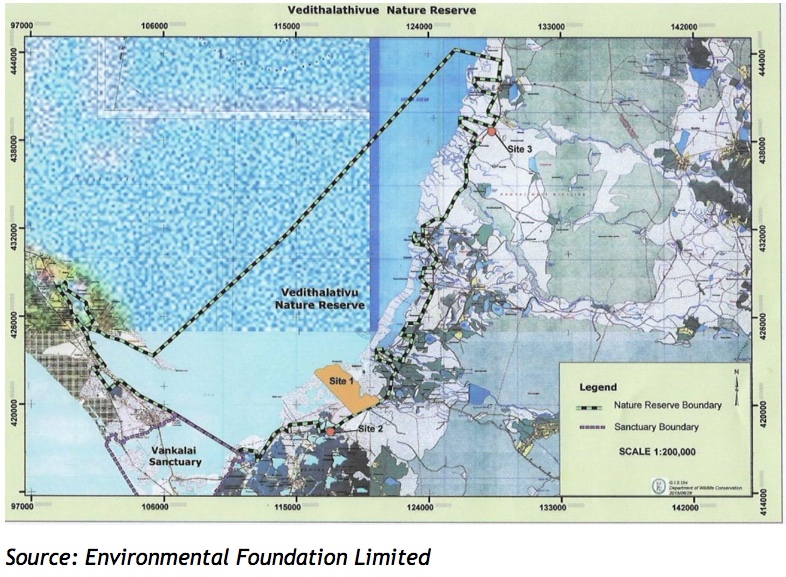
Gazetting of Wedithalathive Nature Reserve
Wedithalathive is a small town situated on the coast, accessed by the
Mannar-Jaffna A32 highway. On 25 February 2016, Wedithalathive’s
ecosystems were given legal protection by its declaration as a Nature
Reserve under the Fauna and Flora Protection Ordinance. This was carried
out just 2 years ago by the Department of Wildlife Conservation, and
gave protection to mangroves, seagrass beds and coral reefs situated in
the area. These natural ecosystems have been recognized worldwide for
their importance in maintaining ocean productivity.
Proposed Aquaculture Park
According to the Environmental Foundation Limited (EFL) as well as
published sources, a cabinet paper has been prepared to excise and
de-gazette approximately 1000 hectares of land from this newly declared
reserve, in order to establish a commercial Aquaculture park. The paper
was co-proposed by both the Minister of Fisheries and the Minister of
Sustainable Development and Wildlife, with the recommendation from the
Cabinet Committee on Economic Management. The proposed Aquapark is
slated to yield a commercial harvest of fish and shellfish, especially
prawns, for export.
This raises many red flags, as pond-based prawn farming has not been a
success story in Sri Lanka and elsewhere in Asia. In fact, a closer look
at the area just South of Wedithalathive, in Puttalam and Mundal, show
large tracts of prawn farms abandoned in the last 30 years due to
disease outbreaks and unsustainable practices.
In an Aquapark, the landscape is created for artificial breeding of
economically important fishery species. Land units are leased to
aquaculture farmers, and these units include purpose built ponds and
facilities for seawater take and discharge. The park should also have
wet-laboratories and hatcheries, intensive culture facilities, and
dry-laboratories, for quality assurance and updated research purposes.
Overall, stringent scientific standards must be met if an Aquapark is to
be successful.
However, in practice, the execution of such projects is difficult due to
the complex variables that need to be considered, and de-gazetting
Protected Areas for such commercial ventures is a dangerous precedent to
set, as the impacts may outweigh the benefits.
Read More
