Peace for the World World ! Your War Our Lives

The Dalai Lama
A Brief Colonial History Of Ceylon(SriLanka)
Sri Lanka: One Island Two Nations
A Brief Colonial History Of Ceylon(SriLanka)
Sri Lanka: One Island Two Nations
(Full Story)
Back to 500BC.

Friday, April 13, 2018
Lessons from a neighbour
India has much to learn from the way Sri Lankan Parliament conducted the no-confidence motion against the government.
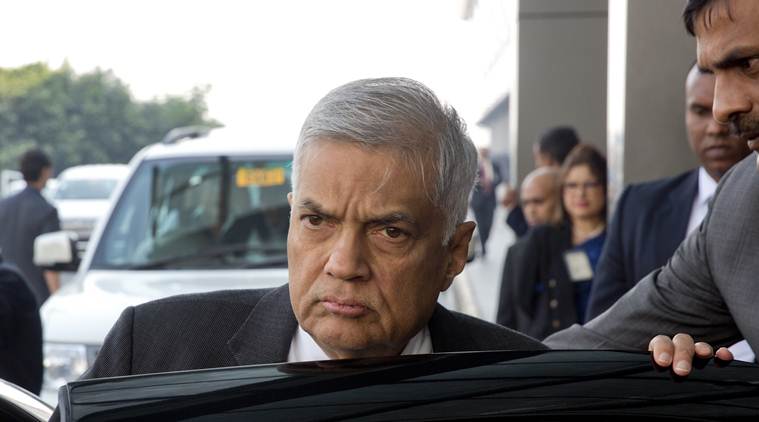
Sri Lankan Prime Minister Ranil Wickremesinghe. (AP Photo/Manish Swarup, File)
 Last
Wednesday, parliamentarians debated a no-confidence motion moved by
Opposition MPs. The debate began at 9.30 am and by the time the vote was
counted, it was 9.30 pm. All the government’s shortcomings were
discussed threadbare. Ruling party legislators gave as good as they got.
After heated speeches both ways, and a division by name, the prime
minister comfortably won the day. In Sri Lanka.
Last
Wednesday, parliamentarians debated a no-confidence motion moved by
Opposition MPs. The debate began at 9.30 am and by the time the vote was
counted, it was 9.30 pm. All the government’s shortcomings were
discussed threadbare. Ruling party legislators gave as good as they got.
After heated speeches both ways, and a division by name, the prime
minister comfortably won the day. In Sri Lanka.
Sri Lanka is not the world’s biggest democracy, and has plenty of
well-documented failings, but on April 4, it was an inspiring example of
democratic parliamentary practice in South Asia. In India, meanwhile,
the Budget Session would wind to a dismal end two days later, on April
6, going down in history as the least productive session of Parliament
in the world’s largest democracy. Four parties had submitted
no-confidence motions against the NDA government, but the Speaker never
took them up on grounds of a daily ruckus in the House.
With its majority in Parliament, the BJP would have had no problem
defeating the no-confidence motions. Sri Lankan Prime Minister Ranil
Wickremesinghe, on the other hand, had a numbers problem until a few
hours before the debate, as even the loyalty of MPs from his own United
National Party was in question. The no-confidence motion had been
brought against the government by arch foe and former president, Mahinda
Rajapaksa. Wickremesinghe’s government is in a cohabitiation “national
unity” arrangement with the President Maithripala Sirisena-led United
People’s Freedom Alliance (UPFA). The main constituent of the UPFA is
the Sri Lanka Freedom Party (SLFP), to which Sirisena and Rajapaksa both
belong. The party is divided between these two leaders in two rival
factions. As many as 13 SLFP cabinet ministers in Wickremesinghe’s
government voted for the no-confidence motion against the prime
minister. Even Sirisena, competing with Rajapaksa for SLFP loyalty, is
said to have secretly given his blessings to the no-confidence motion
and encouraged party members to vote for it.
But Wickremesinghe had the last laugh. Despite a crushing defeat at the
local government elections in February, which triggered demands from
both Sirisena and some members of his own party that he should step
down, and led to Rajapaksa’s no-confidence motion gambit, Prime Minister
Wickremesinghe has come out much stronger from facing the test in
parliament than he was two months ago, or even a day before the vote.
His problems are not over — elections are due later this year in the
provinces, which will be a big test for where his party really stands.
And the cohabitation arrangement with Sirisena and the UPFA is under
more strain now with seniors in that coalition voting against their own
government.
The no-confidence motion focussed on what is known as the “bond scam”
involving the Central Bank of Sri Lanka, and sought to implicate
Wickremesinghe in it. It also blamed the government for “failing… to
provide protection to Sinhalese, Tamil and Muslim people” during the
recent communal flare up in Kandy. Rajapaksa, who won a seat to the
parliament in the 2015 election, arrived in the House only to vote,
staying away from the debate that saw plenty of references to his flawed
record while in power. There was some shouting and booing too during
the speeches but the proceedings continued with no hitch.
In Delhi, not having the numbers to carry a no-confidence motion, the
Opposition’s intention was perhaps to put the government on the mat with
such a debate in the Lok Sabha, examining the government’s record. The
Speaker’s decision not to take up the no-confidence motions submitted by
the Telugu Desam Party, YSR Congress, Congress and the communists, on
the ground that there was disorder in the House, has sparked
controversy, and a debate on whether the Speaker has the power to admit
or disallow the motion.
Back inside the Geoffrey-Bawa designed Sri Lankan parliament building,
it was the country’s 47th no-confidence motion in seven decades, but
only the third time against a prime minister — the last two times were
in 1957, against S W R D Bandaranaike, and in 1975, against Sirimavo
Bandaranaike. In the 225-seat parliament, Wickremesinghe won comfortably
with 122 votes — he received all votes of the UNP and its allies that
make up the United National Front coalition, and the 16 votes of the
Tamil National Alliance. In favour of the motion, there were 76 votes.
In short, it was a classic demonstration of parliament in action. It
moved the Maldivian Democratic Party (MDP), whose leadership has been
under siege by an authoritarian leader, to issue a statement holding up
Wickremesinghe as “a great example of how democratic leaders respond to
challenges from their political opposition”. The MDP said President
Yameen Abdulla, who ordered the military into the Maldivian parliament
to deal with a no confidence motion against him, “has much to learn from
true leaders like Prime Minister Wickremesinghe”.
As Delhi attempts to regain its influence in the region, what India does
at home is as important as its foreign policy. Minus China’s deep
pockets, India has something that its Asian rival does not — a
democratic polity and the moral high ground that goes with it. How India
works its democracy to meet an array of challenges, to further the
interests of all its citizens, is of immense interest to its neighbours,
all at different stages of democratic evolution. India imagines itself
as a political role model for these countries. But from last week’s
parallel demonstrations in the parliaments of India and Sri Lanka, it
seemed as if it was big brother that needed lessons from a smaller
neighbour.
nirupama.subramanian@expressindia.com
